China’s Taiwan Tryst and The 2027 Question
| AUTHOR | Anushka Saxena |
| DATE | September 3, 2026 |
| DOCUMENT | Takshashila Issue Brief 2026-20 |
| VERSION | Version 1.0, September 2026 |
| CATEGORIES | China Defence Taiwan Geostrategy |
Executive Summary
In the run-up to the PLA’s centenary in August 2027 and the 21st Party Congress in October 2027, the 2027 timeline has been widely misread. This Brief finds that:
For Beijing, 2027 is a capability milestone rather than a campaign date. The American alarmist reading, delivered alongside budget advocacy, has since been walked back by the US’s intelligence community itself.
Across three PLA offensive campaign options, Beijing’s roadmap can best be understood as a coercion ladder designed to win without landing on the island. Its binding constraints, in this regard, are troop sustainment and port access, and not the initial landing.
Chinese pressure on the LAC during a Taiwan contingency is plausible, but inducement – including the proposition for Early Harvest boundary settlement – may buy Indian acquiescence.
1. Introduction
On January 24, 2026, China’s Ministry of National Defence announced that General Zhang Youxia, the first-ranked Vice-Chairman of the Central Military Commission (CMC), and General Liu Zhenli, Chief of the CMC Joint Staff Department, were both under investigation for “serious violations of discipline and law”. Between them, the two high-ranking military officials not only led the People’s Liberation Army (PLA)’s armaments and operational portfolios, but they were also the last serving officers with combat experience from the Sino-Vietnamese border wars between 1979 and 1991. Their removal1 hollowed out the CMC, the top-most defence decision-making body in China, and left it with two members – from seven in 2022. These are Chinese President Xi Jinping himself and Zhang Shengmin, an erstwhile head of the CMC Discipline Inspection Commission, and now the CMC’s Vice-Chairman.
The announcement came 18 months before August 1, 2027, the 100th anniversary of the Nanchang Uprising and the date by which the Party has committed the PLA to meeting its “centenary goal of army building”. Often, that goal is conflated with China’s ambitions on moving towards Taiwan.
In the run-up to the PLA’s centenary in August 2027, and the 21st Party Congress, likely to be held in Beijing in October 2027, it is vital to assess what the year means for the Chinese defence decision-making apparatus, as well as for Washington and Taipei. This Issue Brief delves into the origins and explanations of 2027 as a campaign and capability timeline by assessing how the three capitals have viewed it in official discourse. It further ideates, using Chinese articulations and OSINT, on operational scenarios that China may be preparing for vis-à-vis Taiwan, its broader coercion toolkit, and the platforms the PLA touts for an amphibious campaign. Finally, the Brief assesses some implications for India and offers a broad comment on what may not motivate Xi Jinping to consider an invasion in 2027. The goal of the Brief is to keep deliberations on the PLA’s Taiwan plans alive in a year that is decisive for the achievement of the PLA’s “centenary goals,” and at a time when China’s military reform and pressure campaign against the island have created a tense security situation in the region and the world.
2. From Three Capitals: The Meaning of The 2027 Timeline
In the run-up to the 21st Congress of the Communist Party of China (CPC) and the 100th anniversary of the founding of the PLA, it is first vital to draw the right inferences from the signalling around the “2027 timeline” of Chinese military modernisation. The introduction of 2027 as a modernisation milestone occurred2 in the communiqué of the Fifth Plenum of the 19th CPC Central Committee, which committed the Party to “ensure the achievement of the centenary goal of army building in 2027” (确保二〇二七年实现建军百年奋斗目标). A month later, on November 26, 2020, Ministry of National Defence spokesperson Ren Guoqiang was asked3 at a press conference what the formulation meant. His answer ran into four themes: accelerating the integrated development of mechanisation, informatisation, and intelligentisation; modernising military theory, organisation, personnel, and equipment; sharpening combat readiness training; and raising the strategic capability to defend sovereignty, security, and development interests. As is evident from Ren’s response, while the agenda items to be achieved by the milestone year pertain to enhanced militarisation and modernisation of the PLA, they, in and of themselves, do not suggest an invasion sequence.
The 2027 goal is the first step of a “three-step” strategy reformulated in 2020. The next two steps revolve around “basically completing national defence and military modernisation by 2035,” and building a “world-class military” by mid-century. The latter is timed to the centenary of the People’s Republic – and had already been introduced at the 19th Party Congress in 2017. The meaning hence attached to the strategy is remarkably consistent4 across Chinese commentary ever since, and is supplemented by mechanisation-informatisation-intelligentisation integration, joint operations capability, and self-reliance in defence science and technology. A 2023 Qiushi explainer described the centenary goal as “the most crucial of the three steps”5 to modernise national defence in the New Era – crucial, that is, to modernisation, not to a campaign.
The US Department of War’s China Military Power Report, released on December 23, 2025, too, makes exactly that case, framing 2027 as a capabilities-based requirement aimed at coercing Taiwan and deterring or defeating American and allied intervention. Hence, till such a time as the PLA can claim sufficient prowess to achieve what the CMPR refers to as a “strategic decisive victory” over the island, capability development remains the main focus.
But Washington’s thinking on the 2027 timeline has reached this stage only after a rather alarmist evolution. This began on March 9, 2021, with Admiral Philip Davidson, then commander of US Indo-Pacific Command, telling the Senate Armed Services Committee that the Chinese threat to Taiwan was manifest during that decade, and in fact within the next six years. Interestingly, the testimony was delivered alongside advocacy for a substantial budgetary increase in the Pacific Deterrence Initiative. General Mark Milley later informed6 Congress that Davidson’s assessment apparently rested on a speech made by Xi, calling on the military to develop capabilities to seize Taiwan and to bring the requirement forward from 2035 to 2027. The text of that speech has never been released.
Subsequently, CIA Director William Burns clarified7 at a lecture at Georgetown in February 2023 that Xi had instructed the PLA to be ready by 2027 to conduct a successful invasion – but “that does not mean that he’s decided to conduct an invasion in 2027, or any other year.” By 2026, the Office of the Director of National Intelligence’s Annual Threat Assessment stated8 that Chinese leaders do not currently plan to execute an invasion of Taiwan in 2027, and hold no fixed timeline for achieving unification.
Major official assessments from Taipei express a similar sentiment. In October 2020, Shen Ming-shih (沈明室), former director of the Strategy Institute at National Defence University, authored a brief9 to be circulated within the post-Plenum meeting of the Mainland Affairs Council. The brief characterised the new milestone as a replacement for the 2020 target for completing mechanisation. With its expiry, the Party required a fresh milestone, and articulated one around accelerating informatisation and intelligentisation.
Other opinions voiced in Taipei have expressed disagreement too. For example, then-defence minister Chiu Kuo-cheng said in 2021 that Beijing would be capable of mounting a “full-scale” invasion by 2025. Of course, at the time, he was seeking10 the passage of a defence budget worth ~US $9 billion in the Legislative Yuan.
Shen’s brief also introduces two caveats that hinder the achievement of the PLA’s milestones by their designated timelines and are worth discussing. First, the PLA’s intelligentisation is hostage to access to semiconductors – a factor that has created significant volatility for Beijing in recent years. Shen hedges rather than asserts, as he articulates the possibility of China’s achievement of its intelligentisation timeline as “恐難達標” – “may well fall short of the target.” Second – and arguably a more debatable one – is that China cannot hope to win against an American naval intervention even with six carrier hulls by 2035, because of the US Navy’s recapitalisation to more advanced Ford-class carriers, and Taiwan’s own advancements in anti-ship missiles and submarine deployments. Yet, the debatability comes from factors such as the low usability of carriers themselves in an operation at least to the west of Taiwan, as well as the augmentation of the throughput of a carrier with various other platforms such as roll-on/roll-off ships (Ro-Ros), landing platform docks (LPDs), destroyers and of course, long-range deterrents operated by the PLA Rocket Force (PLARF).
In sum, the 2027 timeline may not be a myth, but the approach to understanding it must recalibrate from campaign preparation to capability enhancement and milestone achievement. The latter especially opens up a host of counter-tactics ranging from technological restrictions and bounds on China’s defence industrial base, to investing in cognitive strategies and recalculating force projection deployments by both Taiwan and the US in the first and second island chains.
3. Thinking Through Campaigns
PLA writing on a Taiwan campaign focuses on three interesting offensive campaign types, escalating in intensity and risk, and capable of being sequenced or run in parallel. First is the joint blockade campaign11 (联合封锁战役), which focuses on maritime and air interdiction, the isolation of ports and sea lanes, and economic strangulation. This campaign type could be set off12 with a coercive quarantine, in which a Chinese Coast Guard (CCG)-led “customs inspection” regime could be imposed rather than a declared blockade. It is already the norm around the outlying islands of Kinmen and Matsu, where the CCG has increasingly practised it since 2024. Scaled up, it would involve law-enforcement vessels boarding ships bound for ports such as Kaohsiung, selectively interdicting energy imports, and engaging in cyberattacks to degrade port and other critical information infrastructure operations.
Second is the joint firepower strike campaign13 (联合火力打击战役), which adds missile and air salvos against command-and-control, airbases, and radars, and is layered with cyber and electronic warfare paralysis. Third is the joint island landing/ amphibious assault campaign14 (联合登岛战役), which is a comprehensive undertaking comprising amphibious assault waves, airborne and heliborne insertion, and then lodgement, breakout, and control.
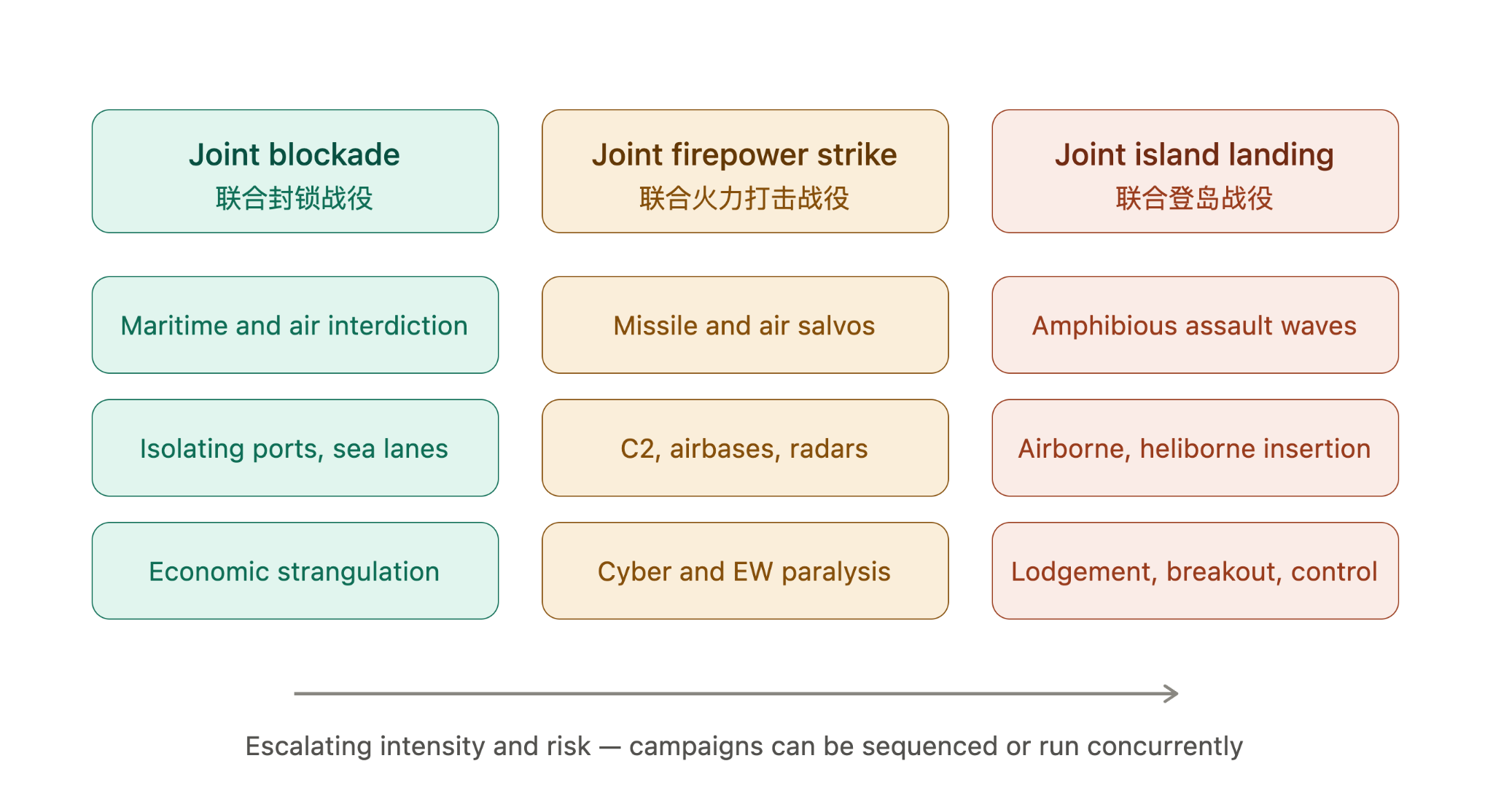
Elements of each of these campaigns have been practised or announced across the seven iterations15 of China’s large-scale military exercises against Taiwan between August 2022 and December 2025. The exercises have evolved in three respects.
First, in content, they have progressed from area denial to blockade and energy decapitation, and, most recently, to invasion simulation and seizure drills. Second, in geometry, they have moved away from just applying pressure along particular geographical axes to all-round fluid pressure, with the trigger bars for launching an exercise steadily lowered – i.e., from a Taiwanese leader’s visit to the US, to, more recently, a National Day speech by the Taiwanese President. Third, in composition, the PLA Eastern Theater Command’s utilisation of platforms has progressed from missiles alone to a combination involving CCG vessels, multiple rocket launcher systems, fighters, destroyers, frigates and bombers. The Coast Guard’s growing prominence also allows Beijing to exercise coercion under the guise of law enforcement.
The sense one gets on the ground in Taipei is more granular, and comes down to three points. First, operationally, an invasion attempt may be possible tomorrow because the PLA already possesses the capability to land on Taiwanese beaches on the West Coast. But the binding challenge is sustaining a multi-division attack through beach landings alone, because such an effort would require repeated docking of replenishment vessels for fuel, food, and ammunition, and rail or road connectivity for armoured vehicles to move inland. While Infantry fighting vehicles/ Armoured Personnel Carriers/ Tanks are more likely to cross the tidal mudflats on Taiwan’s west coast, the wheeled logistics behind them may not do so at the rate divisions entering the island would require. In any case, docking potential would be restricted to small vessels with relatively diminished load-bearing capacities.
Table 1: Decisive platforms for the PLA’s amphibious lift and beaching endeavours in a Taiwan campaign
| Platform Type | Platform Use | China’s Main Arsenal | Photograph |
|---|---|---|---|
| Landing Ship/ Craft Tank (LS/CT) | Flat-bottomed vessel that grounds on a beach shore to drive out many tanks/ armoured vehicles. | Type 072-series (Yuting/Yukan classes); Type 073 medium Landing Ship | 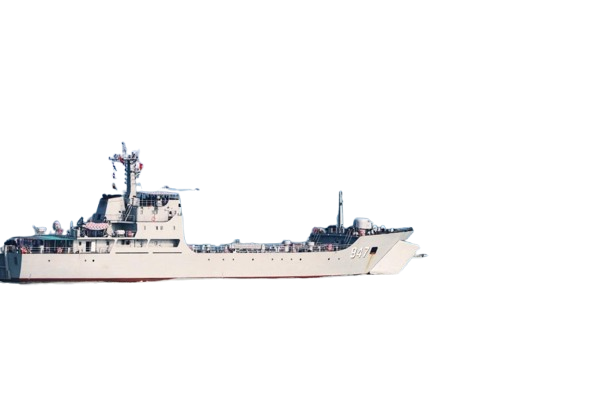 |
| Landing Platform Docks (LPD) | Carries its cargo in a floodable well deck, from which air-cushion landing craft or conventional landing craft swim out over the horizon; Also includes a flight deck for helicopters. | Type 071 Yuzhao class | 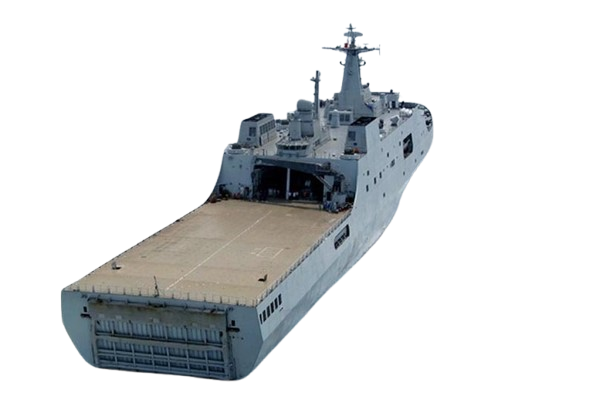 |
| Landing Helicopter Docks (LHD) | Like a smaller carrier, includes an LPD’s well deck alongside full- length flat tops; China also calls them “assault ships.” | Type 075 Yushen and 076 Sichuan (both come with full-length flight decks, 076 also has an electromagnetic catapult for fixed-wing drones like the GJ-11) | 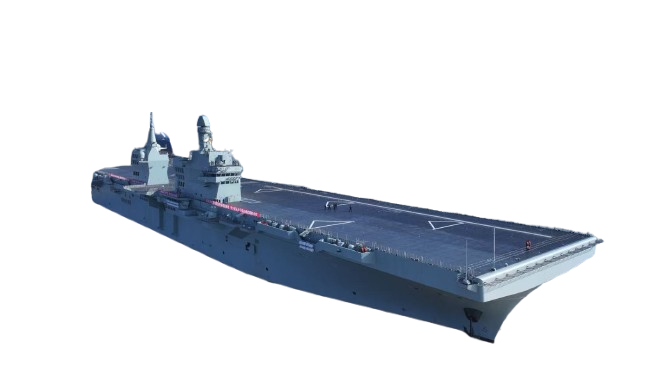 |
| Roll-on/Roll-off vessels (Ro-Ro) | Civilian workhorses (also called ferries) with stern or quarter ramps and “parking” spaces, so that wheeled and tracked cargo drives onto them without cranes or lifting; Cannot beach on its own – always needs a pier. | Bohai Ferry Group’s “Pearl” series; COSCO Shipping’s ‘Bang Chui Dao’ | 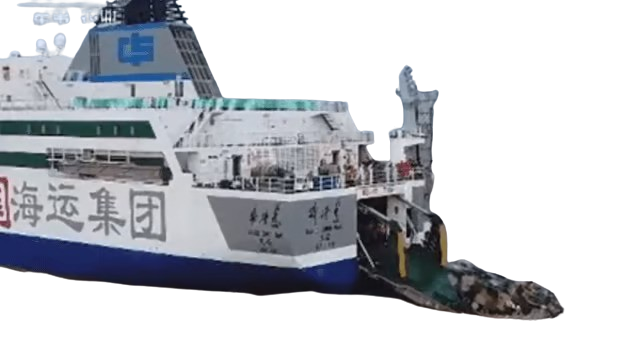 |
| Shuiqiao Barges | Self-propelled jack-up barges with telescoping Bailey-bridge spans. Three length variants have been identified, each with a roughly 120-meter extendable bridge. They can link together to form an 820-metre composite relocatable pier. | Shuiqiao-110, -135, and -185; new January 2026 variants are [reportedly]16 108m, 128m, and 185m | 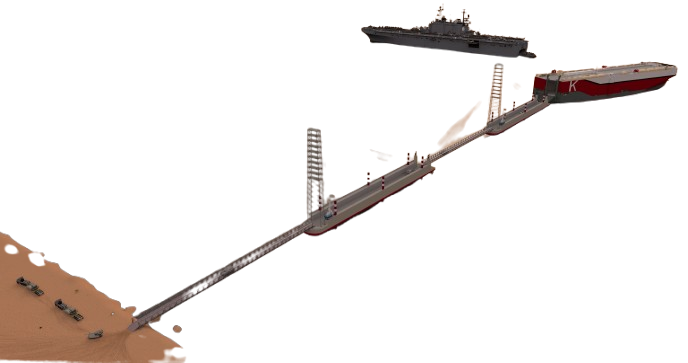 |
Hence, tactically, the PLA’s most important task would have to be to gain control over ports, of which four are vital – Taipei, Kaohsiung, Keelung and Taichung. China’s task would be cut out for it, as it may unsurprisingly find that Taiwanese defences are geared fully towards either sabotaging or protecting precisely these infrastructures. This is because losing access to them drastically impacts the island’s ability to import crude oil and LNG. As Taiwan famously holds very limited energy reserves domestically and imports 95-97 per cent17 of its requirements, in a conflict, port access is an existential matter for it.
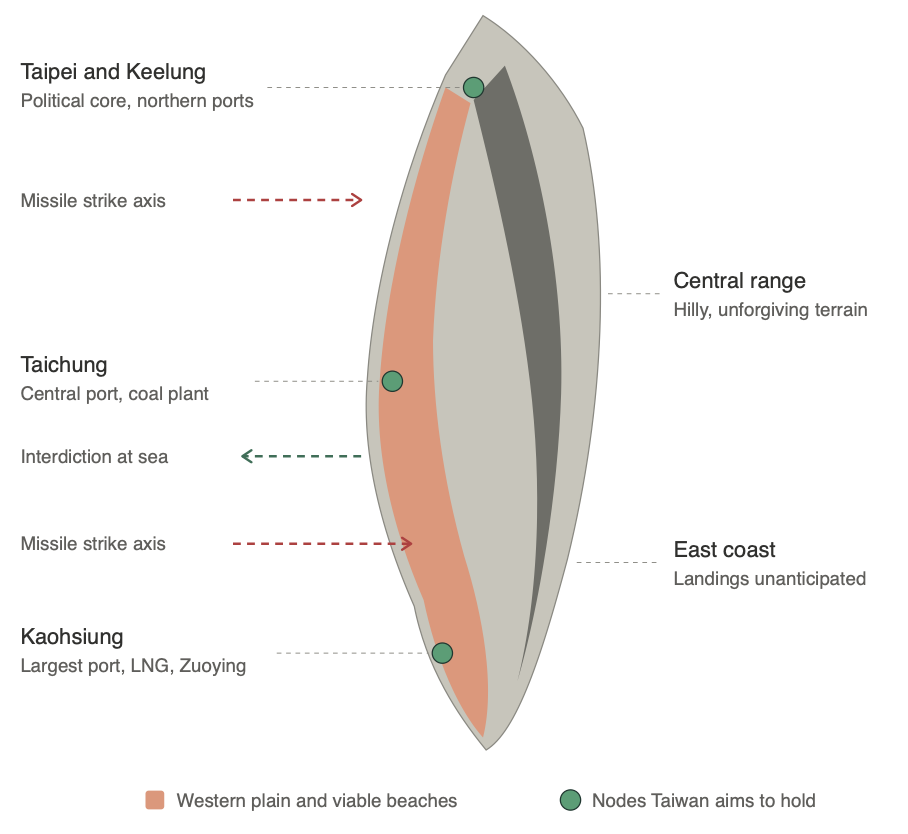
This also means that blockades, with or without invasion tactics, are a most useful tool for the Chinese, especially given that port/ beach access difficulties are already being mitigated by LPDs and Landing Ship Tanks, civilian merchant-type deck cargo ships, and Ro-Ro vessels. For the latter two categories, in particular, shore access is being enabled by Shuiqiao piers/ barges.18 Of course, it is noteworthy19 that a jacked-up, three-barge Shuiqiao set offloading a heavy combined-arms battalion of roughly 150 vehicles would take 40 to 60 minutes. In that time, they are immobile and radar-conspicuous targets that can be found by Taiwan’s American-imported Harpoons and indigenous Hsiung Feng missiles.
Second, after a potential initial conflict with beach-landing battalions, the contest will likely play out between the PLA’s urban warfare and beach-landing capabilities and Taiwan’s ability to sink replenishment at sea while holding Taipei, central Taiwan around Taichung, and Kaohsiung. The PLA’s urban warfare experience is minimal at best, giving retreating Taiwanese forces an opportunity to create dense “hellscapes”20 (in US Admiral Sam Paparo’s articulation) using drones and to impose intensive metropolitan obstacles. At the same time, while landings on the east coast are largely unanticipated because of the terrain there being hilly and unforgiving, activities of the long-range deterrents placed at mainland bases in the east and southeast (such as PLARF bases 61 and 62) will be designed for covering that region.
Third, commitment signalling and scheduling are distinct aspects, and conflating them is a strategic error. Beijing’s roadmap is best read as a coercion ladder designed to win without ever landing on the island. In this case, it is important to understand how Beijing’s coercion gradient works.
Militarily, the erosion of the Strait’s median line and of the Taiwanese Air Defence Identification Zone is now the established status quo. As of October 10, 2025, the US-China Economic and Security Review Commission recorded21 3,056 PLA sorties into Taiwan’s ADIZ for the year, up 33 per cent from 2,301 over the same period in 2024. The full-year figure came in at 3,764,22 a 22.4 per cent rise on a 2024 that had itself smashed every previous record, and monthly sorties have not dipped below 209 since the inauguration of the current Taiwanese President, Lai Ching-te, in May 2024. The shortening of warning times, the lowering of the baseline of what constitutes conflict, and the sustainment of coercion to wear out Taiwanese defence forces, together create a new normal that likely requires a more comprehensive counter-strategy than campaign signalling itself.
Beyond the military dimension, the Chinese pressure toolkit against Taiwan operates in multiple directions. On values-based rhetoric, Beijing legitimises internationally and domestically the idea that Taiwan is an inalienable part of China, and casts any attempt to bolster Taiwanese narratives as “separatism” and a violation23 of UNGA Resolution 2758. In terms of aerial pressure, in addition to disrupting the activities of the ROC Air Force (ROCAF), Beijing also makes unilateral changes to commercial flight routes, such as M503, pushing civilian routes closer to ROCAF’s areas of operation. On the economic front, Beijing has weaponised the Cross-Strait Economic Cooperation Framework Agreement and sanctioned over 30 American defence firms since 2020 for selling arms to Taiwan. On political coercion, Taiwan’s diplomatic allies have been steadily poached – Tsai Ing-wen lost 10 during her tenure; today, 12 remain. On cognitive coercion, Chinese drones drop cardboard boxes of flyers over outlying islands, the official media channel CCTV released24 a video explaining what a PLA invasion would look like, and social media is flooded with material on the inefficiencies of the ruling Democratic Progressive Party.
Table 2: China’s Five-Front Toolkit on Coercing Taiwan
| Narrative based on ‘Values’ | Military Coercion | Economic Coercion | Political Coercion | Cognitive Coercion |
|---|---|---|---|---|
| Taiwan is an inalienable part of China, and it is incumbent upon a powerful leader like China to realise reunification & Great Rejuvenation | Extensive combat preparedness work is underway in the PLA Eastern Theater Command (ETC), including seven exercises since 2022 | Weaponisation of the Cross-Strait Economic Cooperation Framework Agreement (ECFA) by suspending preferential tax rates for Taiwanese firms | Election Interference: DPP busted KMT officials and their family members for travelling to Beijing pre-elections | Leaflets: Chinese drones (sometimes civilian, potentially acting on military orders) drop cardboard boxes filled with flyers condemning ideas of ‘independence’ |
| Taiwan is a red line no other country should cross – especially the US, which has given China assurances in its ‘Three Communiqués’ | Regular Flybys, naval sorties, and balloons beyond the median line of the Taiwan Air Defence Identification Zone | American arms sales to Taiwan have led to China sanctioning over 30 US defence firms in tranches, since 2020 | China suspended open lines of communication on key issues with the US (post-Pelosi visit; many have now resumed) | Video releases by PRC state media, such as CCTV, informing what an invasion of Taiwan by the PLA would look like |
| Any attempt to bolster Taiwanese narratives is separatism, secessionism, and a violation of UNGA Resolution 2758 | Unilateral changes in commercial flight routes like M503 have led the island to upgrade its aerial defence systems | Beijing might begin to arbitrarily target companies that make financial donations to Taiwan’s two largest political parties | Taiwan’s diplomatic allies have been poached – Tsai lost 10 in her tenure – 12 remain. | Facebook and other social media are often flooded with disinformation vis-à- vis the inefficiencies of the DPP |
4. The India Angle
It is evident that if China indeed attempts an invasion of Taiwan, India will face the same fallout as the rest of the region and the world – economic shock and disruptions of sea lanes, for instance. In India’s case specifically, there could be potential pressure along the LAC as Beijing attempts to tie down Indian forces so they cannot assist an allied countercampaign. Electronics from Taiwan, and vital imports from China itself – organic chemicals, machinery and machining tools, and electronics, for example – may take a hit, especially considering the disruption to all East Asian maritime routes and rising insurance premiums on shipping in a conflict zone.
Militarily, Chinese doctrine expresses concern25 about exactly this scenario, described in the 2020 ‘Science of Military Strategy’ as ‘liansuo fanying’ (连锁反应), or “the risk of triggering a chain reaction” across strategic directions during conflict. Hence, in a campaign scenario, if Beijing truly fears a two-front squeeze, then India’s posture on the Line of Actual Control (LAC) would already be part of cross-Strait deterrence, whether or not India ever intends to participate in a conflict over Taiwan. However, it is equally possible that instead of a Taiwan crisis causing pressure on the LAC, Beijing may manufacture a Galwan-style incident, a Depsang-style standoff, or an incursion in Arunachal before or during a Taiwan contingency, with the specific aim of fixing Indian forces westward on the Himalayan frontier. This, of course, is equally a possibility for a failed Chinese invasion attempt.
Two consequences thus bear on Indian military planning. Firstly, a successful invasion would free PLA assets currently dedicated to the Taiwan theatre for deployment along the Himalayan frontier. It would erase the “untested PLA” assumption, and release the PLA Navy from first island chain containment into the Indian Ocean. Secondly, a victory for the PLA in a Taiwan campaign would be the ultimate validation environment for Chinese systems, and its lessons would flow to Pakistan’s Chinese-origin arsenal faster than to anyone else’s. Hence, India’s interest is in the conflict never occurring, and its leverage lies in raising China’s two-front opportunity costs by continually developing deterrence and denial capabilities along the LAC.
However, if one applies the toolkit described in Table 2 to India as well, it is important to note that coercion is not the only instrument available to Beijing. At the 25th round of Special Representatives talks in Beijing on August 25, 2026, Indian National Security Adviser Ajit Doval and Chinese Foreign Minister Wang Yi agreed on an eight-point consensus26 tasking the Expert Group on Boundary Delimitation and the Working Group on Border Management with advancing an “Early and Substantial Harvest”. This comes a year after the 24th round in Delhi established the Expert Group to explore early harvest in a few key sectors.
The articulation revolves around solutions to contentious stretches or low-hanging fruit before a comprehensive, “package” deal is reached. Delhi’s agreement to the idea since last year represents a departure from two decades of insistence on a package deal. Hence, if Beijing seeks to keep New Delhi out of a Taiwan contingency, it has an obvious use for carrots and concessions along the LAC. Settling disputes over Sikkim or the Middle Sectors, for example, to Indian satisfaction would demonstrate that dialogue delivers. Inducement, and the acquiescence it extracts in trade-off, are also facets for Indian planners to consider.
5. The Political Assessment
Much of the discussion about the potential timeline and scenarios for China’s Taiwan campaign centres on military capabilities and global sentiment. A decisive factor shall also be the leader – in this case, Xi Jinping’s own drivers and the culture of the CPC at any given time. Xi has broken long-held norms on terms and age. His military purges are arguably the most sweeping in CPC history, both quantitatively and in the ranks of the leaders targeted. The PLA’s organisation and technological capabilities have been entirely reformed by him, even as troops may struggle to catch up.
Before a Party Congress destined to propel him to a fourth term, and at a time when he is facing no particular pushback or challenge, for Xi to undertake an endeavour as risky as an invasion or even a blockade of Taiwan can only be explained by a quagmire. Hence, while exigent circumstances, emotional triggers, or genuine confidence in the PLA’s capabilities may propel Xi in the future, the need to further establish a legacy as the leader who took Taiwan is a debatable motivator. A successful takeover of Taiwan would indeed go the extra mile to silence critics and consolidate his position – but he cannot be the leader who evidently lost Taiwan. Because legacy cuts both ways, a failed invasion is regime-ending in a way that no amount of grey-zone pressure is. The purges themselves undercut the thesis, because they signal doubt rather than confidence, in that if Xi were confident of a legacy-sealing victory, he would ideally not have gutted the entire military command structure a year before attempting it.
Operationally, as discussed above, China appears to be making meaningful progress on platforms and training. In terms of capacity, revolving around the ability to sustain a campaign rather than just launch one, the record is mixed. On organisational structures, the 2015-16 reforms and the April 2024 disbandment of the Strategic Support Force into the Aerospace Force, the Cyberspace Force and the Information Support Force have built the right architecture on paper, but the purges have hollowed out the leadership a Taiwan campaign may depend on. The PLA will likely not meet its 2027 modernisation goals and is not positioned to stage an invasion in the near term – though its tactical and operational-level units remain largely insulated from the purges, which is why the drill tempo continues undiminished.
Acknowledgements: The author is grateful to Manoj Kewalramani for his research guidance and valuable feedback.
Declaration of AI Use: Figures 1 and 2 were prepared using Claude Opus 4.8.
Image Sources: GlobalMil27; Naval Technology28; The Maritime Executive29; Wikimedia Commons30
Footnotes
Zi Yang, “The Purge of Zhang Youxia and Liu Zhenli: Why and What’s Next for China’s Military,” The Diplomat, January 2026, Link↩︎
“Regular press conference of the Ministry of National Defense on Nov. 26,” The State Council Information Office, The People’s Republic of China, November 2020, Link↩︎
“PRC Pursuit of Xi’s 2027 “Centennial Military Building Goal” (建军一百年奋斗目标): Sources & Analysis,” Andrew Erickson, December 2021, Link↩︎
“Meet the Centenary Goal of the Armed Forces,” Qiushi, September 2023, Link↩︎
Noah Robertson, “How DC became obsessed with a potential 2027 Chinese invasion of Taiwan,” DefenseNews, May 2024, Link↩︎
Grey Norman-Diamond, “China’s Xi has ordered military to be ready for Taiwan invasion by 2027, CIA Director Burns says,” Fox News, February 2023, Link↩︎
Jing Yuan-Chou, “When the Davidson Window Meets the ‘Xi Window’,” The Diplomat, June 2026, Link↩︎
“五, 中共提出「2027 年建軍百年目標」評析,” Mainland Affairs Council, Republic of China (Taiwan), 2020, Link↩︎
“Taiwan says China will be capable of ‘full scale’ invasion by 2025,” NBC News via Reuters, October 2021, Link↩︎
“In Their Own Words: Foreign Military Thought, Science of Military Campaigns,” China Aerospace Studies Institute, February 2020, Link↩︎
“Crossroads of Commerce: How the Taiwan Strait Propels the Global Economy,” CSIS, June 2026, Link↩︎
John Chen and Joel Wuthnow, “China Maritime Report No. 18: Chinese Special Operations in a Large-Scale Island Landing,” CMSI China Maritime Reports 1-2022 (No. 18), January 2022, Link↩︎
“Chen Hu’s Military Review: Island Offensive and Defensive Operations as Seen from the Battle of Yijiangshan Island,” Xinhua, January 2015, Link↩︎
Anushka Saxena, “Sounding the Bugle: An Account of China’s Military Exercises Against Taiwan,” The Takshashila Institution, January 2026, Link↩︎
“China Deploys New Invasion Barges to South China Sea,” SOFX, January 2026, Link↩︎
Kevin Li, “The Iran war tests Taiwan’s energy resilience,” Atlantic Council, March 2026, Link↩︎
HI Sutton, “China Suddenly Building Fleet Of Special Barges Suitable For Taiwan Landings,” Naval News, January 2025, Link↩︎
Thomas Shugart and J. Michael Dahm, “CMSI Note 18: Flooding the Zone: The Use of Civilian Landing Craft (LCTs) in PLA Amphibious Operations,” US Naval War College, January 2026, Link↩︎
Hunter Keeley, “Envisioning a Hellscape: Ukrainian Lessons for a Taiwan Drone Strategy,” US Naval Institute 151(4), April 2025, Link↩︎
“Taiwan and Hong Kong, Chapter 11: Taiwan,” US-China Economic and Security Review Commission, November 2025, Link↩︎
Bonny Lin et al., “Tracking China’s Increased Military Activities in the Indo-Pacific in 2025,” CSIS ChinaPower, February 2026, Link↩︎
Anushka Saxena, “A Politico-Legal Toolkit to Respond to a Taiwan Straits Conflict under a UN Framework,” The Takshashila Institution, February 2024, Link↩︎
“A video released by CCTV News on Tuesday…,” Global Times on Facebook, August 2026, Link↩︎
“In Their Own Words: Science of Military Strategy 2020,” China Aerospace Studies Institute, January 2022, Link↩︎
Manoj Kewalramani, “India-China 8-Point Consensus Calls to ‘Advance Discussions on an Early and Substantial Harvest of Boundary Delimitation & Border Management’,” Tracking People’s Daily on Substack, August 2026, Link↩︎
“TYPE 072-III (YUTING-II CLASS) LARGE LANDING SHIP,” GlobalMil, February 2017, Link↩︎
Richard Thomas, “Analysis: what we know about the Sichuan, China’s drone carrier hybrid,” Naval Technology, November 2025, Link↩︎
Conor Kennedy, “China is Preparing Merchant Ro-Ro Ferries for Amphibious Warfare,” The Maritime Executive, March 2023, Link↩︎
“An artist’s impression of the concept: Bailey Bridge Barge,” Wikimedia Commons, June 2025 (published), Link↩︎
