Sounding the Bugle
| AUTHOR | Anushka Saxena |
| DATE | January 5, 2026 |
| DOCUMENT | Takshashila Issue Brief 2026-01 |
| VERSION | Version 1.0, January 2026 |
| CATEGORIES | China Taiwan Defence Geopolitics People's Liberation Army |
1. Introduction
A crucial component of China’s military strategy vis-à-vis Taiwan since August 2022 has been the conduct of large-scale exercises/ drills. These feature elements of multi-domain integrated operations, live-fire and rocket launch elements, and testing blockade and seizure capabilities of the People’s Liberation Army (PLA) against Taiwan proper and its outlying islands.
This Issue Brief descriptively assesses the nomenclature for each of these exercises, the triggers and motivations for undertaking them, and the weapons systems deployed and operations conducted as a part.
2. The Beginning in 2022
On August 2, 2022, an opinion column1 appearing in the Washington Post asserted that the US has made a vow to protect Taiwanese democracy by supporting the defence of the self-ruled island against a unilateral effort to change the status quo across the Taiwan Strait through the use of force, likely to be perpetrated by the People’s Republic of China. The invocation of this vow, quoting Section (2)(a)(4) of the Taiwan Relations Act of 1979,2 acted as the founding rationale for why a Congressional delegation led by the-then US House Speaker Nancy Pelosi – also the author of the abovementioned opinion column – had to visit Taipei that same day.
In response to that decision by the US, the Chinese PLA’s Eastern Theater Command (ETC) declared that it will conduct “important military training and exercises” (中国人民解放军的-次重要军事训练行动), including live-fire drills, from 12:00 on August 4 to 12:00 on August 7, 2022 (Beijing time), in marked maritime and airspace areas.3
2.1 Motivations
The justification provided for the decision involved three key points, articulated by Professor Meng Xiangqing of China’s National Defense University:4
- On August 2, U.S. House Speaker Nancy Pelosi, disregarding China’s strong opposition and solemn representations, insisted on visiting Taiwan.
- Following the incident, the Ministry of Foreign Affairs of the People’s Republic of China, State Councilor and Foreign Minister Wang Yi, the spokesperson of the Standing Committee of the National People’s Congress, the Taiwan Affairs Office of the CPC Central Committee, the Foreign Affairs Committee of the National Committee of the Chinese People’s Political Consultative Conference, and the spokesperson of the Ministry of National Defense issued statements, remarks, and comments immediately, firmly opposing and severely condemning the visit.
- Late on August 2, Chinese Vice Foreign Minister Xie Feng was ordered to urgently summon US Ambassador to China Burns to lodge a solemn representation and strong protest on behalf of the Chinese government regarding US House Speaker Nancy Pelosi’s visit to Taiwan.
In Meng’s conception, China warned Pelosi against the consequences of a decision to express diplomatic support to Taiwan by visiting the island and conducting meetings with its then-President, Tsai Ing-Wen.
From Beijing’s perspective, the visit and related developments preceding the military exercises were perceived as reductions in US commitments to China. This perception was reinforced by the release of ‘New Guidelines for U.S. Government Interactions with Taiwan Counterparts’ by the US State Department in 2021, the approval of a US$ 108 billion weapons sale to Taiwan by the US Congress in July 2022, and a subsequent US$ 1.1 billion weapons sale by the US Department of Defense in September 2022.5
Additionally, Pelosi’s visit to Taipei received bipartisan support in the United States, and legislative initiatives by Senator Marco Rubio and Representative John Curtis to rename the Taipei Economic and Cultural Representative Office (TECRO) to the ‘Taiwan Representative Office’ (TRO) further provoked China’s disapproval. The impending visit of another five-member Congressional delegation to Taipei, led by Senator Ed Markey, was also viewed as a demonstration of continued US support for Taiwan.
2.2 Location
Coordinates released by the PLA showed six maritime and airspace exclusion zones, within which the ETC conducted its live-fire and military “training” drills (Figure 1).6

2.3 Operations Conducted and Weapons Deployed
Starting on the evening of August 2, the ETC launched a series of joint military operations around Taiwan, conducting joint sea and air exercises in the northern, southwestern, and southeastern areas of Taiwan.
On August 3, the ETC organised a realistic joint exercise in the northern, southwestern, and southeastern seas and airspace of Taiwan. The exercise involved forces from the Theater Command Navy, Air Force, Rocket Force, Strategic Support Force, and Joint Logistics Support Force. The exercise focused on joint containment, maritime strike, land attack, and air superiority operations.
On August 4, the ETC organised troops to conduct an unprecedented large-scale combat-oriented exercise in the sea and airspace surrounding Taiwan. The exercise successfully carried out live-fire firing of long-range firepower and conventional missiles in the designated sea area, and all missiles accurately hit their targets.
On the afternoon of August 4, Senior Colonel Shi Yi, spokesperson for the PLA ETC, stated that the entire live-fire training mission had been concluded and the relevant airspace and sea areas had been reopened.
3. Exercises of April 2023
At 09:00 on April 5, 2023,7 a fleet of maritime law enforcement vessels led by the large Taiwan Strait patrol and rescue vessel “Haixun 06” departed from the Pingtan Maritime Supervision Base of Fujian Maritime Safety Administration, commencing a joint patrol and inspection operation in the central and northern Taiwan Strait.
This “special operation”8 lasted three days and was the first part of the second set of large-scale military exercises since 2022. The first phase (April 5-7) was officially codenamed “Joint Patrol and Inspection Special Operation in the Central and Northern Taiwan Strait” (台海中北部联合巡航巡查专项行动). The second phase (April 8-10), announced by Colonel Shi Yi, was codenamed “Combat Readiness Patrol and ‘Joint Sword’ Exercise around Taiwan Island” (环台岛战备警巡和‘联合利剑’演习).
No coordinates or dedicated exclusion zone maps were released officially for this exercise.
3.1 Motivations
On April 4, 2023, Tsai Ing-Wen made a “transit” in the US and met with then US House Speaker Kevin McCarthy. To respond immediately, the Fujian Coast Guard conducted patrols between 5 and 7 April. Four days later, on April 8, the PLA announced that “in accordance with plans,” combat-readiness patrols around Taiwan were to be conducted. The added element of surprise was the “Joint Sword” exercise in the Taiwan Strait and in the northern and southern areas of Taiwan.
To this end, Colonel Shi Yi stated that this is a stern warning to “Taiwan independence” separatist forces colluding with external forces and engaging in provocations, and a necessary action to safeguard national sovereignty and territorial integrity.
3.2 Operations Conducted and Weapons Deployed
In the first phase, the Fujian Maritime Safety Administration deployed9 “Haixun 06” vessel fleet and maritime law enforcement personnel, together with the East China Sea Rescue Bureau, the East China Sea Navigation Support Center and other relevant forces, to conduct “patrols and inspections” in waters such as the Pingtan-Taiwan direct container shipping route, the “Mini Three Links” passenger shipping route, the Taiwan Strait shipping routes, areas with dense traffic of merchant and fishing vessels, and areas where illegal sand mining activities are frequent.
During the operation, maritime law enforcement officers conducted on-site inspections of cargo ships and construction vessels, possibly including boarding Taiwanese coast guard vessels, to “ensure safe navigation and the safe and orderly operation of key water projects.” From April 5 to 7, the “Haixun 06” patrol vessel fleet continued these patrol and inspection operations in the central and northern Taiwan Strait.
After the ETC Joint Operations Command Center issued orders10 on April 8, mission forces – including Army long-range rocket artillery, Navy destroyers, frigates, coastal missile assault groups, Air Force fighter jets, bombers, aerial refuelling aircraft, and Rocket Force missile units – “rapidly manoeuvered” and assembled in designated areas. They conducted exercises for “joint seizure of control.” Ground command organisations, airborne command hubs, land-based firepower units, and maritime and air combat platforms practised efficient command information flow and close coordination.
Multiple ETC Navy surface ship formations, coastal missile assault groups, and electronic countermeasure and reconnaissance units operating in the East China Sea, the Taiwan Strait, and along the southeastern coast transitioned to higher readiness levels as ordered. Destroyers and frigates advanced rapidly toward waters around Taiwan, applying deterrent pressure, closing in, manoeuvring to seize advantageous positions, and organising training for close-range assaults, long-range deterrence, and air and missile defence as needed.
During exercises to seize air superiority, waves of J-16 and J-10C fighters of the ETC Air Force took off with live munitions, operating in joint formations with naval destroyers, frigates, and ground-based air defence missile forces to build an integrated shore-sea-air combat system. Supported by early-warning, electronic warfare, and tanker aircraft, the fighters conducted medium- and long-range aerial combat. Different aircraft types formed flexible formations, using jamming, suppression, and positional blocking to rapidly seek out and destroy “enemy” air forces, effectively seizing and maintaining air superiority.
At the same time, multiple H-6K and H-6M bombers established several launch positions in designated airspace. With coordinated support from the Navy and the Rocket Force, they conducted simulated precision strikes against “enemy” vessels to seize sea control in the target waters. A pilot, Yang Yang, told reporters of the PLA Daily newspaper that this exercise emphasised testing the entire process of “reconnaissance, control, strike, and assessment,” verifying joint assault and precision destruction capabilities, and further tempering real-combat skills.
On the same days,11 multiple artillery brigades of the ETC Army and multiple conventional missile brigades of the Rocket Force moved into designated operational areas as ordered. Each launch unit rapidly occupied firing positions and began launch preparations, coordinating with maritime and air strike forces to conduct simulated joint strikes against designated targets, testing the effectiveness of rapid firepower response and long-range precision strikes under the support of the joint operations system.
The exercises aimed to evaluate the PLA’s capacity to achieve sea, air, and information control with support from the joint operations system. Task forces conducted simultaneous combat-readiness patrols encircling Taiwan, establishing what was described as an “all-directional encirclement and deterrence posture” around the island.
After the joint seizure-of-control operations concluded, simulated joint firepower strikes were immediately carried out. Multi-service forces conducted simulated joint precision strikes against key targets on Taiwan and in surrounding waters. The Army’s long-range rocket artillery units integrated reconnaissance, command, and firepower networks, relying on unmanned aerial vehicles to provide targeting guidance for launch units, and conducted exercises involving precision strikes against multiple targets and composite destruction using multiple munition types.
Rocket Force mission units focused on “heavy strikes, precise strikes, and disabling strikes,” adopting multiple tactical methods to track and target moving maritime objectives and conduct large-volume, multi-wave simulated firepower attacks.
Finally, the Navy’s Shandong aircraft carrier strike group, which was cruising east of Taiwan on combat readiness, closely coordinated with forward-deployed theater maritime and air forces, organising training in regional air superiority, maritime strike, and support and coordination missions. This was the first time a Carrier Battle formation was deployed in such large-scale exercises. Ships within the formation deployed at sea to conduct air defence and anti-submarine tasks, while J-15 carrier-based fighters took off in succession, “rapidly establishing a carrier strike group combat system” in the exercise area.
4. The Momentum Continues
A large-scale military exercise was conducted for a second time in 2023, around Taiwan, on 24 and 25 August. It was codenamed “Joint Sea and Air Combat Readiness and Patrol Exercise” (联合海空战备巡航演习).
4.1 Motivations
During a regular press conference in mid-August 2023, Chinese Foreign Ministry Spokesperson Wang Wenbin argued12 that the then-Taiwanese Vice President Lai Ching-te…
…Stubbornly adhered to his separatist stance of “Taiwan independence” and is a complete “troublemaker.” The collusion between the US and Taiwan, using a “transit” as a pretext to arrange for Lai Ching-te to engage in political activities in the US, seriously violates the one-China principle and severely undermines China’s sovereignty and territorial integrity.
His comments came in light of a question posed by a Reuters reporter on whether China will respond to another US transit13 conducted by Lai on August 12 and 16, 2023, during his official trip to Paraguay – a Taiwan diplomatic ally. As the precedent to respond to such “transits” was established in April that year, the PLA ETC conducted another, relatively smaller operation as Lai returned – especially also considering that he was a candidate for the post of President in the 2024 Taiwanese national elections.
4.2 Location
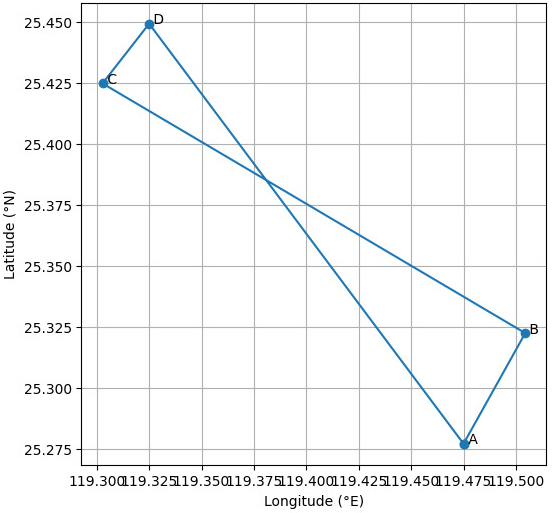
While no exclusion zone coordinates were unveiled for this exercise, live-fire shooting was conducted within a 4-point range from 07:00 to 20:00 on August 24-25.
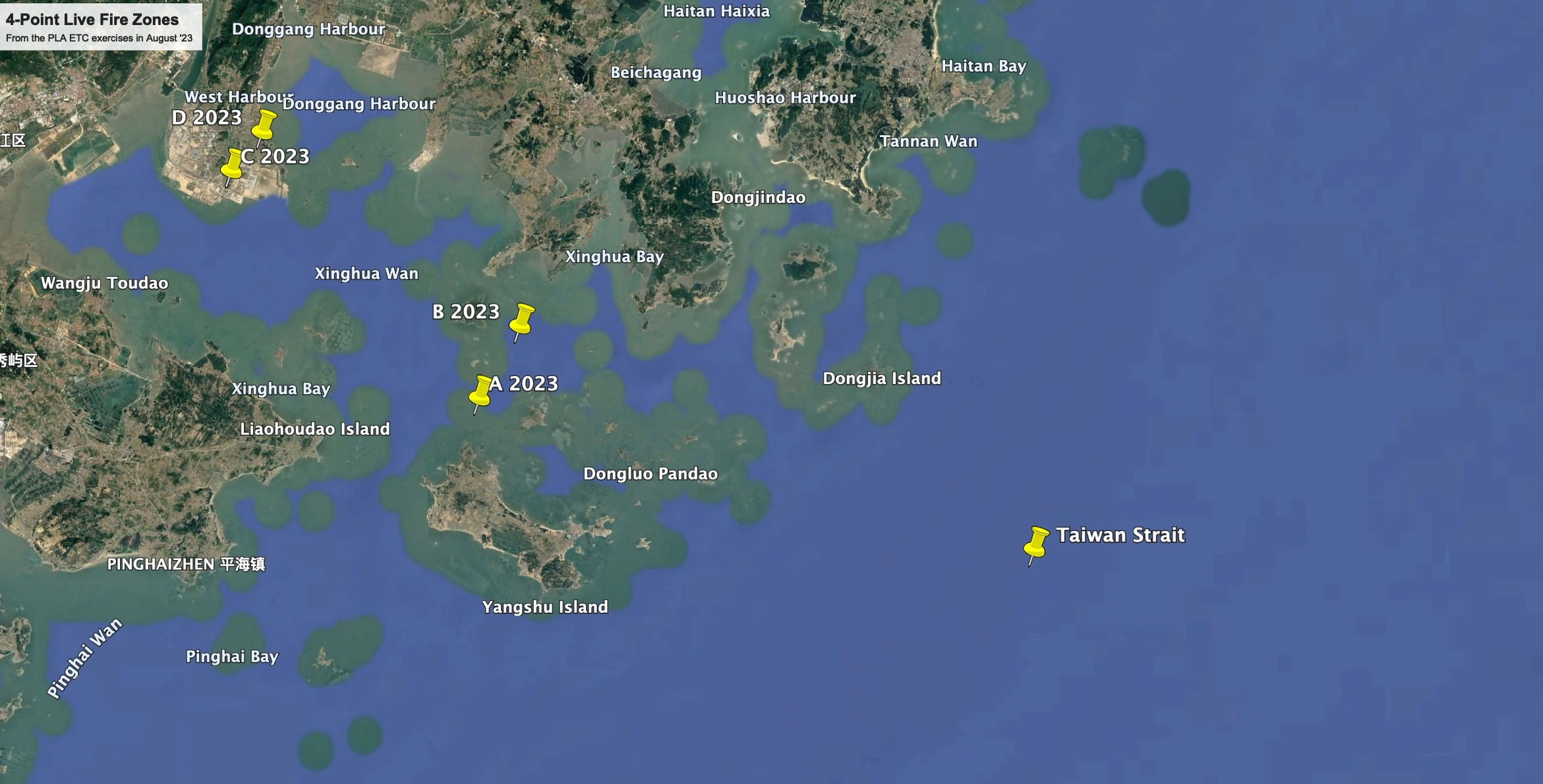
Points A, B, C, and D shown in Figures 2 and 3 depict these live-fire areas, situated on mainland China’s eastern coast.
4.3 Operations Conducted and Weapons Deployed
On August 19, 2023, the PLA ETC carried out training in Taiwan’s northern and southwestern maritime and airspace areas, focusing on jointly seizing sea and air control and conducting submarine search and anti-submarine operations to test the theater command’s joint operational coordination and confrontation capabilities.
After the Joint Operations Command Center of the ETC issued the order, destroyers, frigates, missile speedboats, fighter jets, early warning aircraft, jamming aircraft, and conventional missile troops quickly manoeuvred to the predetermined area and launched combat deployment.
Supported by multi-source intelligence, all troops arrived in the sea and airspace around Taiwan as planned, carried out multi-directional, three-dimensional, long-term close-in deterrence, and formed14 an all-directional encirclement of the island.
On August 22, 2023, the Fujian Maritime Safety Administration issued a navigation warning that live-fire exercises would be held from 07:00 to 20:00 on August 24-25 within a four-nautical-mile area, with entry prohibited. On August 25, the PLA conducted drills in designated zones and in the Taiwan Strait. The Republic of China Ministry of National Defense reported detecting 22 PLA military aircraft sorties and 5 naval vessels in the Taiwan Strait, with 13 aircraft entering the response zone.
5. The New Year of Joint Swords
To conclude the election season in Taiwan, on May 23 and 24, 2024, the PLA ETC announced that forces from the theater’s Army, Navy, Air Force, and Rocket Force would conduct the “Joint Sword-2024A” (联合利剑-2024A) exercise around Taiwan.
5.1 Motivations
Chen Binhua, spokesperson for the State Council Taiwan Affairs Office, claimed15 that upon taking office, the leader of Taiwan, Lai Ching-te…
“Brazenly challenged” the one-China principle, openly peddled the “two-states theory,” attempted to push the “internationalisation” of the Taiwan issue, and continued to “seek independence by relying on external forces” and “seek independence through the use of force,” attempting to drive Taiwan toward a dead end. He further argued that this will never be tolerated or indulged, and no room whatsoever will be left for any form of “Taiwan independence” separatist activities.
Hence, to prevent “Taiwan independence” separatist forces from persisting obstinately or even taking reckless risks, Chen deemed that China must act decisively, resolutely crush “Taiwan independence” separatist schemes, and firmly safeguard national sovereignty and territorial integrity.
5.2 Location
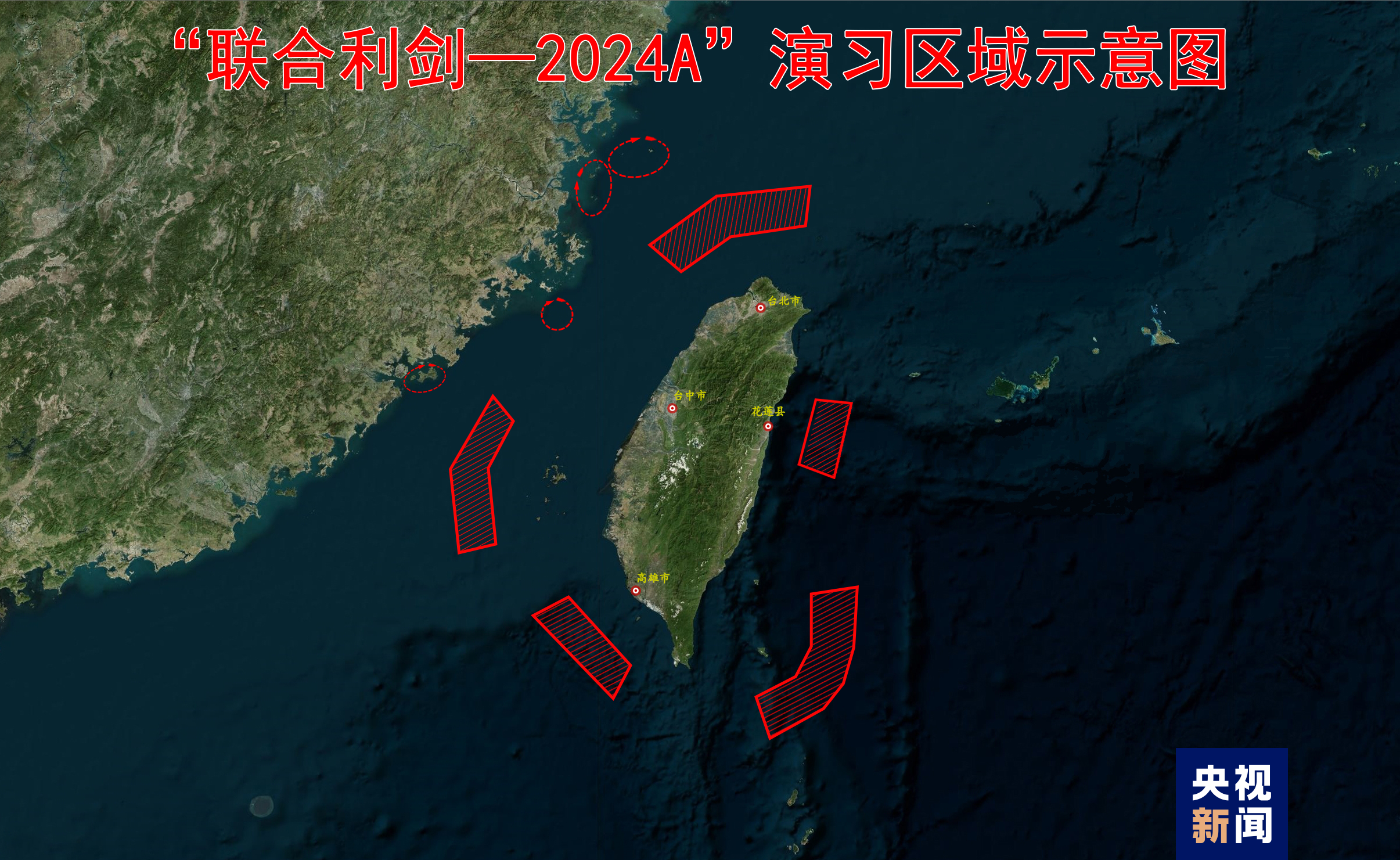
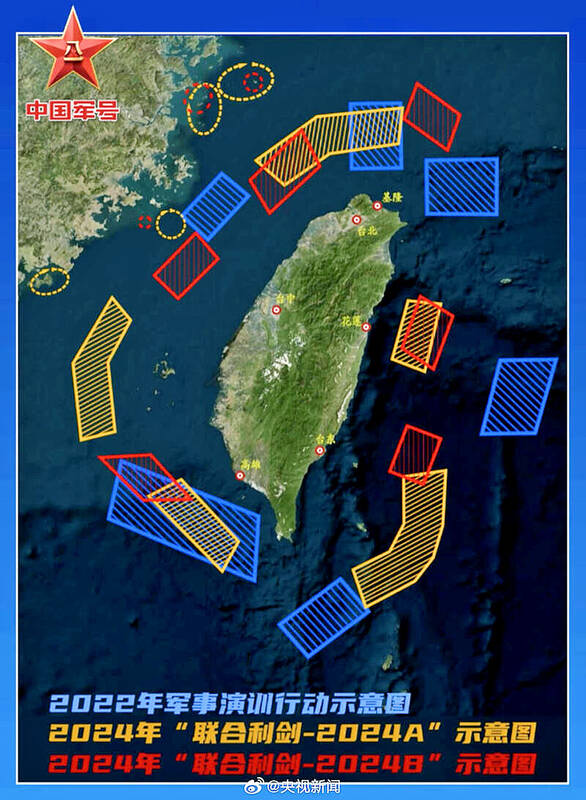
Beginning with Joint Sword-2024A, instead of releasing coordinates, the Chinese officially began unveiling maps showing the exclusion/ drill zones marked (Figure 4).
5.3 Operations Conducted and Weapons Deployed
The drills emphasised joint maritime and air combat-readiness patrols, the coordinated seizure of comprehensive battlefield control, and precision strikes against key targets. Naval vessels and aircraft conducted close-in patrols around the island, integrating operations inside and outside the island chain to assess the theater command’s joint combat capabilities under realistic conditions. The exercise was also intended as a punitive measure against “Taiwan independence” activities and as a warning to external actors.
Beginning at 07:45 on May 23, the PLA ETC conducted16 joint training exercises in the Taiwan Strait; in the northern, southern, and eastern areas of Taiwan; and around Kinmen Island, Matsu Islands, Wuqiu Islet (part of Kinmen islands), and Dongyin Island.
After the theater joint operations command center issued operational orders, multiple destroyer and frigate task groups of the ETC Navy “manoeuvred at high speed from multiple directions toward waters surrounding Taiwan,” shaping an all-directional encirclement and close-in pressure posture around the island.
After arriving in the target sea areas as planned, each vessel “rapidly deployed for combat,” with all weapons systems on constant readiness to strike. Using multi-source intelligence and real-time situational awareness, the ship formations quickly acquired and locked onto targets, carrying out multi-weapon, multi-dimensional simulated strikes.
On May 24, the ETC continued to conduct training in maritime strike, air defence and anti-submarine warfare, and simulated strikes in the airspace and waters around Taiwan, testing the theater forces’ practical capabilities in multi-domain coordination and joint strikes.
In the maritime and airspace areas south of Taiwan, destroyer and frigate formations established networked links with anti-submarine patrol aircraft, while shipborne anti-submarine helicopters simultaneously took off. Ships and aircraft coordinated closely, employing methods such as deploying towed sonar arrays and dropping sonobuoys to “comprehensively sweep areas where ‘enemy’ submarines might operate,” and carried out simulated attacks against underwater targets as ordered.
The ETC Air Force dispatched dozens of sorties to conduct combat patrols around Taiwan and its outlying islands. In the mission airspace, various aircraft types, supported by joint intelligence, used tactical manoeuvres and conducted close-in patrols. With support from the Army and Rocket Force, mixed formations carrying live munitions flew to designated airspace to establish strike positions, coordinating with destroyers, frigates, and missile fast-attack craft to simulate strikes against high-value military targets and reconnaissance or patrol vessels and aircraft.
The simulation animations released by the ETC show that PLA ships and aircraft were operating very close to the coast of Taiwan during the exercise.
6. Joint Sword 2024-B
On October 14, 2024, the PLA followed up on its Joint Sword 2024-A endeavours, with Senior Captain Li Xi, spokesperson of the PLA ETC, highlighting17 that the theater “successfully completed ‘Joint Sword-2024 B’ (聯合利劍-2024B) drills.” The drills “fully tested” the integrated joint operation capabilities of its troops.
6.1 Motivations
While announcing the completion of the exercise, Captain Li Xi said: “Always on high alert, troops of the theater command keep strengthening combat readiness with arduous training, and will foil the ‘Taiwan Independence’ separatist attempts.”
The exercise was primarily conducted to oppose and condemn Lai Ching-te’s “Double Ten” speech, which marked Taiwan’s National Day. Chinese Defense Ministry Spokesperson Wu Qian said that Lai used the speech for hyping up the “new two-state theory” that “both sides of the Taiwan Strait are not subordinate to each other,” and “smear mainland China for aggression and annexation” of Taiwan.
In this regard, he asserted that the PLA’s operational drills on October 14 were specifically designed to counter “Taiwan independence.” He further emphasised that the exercise was not directed at China’s “compatriots in Taiwan.” While China remains committed to pursuing peaceful reunification, “Joint Sword-2024B,” unlike 2024A, represented an intensified effort to exert pressure on “Taiwan independence.”
6.2 Location
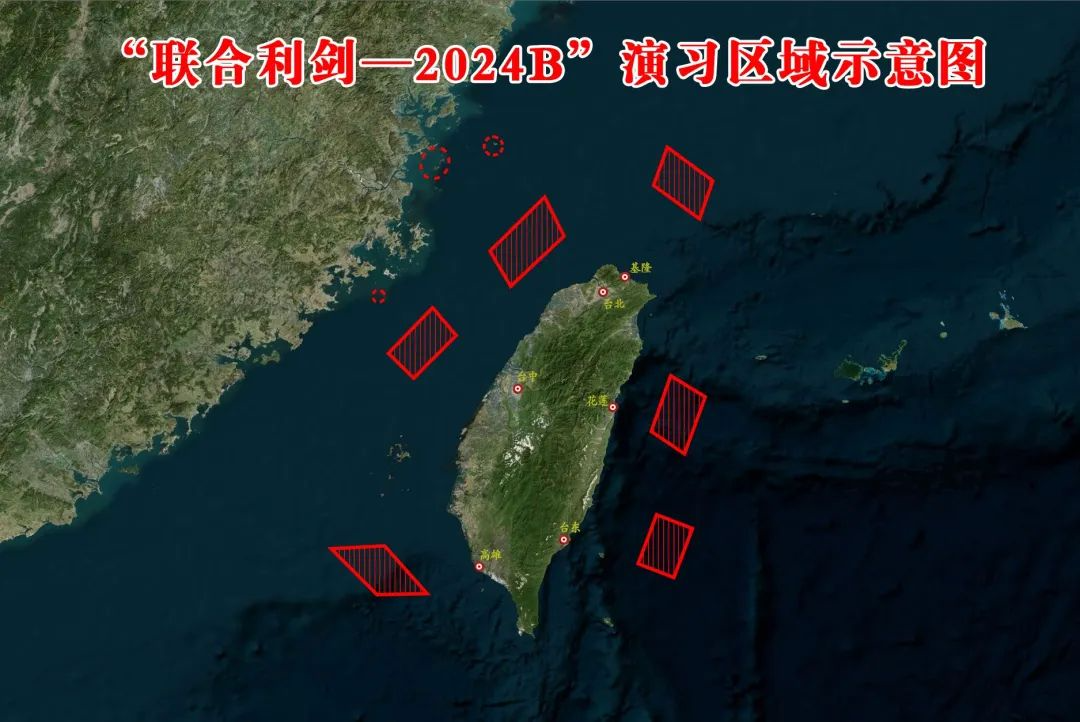
An official map-based imagery of the drill zones for 2024 B was released by the PLA.
6.3 Operations Conducted and Weapons Deployed
The ETC dispatched18 troops from the army, navy, air force, and rocket force to conduct joint military drills in the Taiwan Strait and in areas north, south, and east of Taiwan. Vessels and aircraft approached Taiwan from different directions as multiple services engaged in joint drills, focusing on sea-air combat-readiness patrols, blockades of key ports and areas, assaults on maritime and ground targets, and joint seizure of comprehensive superiority to test the theater command’s joint operations capabilities.
The three main goals of the exercise were as follows:
First, the exercise closely simulated actual combat. PLA forces launched operations at night, rapidly deployed while moving, and began deterrence operations at 05:00. They transitioned from training to actual combat as needed, demonstrating tenacity, combat readiness, and strong capabilities.
Second, a three-dimensional deterrent and multi-pronged encirclement was practised. ETC naval forces, mainly destroyers and frigates, approached Taiwan from four directions: the Taiwan Strait, and the northern, eastern, and southwestern parts of Taiwan. At the same time, ETC air forces, mainly fighter jets and bombers, crossed the strait and approached Taiwan. This created a three-dimensional deterrent and encirclement posture, with the key focus on rapidly seizing comprehensive control of the Taiwan Strait battlefield.
Third,19 the Coast Guard exercise demonstrated law enforcement and naval control. This was the first time Coast Guard vessels patrolled around Taiwan and entered the restricted waters of Matsu Island. The exercise expanded on previous Coast Guard enforcement patrols during “Joint Sword-2024A,” which targeted Wuchiu Islet, Dongyin Island, and waters around Kinmen, extending these practices to the main island of Taiwan.
7. Thunder in the Strait
The first large-scale exercise for 2025 was conducted in April. According to the official WeChat account of the ETC, Senior Colonel Shi Yi, spokesperson for the Theater, stated that on April 2, the PLA organised the “Strait Thunder-2025A” (海峡雷霆-2025A) exercise in the central and southern waters of the Taiwan Strait. The exercise focused on verification and identification, warning and expulsion, interception and seizure, and other subjects, testing the troops’ capabilities in area control, joint containment, and precision strikes.
7.1 Motivations
Articles in the People’s Daily and the PLA Daily newspapers highlighted the rationale behind the conduct of ‘Strait Thunder’. Commentators argued20 that Lai Ching-te is a…
“Ruthless war maker… Dreaming foolishly, he attempts to internationalise the Taiwan issue, seeking independence by relying on foreign forces, and using external forces to realise the evil dream of ‘Taiwan independence’.”
Further, commentators argued that at the end of 2024, during his transit through Guam on a visit to the island’s diplomatic allies, Lai…
…“Falsely claimed that ‘Guam and Taiwan are both located in the first island chain’, revealing his sinister intention to drag the entire Asia-Pacific region into a crisis vortex.” Further, in early 2025, he put forward the “17 strategies” for Taiwan’s national security, which China perceived as “vigorously manipulating ‘all-people defence and resilience operations’, [again] making him an undeniable ‘war maker’.”
No coordinates or dedicated exclusion zone maps were released officially for this exercise.
7.2 Operations Conducted and Weapons Deployed
The drills on April 1 and 2 involved precision strikes on simulated targets at key ports and energy facilities. According to four military operation-themed posters released by the ETC, the exercise’s goals were “Advance, Deterrence and Blockade, Destruction and Paralysis, and Lockdown and Control.”
The ETC also deployed the Shandong aircraft carrier task group, coordinating with naval and air units to conduct drills east of Taiwan. The exercises included vessel-aircraft coordination, seizure of air superiority, and strikes on ground and maritime targets to evaluate capabilities in integrated operations, multi-dimensional blockade and control, and joint operations across services.
A key goal21 in ‘Strait Thunder’ was to conduct long-range live-fire exercises targeting important ports and energy facilities in Taiwan. Targets were simulated for precision strikes. A brigade of the ETC Army used PHL-16 Multiple Rocket Launcher Systems, which rapidly mobilised to preset positions and simulated an attack on the Yong’an LNG Terminal in Kaohsiung. As a commander gave the order, shells hurtled toward the designated targets. This long-range strike focused on tactics such as multi-platform coordinated assaults and multi-munition composite strikes, improving rapid-fire response and joint precision-strike capabilities. It also tested the ability to control energy channels, cut off supply routes, and block or divert underground passages during wartime, achieving the expected results.
As highlighted by Fu Zhengnan of the PLA Academy of Military Sciences in a Global Times commentary, the MLRSs have five advantages for an amphibious campaign in the Taiwan Strait:
It has a long range, capable of reaching hundreds of kilometers and covering the entire island of Taiwan.
It offers high precision, achieved through advanced guidance technologies that enable a margin of error of less than one meter within 300 kilometers.
It possesses strong firepower, as a single barrage can deliver dozens of munitions of different types, creating powerful fire coverage and destructive effects.
It has high mobility due to its relatively small size, making it easy to hide and leading to strong survivability on the battlefield.
It offers high cost-efficiency, as its cost is lower than that of conventional missiles, allowing for deployment in large numbers.
The exercise video released by official state media also showed for the first time the H-6K bomber carrying the Eagle Strike 21 anti-ship missile.
8. Concluding with a ‘Just Mission’?
Starting December 29, 2025, the ETC organised forces from the Army, Navy, Air Force, and Rocket Force to conduct the “Justice Mission-2025” (正义使命-2025) exercise in the Taiwan Strait, and in the northern, southwestern, southeastern, and eastern regions of the island. In addition, the theater also conducted live-fire exercises with long-range firepower on the 30th. This was not a ‘B’ edition of ‘Strait Thunder’, but rather a series of its own, motivated by the need to seek “justice” for China’s cause vis-à-vis Taiwan.
8.1 Motivations
Beijing explained22 that “Justice Mission-2025” was organised for “comprehensively testing the integrated joint combat capabilities of the participating forces” and “fully demonstrating strong capabilities to strike ‘Taiwan independence’, promote reunification, and counter external interference.” It aimed to show that any “egregious act” that crosses red lines and provokes on the Taiwan question will be met with resolute countermeasures, and that “any dangerous schemes aimed at obstructing China’s reunification” will not succeed.
Further, military commentators noted that “external interference” also prompted the exercise. They argued23 that the US and Taiwan have been colluding frequently and engaging in acts that harm Taiwan. Their main concern was that Lai Ching-te claimed he would push for an “unprecedented” US$ 40 billion arms purchase; the US announced a new round of arms sales to Taiwan worth over US$ 11 billion, far exceeding previous amounts. Wang Wenjuan, a researcher at the Academy of Military Sciences, said that this seriously violates the one-China principle and the provisions of the three Sino-US joint communiqués, especially the “August 17” communiqué.
Further, tensions between China and Japan have been ramping up as remarks made by Japanese Prime Minister Sanae Takaichi earlier in December regarding a “Taiwan contingency” were, in the political corridors of Beijing, a message of Tokyo’s intent to intervene militarily in a cross-Strait conflict. Takaichi’s comments suggested that Japanese Self-Defense Forces (JSDF) could be drawn into a conflict to protect Japanese nationals or allied interests, and this struck at the core of Beijing’s “counter-intervention” anxieties. Consequently, the “Justice Mission” drills were designed with a distinct anti-access/ area denial (A2/AD) character, explicitly targeting the northern approaches to Taiwan – the vector from which Japanese or US forces based in Okinawa would likely approach.24
8.2 Location
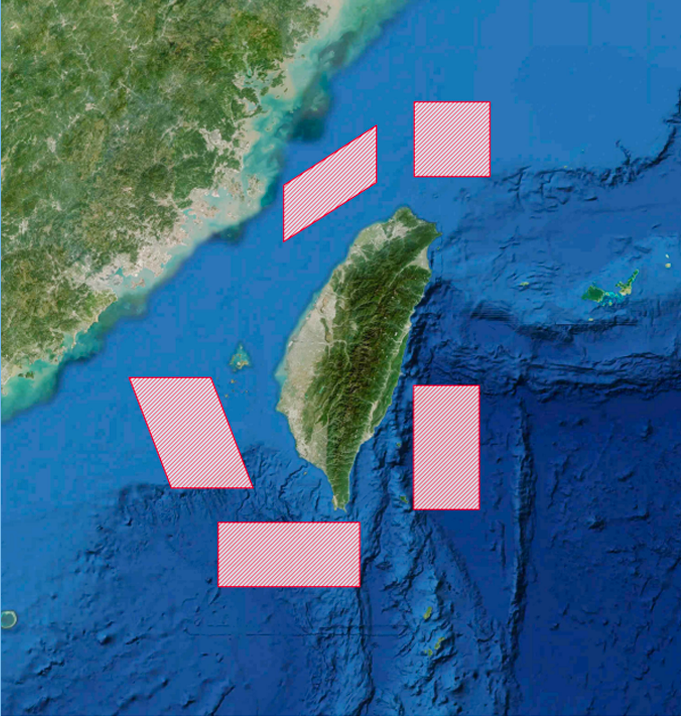
An official map-based imagery of the drill zones for ‘Justice Mission’ was released by the PLA.
8.3 Operations Conducted and Weapons Deployed
On December 29, the exercise focused on maritime and air combat readiness patrols, seizing comprehensive control, blocking key ports and areas, and three-dimensional deterrence along external lines. Ships and aircraft approached Taiwan from multiple directions, and various branches of the armed forces conducted joint strikes. The exercise aimed to test the joint combat capabilities of the theater command’s forces.
The subjects included sea-air combat readiness patrol, joint seizure of comprehensive superiority, blockade on key ports and areas, as well as all-dimensional deterrence outside the island chain. With vessels and aircraft approaching the Taiwan Island in close proximity from different directions, troops of multiple services engaged in joint assaults so as to test their joint operations capabilities.25
On the morning of the 30th, the ETC organised destroyers, frigates, fighter jets, and other forces to conduct exercises in relevant sea and air areas at both the northern and southern ends of Taiwan. Multiple destroyers and frigates of the ETC Navy, supported by multi-source intelligence, “manoeuvred at high speed to occupy advantageous positions” and conducted exercises in subjects such as anti-ship strikes and air defence/ anti-submarine warfare.
In a farther airspace, a formation of H-6K bombers carrying live ammunition, under the command of an early warning aircraft and supported by fighter jets and jamming aircraft, conducted a long-range strike and used precision-guided munitions to simulate strikes against multiple important targets. The ETC also deployed multiple batches of fighter jets, in conjunction with naval fleets, to conduct exercises on verification and identification, warning and expulsion, and simulated strikes, effectively testing the sea-air coordination and integrated containment capabilities.
Further,26 multiple long-range rocket strike units of the ETC Army were ordered to deploy rapidly in small groups and multiple routes, arriving at the mission area and completing combat preparations. At the commander’s order, dozens of rockets roared out. Drones transmitted footage of huge waves crashing onto the surface of the sea, with all rockets accurately hitting their designated impact areas. An Army brigade commander commented that this firepower drill was an effective test of the unit’s island-blockade and supply chain disruption capabilities.
Finally, on the afternoon of the 30th, in the waters east of Taiwan, the amphibious assault ship Hainan frigate formation, together with relevant destroyers, frigates, drones and other forces from the ETC, also conducted exercises on aspects such as three-dimensional delivery, elite troop raids and seizure of key ports, to test the formation’s coordination, system-of-systems operations and precision strike capabilities.
9. Comparative Assessments
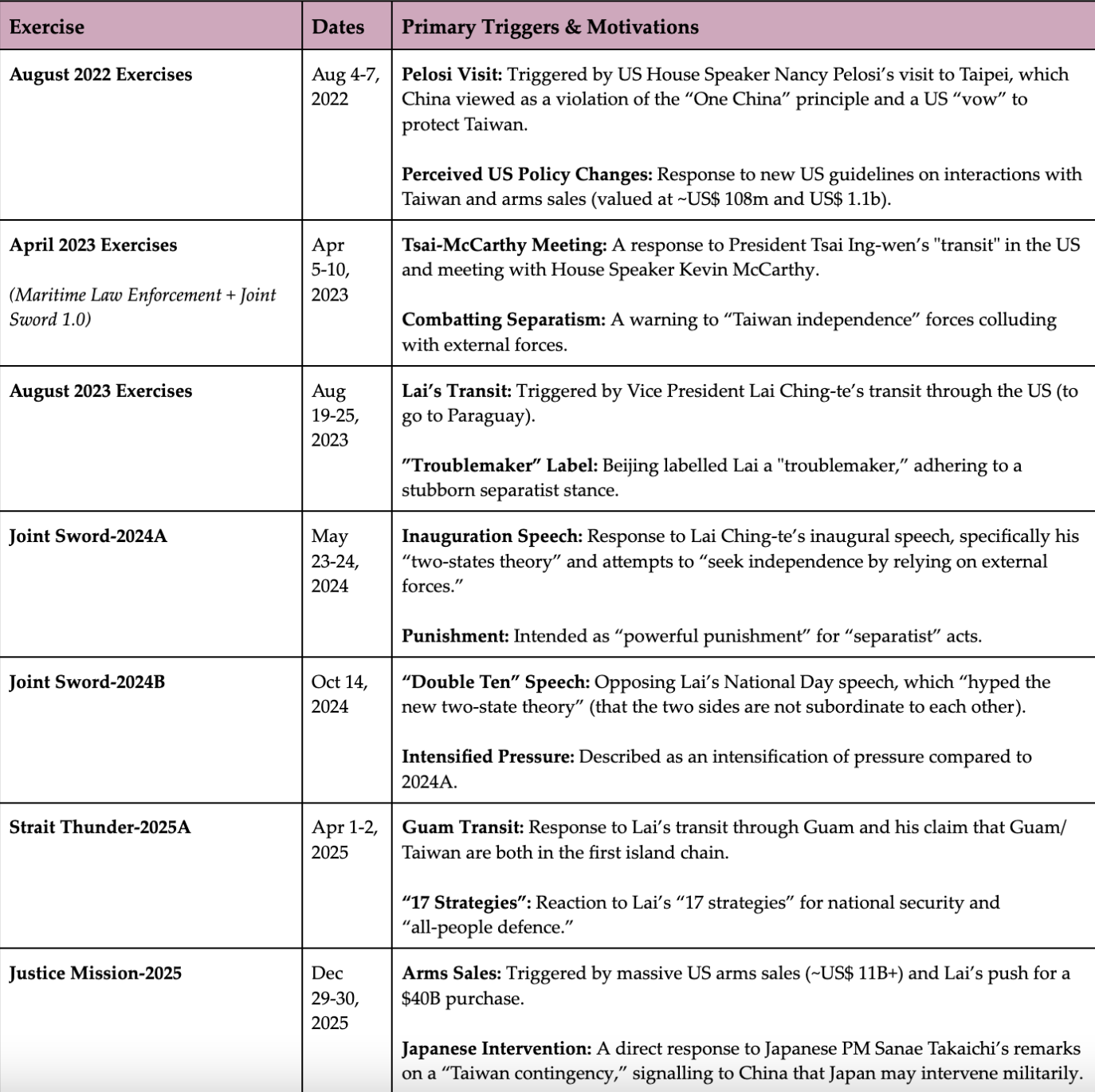
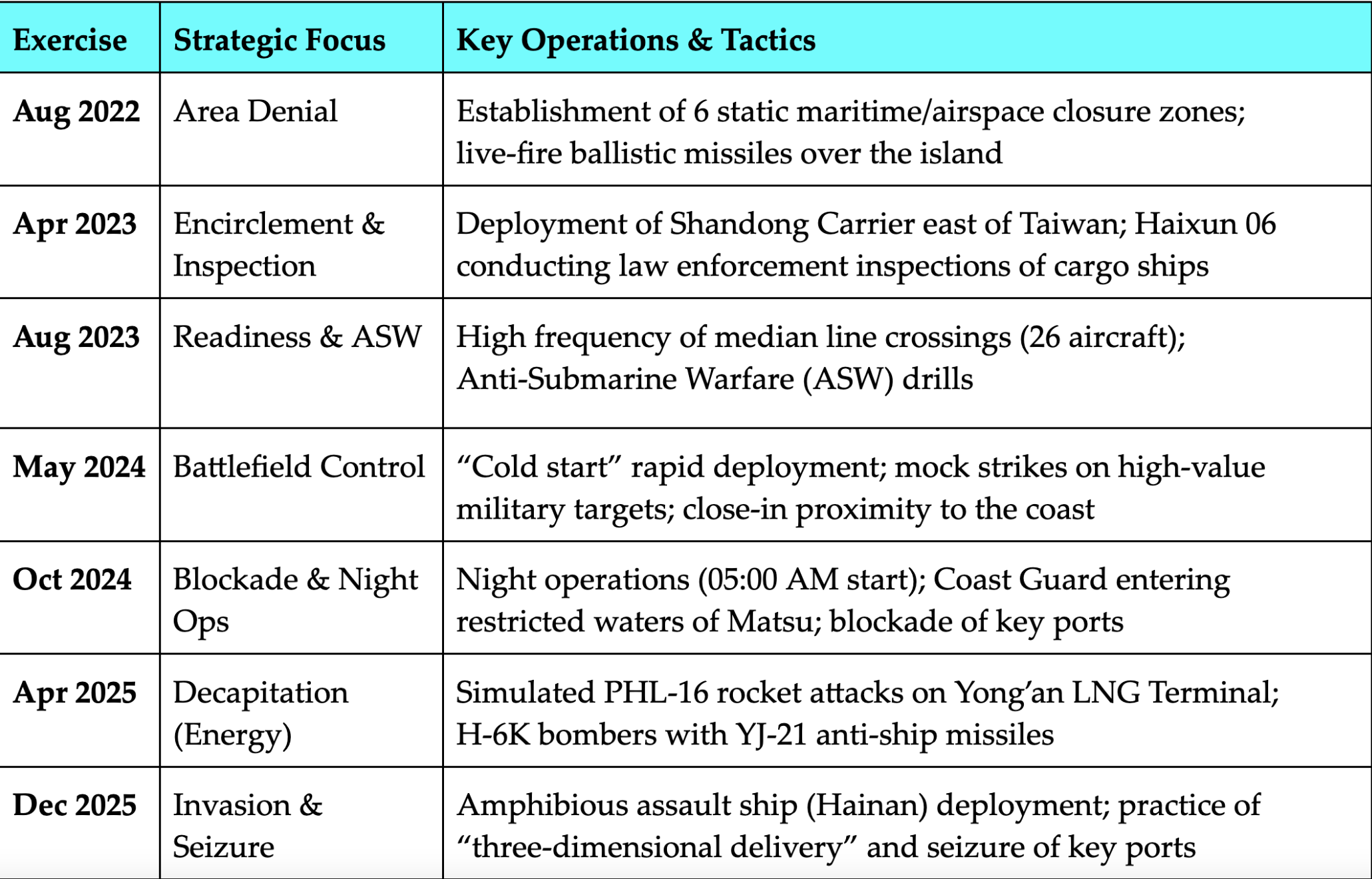
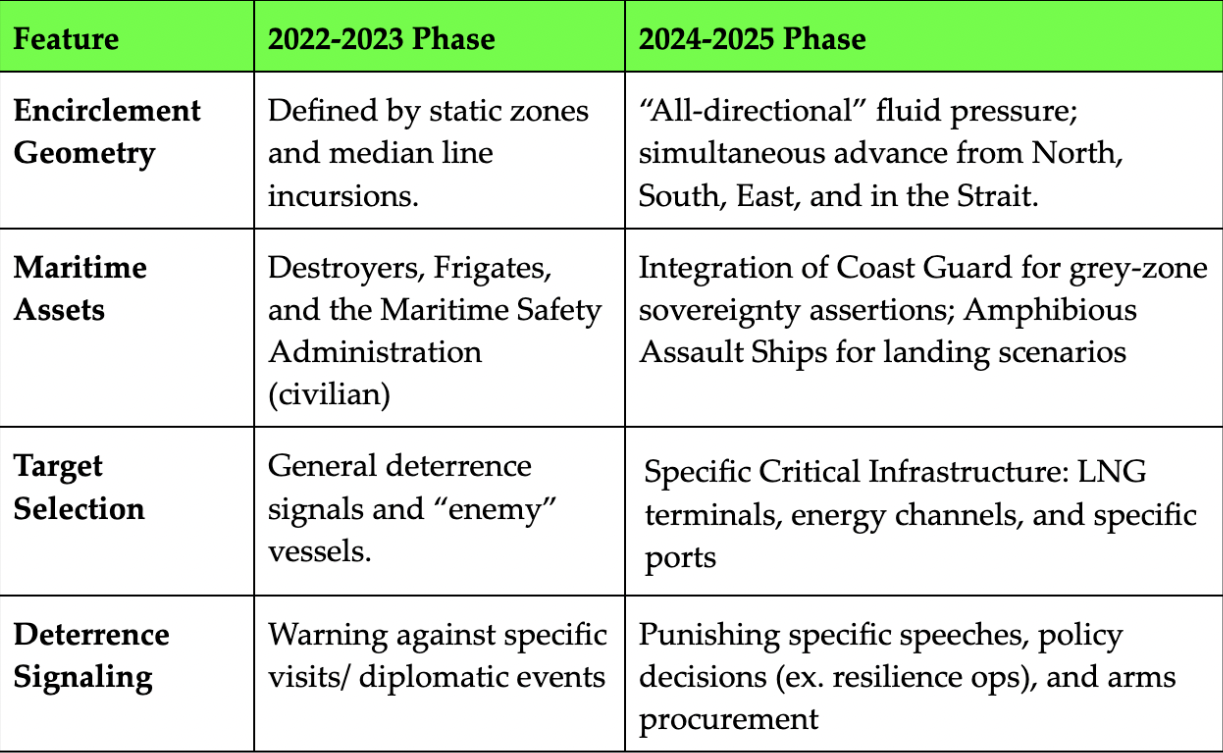
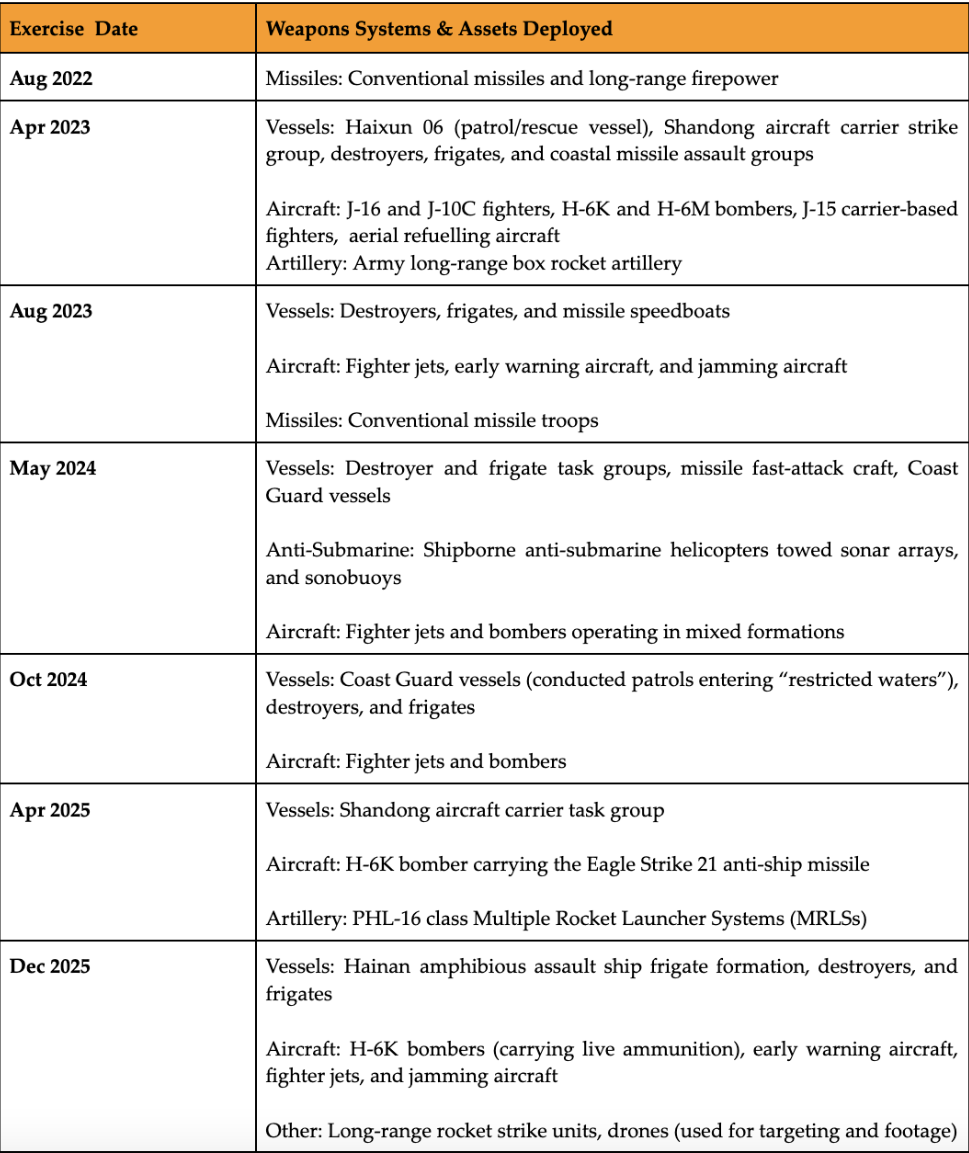
The following tabular representations provide a summary comparative assessment of rationales, operational foci, broad strategic evolutions, and unveiled weapons systems across China’s 7 main large-scale exercises vis-à-vis Taiwan between August 2022 and December 2025.
Footnotes
Nancy Pelosi, “Why I’m leading a congressional delegation to Taiwan,” Washington Post. 2 August 2022. Link.↩︎
Taiwan Relations Act: Public Law 96-8 96th Congress. USC US-China Institute. Link.↩︎
Ministry of Defense, People’s Republic of China. 2 August 2022. Link.↩︎
“The PLA’s largest cross-strait exercise to date: experts say it’s unprecedented in its approach to encircling Taiwan.” 81.cn. 6 August 2022. Link.↩︎
Anushka Saxena, “Nancy Pelosi’s visit to Taipei: Implications for the US-China-Taiwan Equation,” Institute of Chinese Studies. 20 October 2022. Link.↩︎
Ministry of Defense, People’s Republic of China. 2 August 2022. Link.↩︎
“Joint patrol and inspection operation launched in the central and northern Taiwan Strait,” CCTV News. 5 April 2023. Link.↩︎
“The Eastern Theater Command will organize a combat readiness patrol around Taiwan and the”Joint Sword” exercise,” 81.cn. 8 April 2023. Link.↩︎
“Joint patrol and inspection operation launched in the central and northern Taiwan Strait,” CCTV News. 5 April 2023. Link.↩︎
“The Eastern Theater Command successfully completed its combat readiness patrol around Taiwan and the”Joint Sharp Sword” exercise,” 81.cn. 10 April 2023. Link.↩︎
“The Eastern Theater Command organized a combat readiness patrol around Taiwan and the”Joint Sharp Sword” exercise,” 81.cn. 9 April 2023. Link.↩︎
“On August 15, 2023, Foreign Ministry Spokesperson Wang Wenbin hosted a regular press conference,” Chinese Embassy in New Zealand. 15 August 2023. Link.↩︎
Nils Peterson, “People’s Republic of China Framing Lai’s US Transit as a Crisis,” Institute for the Study of War. 9 August 2023. Link.↩︎
“PLA conducts joint combat-ready patrol and training exercise around Taiwan Island,” China Military Online. 19 August 2023. Link.↩︎
“The Taiwan Affairs Office of the State Council stated that the”Joint Sword-2024A” exercise is a resolute punishment for provocations by the Taiwan region leader seeking “independence”,” Xinhua. 23 May 2024. Link.↩︎
“What is the significance of the”Joint Sword-2024A” exercise being held so close to Taiwan? Experts analyze: This time, the PLA is using overwhelming strength to launch a counterattack,” Baidu. 25 May 2024. Link.↩︎
“The PLA Eastern Theater Command Successfully Completed”Joint Sword-2024B” Drills,” 81.cn. 14 October 2024. Link.↩︎
“The PLA Eastern Theater Command Conducts “Joint Sword-2024B” Drills,” 81.cn. 10 October 2024. Link.↩︎
“More details on the”Joint Sword-2024B” exercise are here!,” CCTV. 10 October 2024. Link.↩︎
Bill Bishop, “US tariffs; Strait Thunder 海峡雷霆-2025A Exercise concludes; Improving price governance mechanisms; Politburo shuffle,” Sinocism on Substack. 3 April 2025. Link.↩︎
Guo Yuandan and Liu Xuanzun, “Live-fire rocket shooting biggest highlight of ‘Strait Thunder-2025A’ drills: expert,” Global Times. 2 April 2025. Link.↩︎
“The”Justice Mission-2025” exercise is a stern warning to Lai Ching-te about his attempts to seek independence through force and by relying on foreign powers,” PLA Daily. 31 December 2025. Link.↩︎
“A Just Army Delivers a Just Mission: Military Experts Discuss the”Just Mission-2025” Exercise,” 81.cn. 30 December 2025. Link.↩︎
Anushka Saxena, “US moves on Venezuela, is China next on Taiwan?,” The Economic Times. 5 January 2026. Link.↩︎
“PLA Eastern Theater Command Conducts “Justice Mission 2025” Drills,” 81.cn. 29 December 2025. Link.↩︎
“The Eastern Theater Command continued its”Justice Mission-2025” exercise in the airspace and waters surrounding Taiwan,” 81.cn. 31 December 2025. Link.↩︎