SWOT Analysis of Pakistan’s Mediation in West Asia
| AUTHOR | Aishwaria Sonavane |
| DATE | August 11, 2026 |
| DOCUMENT | Takshashila Discussion Document 2026-26 |
| VERSION | Version 1.0, August 2026 |
| CATEGORIES | Discussion Geopolitics Geostrategy Pakistan West Asia Strategic Studies |
Executive Summary
The document argues that Pakistan’s emergence as a leading mediator in the 2026 US-Iran conflict was a function of opportunism, strategic necessity, and acceptability by stakeholders, and not a function of conventional diplomatic influence. This was potentially underwritten by the country’s geography, its relationships in Washington, Tehran, Beijing, and Riyadh, as well as its nuclear status. The narrowing of options further played a role, as more proximate states found themselves exposed to the conflict to mediate legitimately. Its role is therefore facilitative but not merely passive. It can open channels, convey messages, and help shape the terms of engagement, yet its ability to influence outcomes is constrained by its own diplomatic standing.
This paper uses a SWOT (strengths, weaknesses, opportunities, threats) to weigh Pakistan’s assets against its constraints. The paper lays out three trajectories: a durable settlement, a temporary peace deal that yields limited returns, or a complete collapse of talks that forces Pakistan off the fence. The paper reframes Pakistan’s relevance in the international community beyond the traditional security-centric approach.
Introduction
Scholarship on Pakistan has examined a wide range of issues, including civil-military dynamics, religious nationalism, the Military-Jihadi Complex, external financial dependence, and its relationship with India, alongside aspects of its political economy and society. Pakistan’s facilitation of the US-China rapprochement in 1971, its history of nuclear proliferation, and its centrality to China’s Belt and Road Initiative (BRI) have also received considerable attention. Against this broader literature, this document analyses Pakistan’s contemporary role in mediating dialogue between the US and Iran.
Acknowledgements: The author would like to thank Pranay Kotasthane and Manoj Kewalramani for their valuable feedback and guidance.
In early 2026, Pakistan’s role in global diplomacy came into focus when the country occupied a notable position in mediating a conflict between the US and Iran. The conflict broke out as a result of US and Israeli attacks on Iran, resulting in Iranian retaliation on American military bases in the Gulf. The military exchange began on 28 February and lasted until 8 April, when a brief two-week truce was agreed upon. The US and Iranian delegations held 21 hours of direct negotiations in Islamabad, the first high-level talks since 1979, producing dialogue but no agreement. The talks failed, leading to renewed skirmishes, blockades of the Strait of Hormuz by both the US and Iran, and recurring periods of fragile ceasefires.
AI use disclosure: AI was used to review the paper, brainstorm logical inconsistencies, and citations for this document.
Following renewed negotiations, the Islamabad Memorandum was signed on 17 June, under which the US and Iran agreed to a 14-point MoU to conclude the war. The agreement provided a 60-day window to negotiate the final terms, including the lifting of sanctions on Iran, Tehran’s commitment not to pursue nuclear weapons, the reopening of the Strait of Hormuz, and the release of blocked Iranian assets. The agreement provided a 60-day window to negotiate the final terms – including the removal of sanctions on Iran, Tehran’s commitment to not pursue nuclear arms, the reopening of the Strait of Hormuz, and the release of blocked Iranian assets. Nonetheless, the subsequent developments complicated the implementation of these terms. As of this assessment, Pakistani diplomats were committed to salvaging the agreement, and both Prime Minister Shehbaz Sharif and Army Chief Field Marshal Asim Munir were continuing to push both sides to return to a pause in hostilities.
In international studies, mediation is defined as a structured intervention from an external third party to facilitate communication, negotiation, and compromise among disputants without possessing direct coercive power.1 Mediators are commonly either economically sound, neutral states (such as Switzerland, Norway, Oman, or Qatar), or great powers with significant leverage (like China or the US). Pakistan was an unlikely candidate to emerge as a primary mediator of US-Iran talks, following the geopolitical events of 2026 in West Asia.
Historically, Pakistan’s foreign policy in West Asia has been characterised by a calculated and precarious balance between its primary economic patron, Saudi Arabia, and its western neighbour Iran.2 Pakistan’s domestic landscape is often consumed by chronic economic instability, military dominance, and vulnerability to external shocks. Despite these existential and extensive crises at home, Pakistan capitalised on its geostrategic location, relationships with diverse stakeholders, and domestic imperatives to facilitate the historic negotiations (the ‘Islamabad Talks’) in April 2026, culminating in the signing in June of the short-lived Islamabad MoU.
Even as the ceasefire remains precarious and deep mistrust exists between the parties, the role of Pakistan raises a question worth analysing. Under what conditions does Pakistan fit the role of an interlocutor in West Asia? And what consequences follow from its playing such a role?
Islamabad’s acceptability in West Asia and among global powers like the US and China was potentially consequential in enabling it to occupy the role of an interlocutor. That said, Pakistan’s diplomatic agility has been critical in sustaining this position. Within days of the US/Israel-Iran conflict, Pakistan established itself as a suitable candidate for engaging with all principal stakeholders – Tehran, Washington, Riyadh, and Doha. To that end, the military establishment, which drives the country’s foreign policy, explicitly expressed its desire to mediate the conflict. The offer found resonance with the Trump administration, which had already demonstrated willingness to re-establish relations with Pakistan in the months preceding the war.
Since Trump came back to power in November 2024, Islamabad has invested heavily to rebuild its access and influence in Washington, reaching out to Trump and his administration, while also building investment ties with his family members. Pakistan’s nomination of Trump for the Nobel Peace Prize and its participation in his proposed Gaza Board of Peace exemplify these efforts to cultivate proximity. Therefore, at a moment when Washington was likely wary of being seen as engaging directly with Tehran, Pakistan’s offer to relay messages may have seemed like a solid bargain.3
Pakistan’s ability to position itself as a useful partner for Washington is not without precedent. During the Cold War and the US-led War on Terror in Afghanistan, Islamabad has capitalised on its strategic position to become an indispensable partner to Washington. Its military establishment, which remains at the helm of the decision-making structure, further enabled it to move coherently and rapidly on foreign policy, often with fewer domestic limitations.
In that context, Pakistan’s mediation position can be better understood through the prism of high utility rather than trust. Its value lies more in its ability to maintain channels with warring actors, who may otherwise find it challenging to communicate directly. This becomes especially consequential when both sides are seeking an off-ramp from an escalatory conflict.
At first, Pakistan’s case brings to light the dynamics of how a state with its rentier state tendencies – leveraging geography, resources, and its military – finds itself at the heart of crisis diplomacy. This document examines Pakistan’s actions in West Asia, its bilateral relationships and domestic imperatives, and consequent strategic incentives attached to this mediation. This paper employs a SWOT (Strengths, Weaknesses, Opportunities, and Threats) framework to examine Pakistan’s strategic positioning and institutional leverage within the regional conflict. The framework facilitates an evaluation of Pakistan’s internal Strengths and Weaknesses, along with the external Opportunities and Threats in this strategic environment.
Acknowledgements: Anand Arni’s input contributed to refining the initial ideas in this paper.
Historical Context of Pakistan’s Strategic Position in Conflicts
While Pakistan has previously facilitated engagements between global powers, as well as state and non-state actors, its direct and deep involvement in such an active, high-stakes environment potentially marks a more consequential role for Islamabad. Most notably, Pakistan enabled a secret meeting between the US and China in the early 1970s. Pakistan’s President, Yahya Khan, personally delivered US President Richard Nixon’s messages to Chinese Premier Zhou Enlai, paving the way for US Secretary of State Henry Kissinger’s secret 1971 visit, consequently opening Beijing-Washington diplomatic relations.4 Pakistan’s acceptability in both capitals was most likely instrumental in enabling this engagement.
Pakistan played a balancing act during the Iran-Iraq conflict between 1980 and 1988. Though Pakistan’s Gulf allies, including Saudi Arabia, were backing Iraqi President Saddam Hussein, Islamabad held its ground on refusing to sever ties with Iran. Pakistan’s General Zia-ul-Haq opened Karachi port to Iranian shipping, allowing Iran to bypass Iraqi aerial attacks. This period also saw a spike in Pakistan-Iran trade.5 Concurrently, Zia also placated Gulf concerns. In effect, Pakistan refrained from taking sides in West Asia by providing limited transit access to Iran without directly joining any conflict bloc. However, Pakistan’s role in this conflict was limited to rhetoric and logistics.
Pakistan has consistently resisted direct entanglement in West Asia and maintained strategic neutrality. The internal sectarian vulnerabilities and economic reliance on the Gulf may have informed this position.6 Even in 2015, Pakistan’s parliament unanimously passed a resolution declining Saudi Arabia’s request to deploy troops and military assets to the coalition against Houthi rebels in Yemen — which remains an ally of the Iranian state. Similarly, during the Gulf crisis, Islamabad resisted pressure from Riyadh and Abu Dhabi to boycott Qatar.7 On both occasions, Pakistan’s intervention reflected a non-aligned approach, which involved maintaining a diplomatic independence without formally aligning itself with either side or participating in conflict-resolution mechanisms.
Most recently, in 2020, Pakistan played a role in facilitating the Doha agreement between the US and the Taliban. Pakistan enabled negotiations by hosting some of the very first direct, formal discussions between the Taliban and representatives of the former Afghan government in Murree as early as 2014 and 2015.8 This direct intervention was aligned with Pakistan’s security concerns and skin in the game, following the Western troop withdrawal from bordering Afghanistan. Meanwhile, Pakistan’s role in the US-Iran negotiations extended beyond hosting or providing a venue for negotiations. Its function was that of an intermediary, maintaining communication between the parties, conveying messages and positions, and sustaining a channel for negotiations when direct engagement was complicated. It did not negotiate the substantive terms of the agreement of behalf of either party and its ability to shape the negotiating process gave it a degree of diplomatic agency.
It’s worth noting that during the brief cross-border exchange of airstrikes between Iranian and Pakistani military in January 2024, both neighbors willingly and rapidly de-escalated tensions through back-channel conversations.9 This resulted in mutual agreement to cooperate along the shared border, without requiring any third-party intervention, unlike Pakistan’s equation with other neighbours, India and Afghanistan. Meanwhile, multiple countries from China to Saudi Arabia and Turkey have stepped in to mediate the Taliban-Pakistan hostilities.
Jumping to 2026, Pakistan’s direct mediation and involvement in West Asia remains in part driven by opportunism and strategic vulnerabilities, given internal sectarian sensitivities and external financial dependencies. As such, the mediation was both a matter of state survival for Pakistan, as well as an opportunity to demonstrate utility and subsequently gain international reputation. The desire to attract financial benefits also remains a part of this process. Overall, Pakistan’s existing assets such as geostrategic location, military dominance, Islamic legitimacy, nuclear status, and access to multiple regional stakeholders further support it in becoming a suitable candidate for this role.10
To sum up, history suggests that Pakistan’s incentives to mediate in 2026 rely less on altruism than on a convergence of exposure, opportunity, and dependency. Its economic dependence on Gulf states gives Pakistan a stake in the stability of the region that a protracted Iran-US conflict could threaten. Concurrently, its practice of managing ties with Tehran bilaterally indicates Pakistan’s interest in preventing any sort of destabilisation of Iran, while also appeasing its patrons in the Gulf. Mediation could offer Pakistan a rare window to demonstrate utility to the US, at a time when Washington-Islamabad relations are dealing with cooperation on critical minerals and counter-terrorism, with potential for tangible gains. As such, by positioning itself as useful to all stakeholders simultaneously, Pakistan is seeking to extract benefits from each relationship while also rebranding its global reputation long defined by security-centric narratives.
Logic of Pakistan’s Role in Mediation
The paper does not make a comparative claim that Pakistan is structurally better suited to serve as a mediator between the US and Iran, rather than traditional mediators, or even India. Rather, it can be understood as an exercise in elimination, whereby Gulf nations, including Oman and Qatar, were removed from this space given their exposure to the conflict and not because of their deficient credentials or capacity to mediate.
The Foreign Minister of Oman, Sayyid Badr Albusaidi, was involved in mediating a round of US-Iran negotiations in Oman in early February, followed by a final round in Geneva, Switzerland, two days before the war was initiated by Israeli and American strikes.11 Qatar and UAE also reportedly maintained diplomatic channels through early 2026. However, following the strikes on Iran, Albusaidi levelled accusations against the Trump administration of having lost its “own foreign policy” and of acting on behalf of Israel in Iran.12 While Oman had stronger institutional claims to the mediator’s role before the conflict began on February 28, built on its active backchannel negotiation with Iran and the US, this position was eroded at the onset of hostilities. Iranian retaliatory strikes on Omani ports, as well as attacks on Qatari territories, targeting US interests and military bases, turned the Gulf states from neutral channels into targets exposed to the conflict. The Israeli strikes on Doha in 2025 had already compromised Qatar’s position to operate with neutrality.
Therefore, Pakistan’s advantage lay in this relative distance from these immediate challenges, considering it does not host US military bases on its territory, and has no diplomatic relationship with Israel. Together with the degree of trust Pakistan has established with the parties involved, these features factored into its case as a more suitable option. Add to this Munir’s decades-long experience in military intelligence, his tenure in the Inter-Services Intelligence (ISI), and his position as Army Chief that potentially offered him an advantage in establishing personal rapport with Iranian and American officials.
Pakistan’s potential role as a mediator can be analysed against three key mediation parameters – strategic necessity, acceptability to the belligerent parties, and the presence of an opportunity for international mediation.13
- Strategic Necessity: Defined as a vulnerability incentive, strategic necessity argues that a third-party mediator must possess strong domestic stakes in the outcome of the conflict to motivate sustained engagement.14 For an import-dependent economy like Pakistan’s, a protracted war in West Asia threatens the state by disrupting Gulf trade routes and energy supplies. Disruptions drove the rapid inflation and collapse of the Pakistani rupee to oil supplies and regional markets.15 Furthermore, the demographic sensitivities were evident following the assassination of Iran’s Supreme Leader Ali Khomenai, which triggered protests from Pakistan’s sizable Shia population, the second-largest outside Iran. Add to that the restive Balochistan province bordering Iran, which remains marred by sectarian violence by Baloch insurgent groups. Together, Pakistan turned its internal exposure into a commitment currency to facilitate a resolution to the conflict.
- Acceptability to stakeholders: This requires a mediator to appear sufficiently neutral and trustworthy to facilitate talks between conflicting parties.16 In this framework, Pakistan maintains financial and defence ties with Saudi Arabia and the Gulf, while preserving amicable ties with neighbouring Iran. The impact of cultural and historical influences on state-to-state ties may be overstated; however, the relevance of state-to-people ties was evident in the political messaging of deceased Iranian leader Ayatollah Ali Khamenei, which also reached an estimated 40 million Pakistani Shia population.17 Additionally, there is evidence of Pakistan establishing channel of interaction with Iran. In the 1980s, Abdul Qadeer Khan’s proliferation network reportedly supplied Iran with gas-centrifudge technology for uranium enrichment, creating an early link between Iranian and Pakistani actors.18
- Pakistan government’s knowledge of this lucrative deal remains under debate. While Pakistan has bolstered its defence ties with Saudi Arabia under the 2025 Strategic Mutual Defence Agreement (SMDA), and now with Kuwait, these arrangements seem to be driven by broader regional security concerns involving Israel rather than a position against the Houthis or Iran. This may have likely informed the Iranian perception of viewing Pakistan as a credible mediator, regardless of its relationships in the Gulf.19 Meanwhile, Washington found Islamabad acceptable given the personal rapport between Munir and US President Donald Trump since March 2025, which grew in the aftermath of the Pakistan-India conflict in May 2025.20 This opportunity also coincided with the sidelining of traditional alternatives – Qatar, housing US bases, remains a target for Iran; Oman lacks influence in the US, and Turkey has frayed ties with Iran.
- International Opportunity: Pakistan benefited from stakeholders favouring de-escalation. A transactional Trump administration favoured an exit ramp from the conflict, while Iran recognised the deep challenges of sustaining a military operation with America.21 In the absence of American and Iranian willingness, regional exhaustion, and diplomatic backing of Beijing, Islamabad’s mediation efforts would have likely been futile. # SWOT Analysis
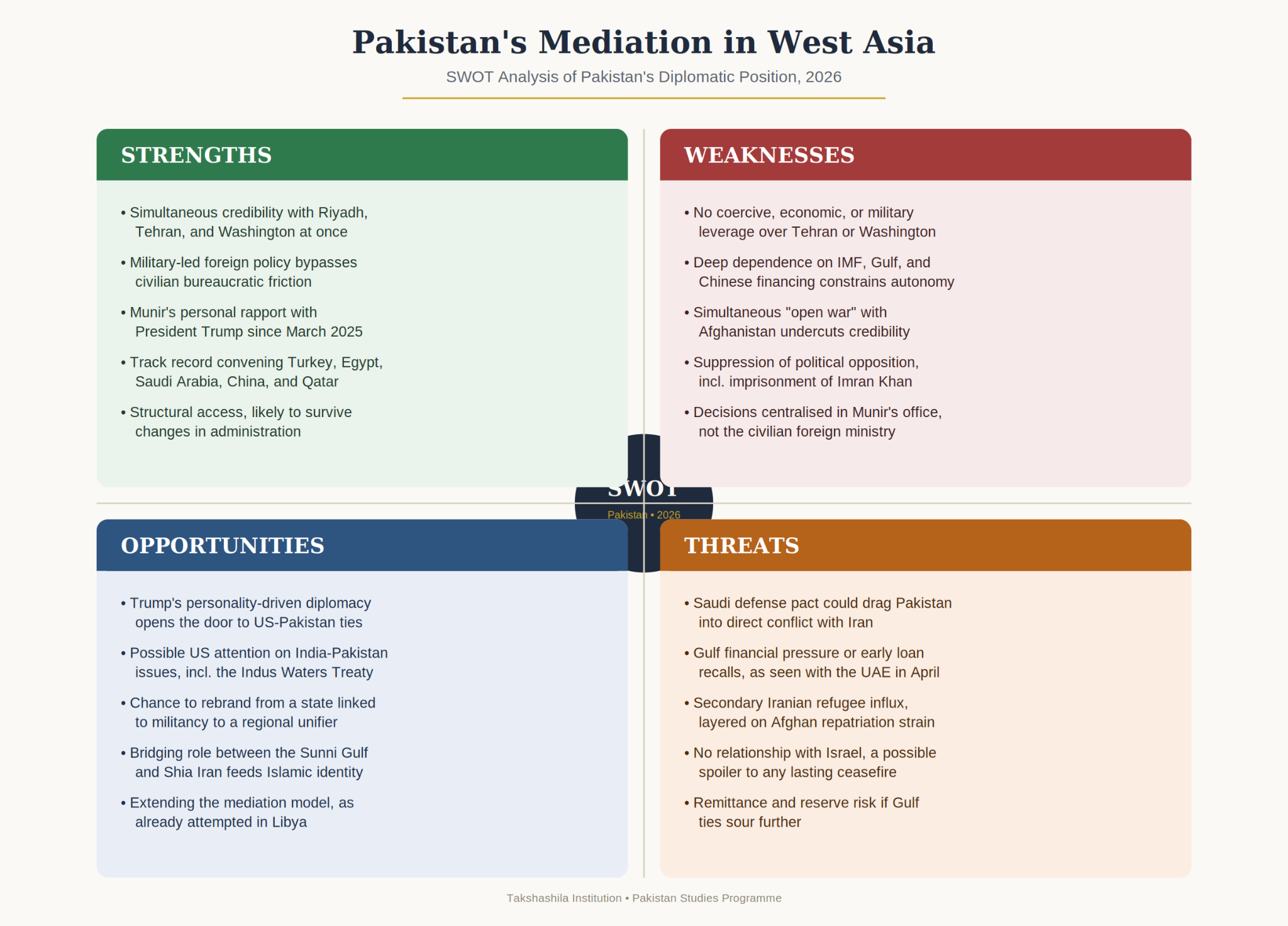
Having established the logic underpinning Pakistan’s role as a primary negotiator, the following section intends to further probe the conditionalities that may empower or constrain its ability to sustain its mediation position – and more crucially, whether doing so will continue to serve the state’s strategic interests. To do this, a SWOT analysis is carried out to examine the factors that determine the internal capabilities and external conditions that may shape Pakistan’s ability to pursue its interests in this role.
The value of the SWOT framework rests on Pakistan’s internal strengths and weaknesses – characteristics the country carries into the mediation process, regardless of the external environment. It is rooted in Pakistan’s diplomatic structure, economic network, and decision-making architecture. Meanwhile, opportunities and threats are external conditions that are a product of choices by other actors, over which Pakistan has limited or no control.
Strengths
Pakistan’s mediation is grounded in a form of capital that likely no other player in the world currently possesses - simultaneous credibility and consensus of neutrality among all stakeholders, at once. The dual acceptance by regional rivals in West Asia – Tehran and Riyadh, as well as ties in Washington, allowed Islamabad to present itself as a reliable messenger and venue for negotiations. This access is structural and not situational, at least in West Asia, given its anchoring in Pakistan’s foreign policy. Pakistan’s September 2025 Saudi–Pakistan SMDA (2025) demonstrates Riyadh’s deep trust in Pakistan as a security provider, while Pakistan’s explicit condemnation of the US-Israeli strike on Iran illustrates its acknowledgement of Iranian anxieties. This acceptance enabled Pakistan to have access on both sides.22
Being the only Muslim-majority nuclear state further gives Pakistan a form of trust (prestige, even) within the Muslim world that non-nuclear states, despite their economic heft, cannot match. This status also lends Pakistan a degree of credibility to mediate a dispute centered on Iran’s own nuclear programme.
This centrality is a product of Pakistan’s existing diplomatic and military networks in place to overcome communication barriers between Washington, Tehran, and other involved Gulf parties. This access can be attributed to Pakistan’s military-dominated foreign policy and diplomacy, which bypass the standard bureaucratic frictions of civilian governments. This dynamic was also illustrated when Trump directly contacted Munir, stating that “Pakistan knows Iran well.”
Munir cultivated this personal rapport methodically – which included counter-terrorism cooperation that resulted in the capture of the Islamic State leader linked to the 2021 Kabul airport bombing, praise for Trump’s alleged mediation in India-Pakistan ceasefire following May 2025 clashes, and a nomination for the Nobel Peace Prize for Trump. Munir’s direct line to the White House likely became the core of Pakistan’s capacity to mediate.
Despite Islamabad’s successes, the mediation has not operated alone. It was also able to bring Turkey, Egypt, and Saudi Arabia into Islamabad before the ceasefire was finalised in April. Munir further flew to Beijing in March to produce a joint five-point statement in favour of talks, and also co-managed a “deconfliction mechanism” for Lebanon with Qatar in June. China’s endorsement of Pakistan’s mediation role further augments Islamabad’s position by lending its diplomacy the support of another major power with substantial interests in the region. This demonstrates organisational capacity to involve multiple states, and gain wider credibility.
Weaknesses
While Pakistan can effectively convene multilateral meetings on short notice, and carry messages to relevant capitals, it cannot make any state act on them. Pakistan’s access is devoid of any coercive, economic, or military lever to compel Tehran or Washington to accept demands. Pakistan’s mediation at present is unlikely to resolve the deep-rooted, intricate US-Iran dispute itself.
Ultimately, Pakistan’s autonomy is limited by its economic vulnerability. Given Pakistan’s economy is deeply dependent on Gulf financial assistance, International Monetary Fund (IMF) loans, and Chinese debt rollovers, its strategic choices remain vulnerable to economic pressures from external actors.23 Pakistan’s weak economic institutions and bureaucracy will prevent it from employing financial flexibility or diversifying energy imports, which could undermine its position of strategic neutrality, should negotiations take an unusual turn.
While Pakistan presents itself as a credible mediator, its legitimacy can be threatened by its own international and external security issues. Simultaneous to the mediation, Pakistan also fought an “open war” with Afghanistan, launching airstrikes in the country in February and March. A state fighting an external conflict, along with internal security challenges by insurgent and militant groups, could be a subject of skepticism for being unable to handle fires in its own backyard. The credibility of the Pakistani government to speak as a responsible state is further compromised by documented suppression of political opposition, also demonstrated by the imprisonment of the populist leader, Imran Khan.
Additionally, the deletion of a draft tweet by Pakistan PM Sharif, purportedly scripted by Trump’s team, further demonstrates the limited autonomy of the civilian foreign policy apparatus. It remains indicative of a decision-making institution in which the military leadership remains significant influence on foreign policies.24
Opportunities
The Trump administration’s personality-driven diplomatic style has created an opening for the US-Pakistan relationship. This follows the departure of Western troops from Afghanistan in 2021, which essentially downgraded Pakistan from American foreign policy priorities. Although unlikely, successful mediation could translate into US investments in Pakistan, at least in the Trump era.
Attention in Washington could also result in renewed interest in India-Pakistan tensions among American policymakers. Consequently, this could lead to Islamabad likely gaining some international attention on its dispute with New Delhi, especially on the issue of the Indus Water Treaty, if not Kashmir. As such, Pakistan’s nomination of Trump for the Nobel Peace Prize, twice, was likely a deliberate investment for keeping the US President’s attention. However, this opportunity will also be contingent on the nature of India-US relations at that moment.
The mediation effort further offers Pakistan an opportunity to position itself as a constructive regional actor capable of mediating conflicts, rather than just managing its problems. 25
This is especially given Pakistan’s ability to engage both Beijing and Washington, beyond its relationship with stakeholders in the conflict. For decades, Pakistan’s identity has been tainted by its association with Islamist outfits like Lashkar-e-Taiba, Jaish-e-Mohammed, and the Afghan Taliban. A shift in perception could invite some diplomatic opportunities. Additionally, Pakistan can use its position to mediate other conflicts, like it’s already doing in Libya. 26
This mediation among West Asian nations also presents Pakistan with an opportunity to reposition itself from a fragile state to a potential unifier of a divided Muslim Ummah, including by serving as a bridge between the Sunni Gulf states and the Shia establishment in Tehran. Such external validation can feed into the domestic narrative of Pakistan’s Islamic identity and long-term relationship with Muslim states.
Threats
One of Pakistan’s biggest strengths – its ties to Saudi Arabia – can quickly turn into a nightmare. The security pact with Riyadh, which compels it to treat an attack against Saudi Arabia as an attack on itself, also possibly extends Pakistan’s nuclear umbrella to Riyadh. Any Iranian strike on Saudi Arabia could force Islamabad into a conflict with its neighbour. Needless to say, this would severely undermine Pakistan’s standing as a neutral mediator for Tehran, while exposing its western border in Balochistan to proxy conflict or cross-border strikes. Furthermore, such events will also have domestic sectarian implications.27
Pakistan’s capacity to absorb new refugee influx is already restrained by the ongoing displacement crisis of the Afghan population in the country. Pakistan has been sending back Afghan migrants, with over 1.15 million Afghans deported from Pakistan in 2025. A prolonged conflict in West Asia could add a second displacement pressure along its western borders, prompting large-scale movement towards Balochistan from Iran. If hostilities are protracted, Pakistan could face a two-front humanitarian challenge. This would additionally strain the country’s already stretched security apparatus and provincial infrastructure, border management systems, and finances.
The fragility of these negotiations has been exposed during the course of the conflict. While opening negotiations was tough, a harder challenge for Pakistan would be converting any diplomatic breakthrough into durable strategic gains.28 Should the Gulf be under stress due to the continuation of the conflict, this may lead to restricted financial support for Pakistan, or worse, demand for early repayment of loans.
This was already seen in the UAE’s demand for early repayment of a USD 3.5 billion loan in April as Pakistan pursued its balancing act. The fallout was beyond economic losses, as the UAE reportedly deported and terminated thousands of Pakistani workers, putting its remittances under threat. Islamabad cannot afford to sour ties with the Gulf, given the consequential role it plays in keeping Pakistan’s foreign exchange reserves afloat.
And finally, Pakistan has no relationship with Israel, which could be a spoiler in achieving any sustainable ceasefire between the US and Iran. 29 Israeli Prime Minister Benjamin Netanyahu previously contradicted Pakistan Prime Minister Sharif’s claim that the April ceasefire included “everywhere including Lebanon.”
 This image is made using Claude
Conclusion
The document has analysed the conditions enabling Pakistan to emerge as a key interlocutor in the US-Iran conflict, and the limits to its ability to translate diplomatic access into meaningful strategic gains. These could include improving Islamabad’s diplomatic standing, expanding relationships in West Asia and with the US, potentially securing diplomatic and economic concessions, and expanding its room for manoeuver in complicated regional environments. The historical context highlights that Pakistan’s mediation carries some precedent, while also reflecting a recurring pattern of leveraging its geography, ties with competing powers, and ability to remain relevant in conflicts outside its immediate region.
The examination of Pakistan’s position also demonstrates that its position was likely steered by a mix of factors, including strategic necessity, acceptability in key capitals, and legitimacy gained due to its exposure to the war. The SWOT analysis exemplifies that while Pakistan possesses rare access and convening capacity, its economic dependence, security ties, internal challenges, and exposure to regional escalation will constrain its ability to continue mediation where the costs begin to outweigh strategic advantages.
This uncertain situation calls for scenario planning to provide useful tools to think through multiple potential futures. A best-case scenario for Pakistan will be to broker a comprehensive conflict resolution between Iran and the US, which includes an end to violence in Lebanon and Yemen. In such a case, Pakistan will gain a reputation of being a successful peacemaker and likely be rewarded with financial gains.
Economic opportunities could emerge as an indirect effect of a resolution, which could involve eased sanctions for Iran and their subsequent ability to participate in regional and global commerce.30 For Pakistan, this could mean bilateral energy cooperation, energy trade, and connectivity. This could also involve potential US investment and expanded mineral cooperation, and Gulf-backed financing. However, the impact on the country’s economic status will remain contingent on Pakistan’s ability to convert diplomatic goodwill into investment, rather than loans and deposits. Meanwhile, reputational gains include higher diplomatic status in West Asia, and a sustained relationship with the Trump administration without dissatisfying Beijing, potentially shifting its role from being facilitative to transformative, thereby allowing a precedent for Pakistan to mediate other global disputes.
The second-best scenario could involve a temporary truce that stabilises global supply chains, generating brief economic relief in the medium term. However, a truce understood to be fragile will not remove the uncertainty driving Gulf states’ security hedging, and may instead create room to formalise it, as seen with Saudi Arabia and Kuwait. Rather than diluting Pakistan’s diplomatic visibility, this would convert it into a different form of regional relevance – a security provider rather than a neutral interlocutor.
Such substitution is not devoid of costs, considering that the status of a security guarantor and a mediator’s credibility stand on opposite postures, thereby making its claim to neutrality and non-alignment harder to sustain. Over time, the relationships that support Pakistan’s value as a security actor could constrain its ability to remain an acceptable mediator in West Asia.
The worst-case situation involves a collapse of the ceasefire, leading to long-term external and internal repercussions for Pakistan. While Pakistan has earned some diplomatic pull, its position remains precarious, especially if the conflict expands to involve Saudi Arabia more directly. Any circumstance in which Pakistan is compelled to invoke its security pact with Riyadh would dislodge its neutral mediator position and act as a spoiler in its ties with Tehran.
A wider regional conflict would further disrupt energy flows and trade routes, further aggravating Pakistan’s already fragile economy and energy crisis. Simultaneously, the conflict’s continuation would further reduce the capacity and willingness of its Gulf patrons to provide financial support to Islamabad. Most notably, direct Pakistani involvement in the conflict could trigger immediate political and sectarian fallout.
Pakistan’s economic fragility and lack of coercive powers mean it can only facilitate and not dictate the outcomes of the conflict. This paper explains that Pakistan’s mediation is driven by domestic imperatives, including Gulf remittances, oil imports, and border security. The future remains uncertain. Even in a favourable outcome, Islamabad will likely share any diplomatic success with China and Gulf states. The more serious risk is that a widening conflict could compel Pakistan to choose between security commitments to Saudi Arabia and its role as a mediator. As such, should Pakistan militarily support Riyadh, the stakeholders in the conflict could reassess its legitimacy and usefulness as a mediator, thereby thinning diplomatic space it currently occupies.
Ultimately, Pakistan’s brokering will not shift its internal challenges, nor will it lead to immediate diplomatic gains against India. Whether this brings new foreign policy assertiveness for Pakistan or remains a one-off response to a specific crisis will depend on Pakistan’s navigation of the conflict, and the continued strength of Munir’s domination in the country.
Footnotes
Bercovitch, Jacob, ed. 1996. Resolving International Conflicts: The Theory and Practice of Mediation. Boulder, CO: Lynne Rienner Publishers.↩︎
Vatanka, Alex. 2015. Iran and Pakistan: Security, Diplomacy and American Influence. London: I.B. Tauris↩︎
Karim, Umer. “The Motives and Constraints Behind Pakistan’s Mediation Between the US and Iran.” Stimson Center, April 9, 2026. Link↩︎
Lüthi, L. M. (2012). Restoring Chaos to History: Sino-Soviet-American Relations, 1969. The China Quarterly, 210, 378–397. Link↩︎
Muhammad Muzaffar, Robina Khan, and Zahid Yaseen, “Saudi–Iran Strife: Complexities for Pakistan,” Global Regional Review 2, no. 1 (2017): 119–134, Link↩︎
Charlotte Kennedy, “How Pakistan Plays the Middle East,” The Interpreter, Lowy Institute, May 7, 2015 Link↩︎
Khurram Abbas, “Passive Mediation in Persian Gulf Conflicts: An Analysis of Pakistan’s Peace Initiatives,” Asian Journal of Middle Eastern and Islamic Studies 13, no. 4 (2019): 504.↩︎
Ali, Nazil, Muhammad Saeed, and Ghulam Mustafa. “Role of Pakistan in Doha Peace Accord: An Analysis.” Pakistan Languages and Humanities Review 9, no. 1 (2025): 74–85.Link↩︎
Al Jazeera. “Pakistan, Iran Agree to ‘De-escalate’ Tensions after Tit-for-Tat Attacks.” January 19, 2024.↩︎
Abid Hussain, “What Does Pakistan Stand to Gain from Helping Broker the US-Iran Deal?” Al Jazeera, June 24, 2026. Link↩︎
Gregory Aftandilian, “Oman and the Iran War: Neutrality Under Strain,” Arab Center Washington DC, May 28, 2026. Link↩︎
Badr Albusaidi, “The Superpower Has Lost Control of Its Foreign Policy,” The Economist, March 19, 2026.Link↩︎
Bercovitch, Jacob, ed. 1996. Resolving International Conflicts: The Theory and Practice of Mediation. Boulder, CO: Lynne Rienner Publishers.↩︎
Touval, Saadia, and I. William Zartman, eds. International Mediation in Theory and Practice. Boulder, CO: Westview Press, 1985. Link↩︎
Khan, Tooba, and Bilal Hussain. “Pakistan Inflation Climbs as Iran War Drives Energy Costs.” Bloomberg, June 1, 2026. Link↩︎
Last, D. (1997). Bercovitch, Jacob, ed. Resolving International Conflicts: The theory and practice of mediation. Boulder, CO: Lynne Rienner, 1996. Journal of Conflict Studies, 17(1). Link↩︎
Alex Vatanka, “Iran and Pakistan: A Case of Keeping a Distance,” in Aparna Pande, ed., Routledge Handbook of Contemporary Pakistan, 2nd ed. (London: Routledge, 2026).↩︎
Middle East Eye. “‘Islamic Bomb’: The Secret Pakistani Scheme to Make Iran a Nuclear Power.” Middle East Eye, 2026. Link↩︎
Nebal Snan, “Kuwait Ratifies Wide-Ranging Defense Cooperation Agreement with Pakistan,” Kuwait Times, 2026. Link↩︎
Zia ur-Rehman, “Syed Asim Munir, Pakistan,” The New York Times, March 25, 2026 Link↩︎
Hamzeh, F., & Hidalgo, N. (2026). How Pakistan Mediated an End to the US-Iran War. Fair Observer.↩︎
Shigri, Zaheer. “The Limits of Pakistan’s Mediation Were Always Structural.” Centre for Strategic and Contemporary Research. Accessed July 29, 2026. Link↩︎
Shahid, Ariba, and Saad Sayeed. “Can Pakistan’s Peacekeeping Role in Iran War Give It an Economic Dividend?” Reuters, June 23, 2026 Link↩︎
The Economic Times, “Shehbaz Sharif’s Draft Tweet Scripted by Trump Team? Pakistan PM’s ‘Peace Message’ Draws Online Mockery,” April 8, 2026. Link↩︎
Shad, Hassan Aslam. “Pakistan and Law of Mediation.” Dawn, June 13, 2026. Link↩︎
Sonavane, Aishwaria. “After US-Iran, Why Is Pakistan Suddenly ‘Brokering’ Peace in Libya Now? Hint: $4 Billion.” NDTV, July 9, 2026. Link↩︎
Basit, Abdul. “Implications of Prolonged Unrest in Iran for Pakistan.” The Diplomat, March, 2026. Link↩︎
Syed Sajjad, Baqir. ‘Pakistan successfully brokered peace between the US and Iran. Can it now reap the dividend?’ Dawn, June 2026.↩︎
NPR. “Israel’s Stance on Lebanon Ceasefire Complicates U.S.-Iran Deal.” June 16, 2026. Link↩︎
Syed Sajjad, Baqir. ‘Pakistan successfully brokered peace between the US and Iran. Can it now reap the dividend?’ Dawn, June 2026.↩︎