Does India Have Leverage Against the US and China?
| AUTHOR | Lokendra Sharma, Pranay Kotasthane |
| DATE | September 7, 2026 |
| DOCUMENT | Takshashila Discussion Document 2026-29 |
| VERSION | Version 1.1, September 2026 |
| CATEGORIES | Geopolitics Geostrategy China Indo-Pacific United States Geoeconomics |
Executive Summary
What leverage does India have today if the US or China harmed or are preparing to harm India’s interests? This question has animated policy circles in India for years, more so in the wake of an often hostile US administration since Trump assumed office in January 2025. While the Indian response to transgressions by either the US or China has largely been to play them down, the Indian strategic community’s response has been constrained on account of the economic and military disparity between India and the major powers. A more powerful India of the future will have more leverage is the common refrain.
Authors: Lokendra Sharma is a staff research analyst with the High-Tech Geopolitics Programme of the Takshashila Institution. Pranay Kotasthane is deputy director of the Takshashila Institution and chairs its High-Tech Geopolitics Programme.
In this paper, we argue that every state — including India — irrespective of its size or economy, has some leverage that it can bring to bear today. In select areas, India can impose costs on either of the major powers.
Acknowledgement: The authors would like to thank the participants of an internal brainstorming session for engaging, critiquing and contributing to the idea presented in this discussion document. Thank you to Amit Kumar for providing inputs for the China portion of this document. Thank you to Shambhavi Naik for review and edits.
Against the US, India should act when high asymmetry of vulnerability favours India and when India’s actions have high political salience in the US. Such leverage options would include altering the defence procurement approach vis-à-vis US contractors, establishing a SAMR-style regulator that targets mergers and acquisitions involving American companies, imposing tariffs on California almonds, and finally delaying the signing of the trade deal.
With respect to China, India’s approach will differ, as New Delhi has to deal with a different political system (one-party rule), comparatively less economic interdependence (and more lopsided trade numbers), and, finally, the presence of a long border.
AI Disclosure: Claude was used for brainstorming and generation of 2x2 matrices (which were substantially refined and revised by the authors).
Therefore, India should act in areas where there is high political salience for the CPC and high asymmetry of vulnerability. This would include upgrading economic relations with Taiwan by signing a free trade agreement, selling defence hardware to China’s neighbours and recognising their claims over contested territories, freedom of navigation missions in the South China Sea and East China Sea, and finally, a calibrated approach on Tibet based on the severity of Chinese transgressions.
Note on Prior Publication: An early version of the paper’s arguments (authored by Pranay Kotasthane) first appeared in edition 348 of the Anticipating the Unintended newsletter on 14 June 2026.
Note on Version History: Ver 1.1, updated on 17 September 2026, incorporates two minor changes to the document.
First, in ver 1, the representation of the x-axis for both 2x2 matrices was not proper (it went from high to low when it should be vice-versa). New images for both matrices have been uploaded in ver 1.1 to correct for the same. No change has been made to the leverage options. The content remains the same.
Second, the section title “The Immediate Trigger: Killing of Indian Seafarers and Other Hiccups” has been updated to “The Immediate Trigger: Killing of Indian Seafarers, AI Access Woes and Russian Oil Tariffs.” No change has been made to the content in this section.
Introduction
While contestations over tariffs and oil defined much of 2025, Washington and New Delhi ties have suffered new setbacks this year that have further strained an already difficult relationship. This includes a US strike killing Indian seafarers off the coast of Oman, the US Senate passing a bill permitting the imposition of up to 100 per cent tariffs on India for the purchase of Russian oil, and US export controls affecting India’s access to Anthropic’s advanced AI models temporarily. The developments since early 2025 have upended a trend of more than two decades where bipartisan support in both the US and India powered the relationship into an upward trajectory. While the Indian polity still sees promise in the New Delhi-Washington relationship for mutual benefits and prosperity, the polarisation in the US polity and ascendancy of the Make America Great Again movement in its new avatar have downplayed India’s significance in the larger US foreign policy calculus.
Close to India’s borders, New Delhi’s relationship with Beijing continues to be strained by structural difficulties, even as there has been a recent thaw. For instance, while the earliest signs of the thaw were emerging in late 2024, news reports surfaced at the same time reporting that China was blocking the export of Tunnel Boring Machines to India.1 Then, in early 2025, reports indicated that China was scuttling the transfer of Foxconn equipment and talent to India for the latter’s iPhone manufacturing plants.2
Further, in July 2025, the Times of India reported how China restricted the supply of fertilisers to India, with the “timing of China’s action” coinciding with the “Kharif season,” leading to “significant DAP (Diammonium Phosphate) shortages across Indian states.”3
Beyond the transgressions by the US and China discussed above, India has also been affected because it is often caught in the crossfire of the Washington-Beijing rivalry. For instance, in early 2025, India was placed in tier 2 of the AI Diffusion Rules (now rescinded) that the Biden administration brought forth during its last few days in power.4 As a tier 2 country, India had to contend with ad hoc procurement and other hurdles. Similarly, China instituted globe-spanning export controls on rare earths last year, affecting the US but also India. These export controls impacted India’s auto industry, especially the makers of electric vehicles.5 For instance, Bajaj Auto halved the production of the electric scooter Chetak in July 2025 (compared to July 2024) owing to rare earth shortages induced by China’s export controls.6
Despite multiple transgressions by both the US and China, India’s response has been to play them down. The economic and military disparity between India and the major powers has constrained the Indian strategic community’s imagination; most have resigned themselves to the idea that a stronger India at some point in the future would be well placed to exercise leverage options vis-à-vis the major powers.
In this discussion document, we make the argument that every state, big or small, has some leverage to wield against other powers, and India is no exception. India has leverage that it can wield against both the US and China today in order to influence their unfavourable behaviour and actions.
This discussion document is divided into five primary sections. The first section lays out the immediate trigger prompting an analysis of India’s leverage options against major powers. The second section counters the idea that India does not hold any leverage or that such options can only exist at some point in the future. The third section closely examines the idea of leverage and factors that help us in assessing leverage. The fourth section explores and discusses India’s leverage options against the US, while the final section offers options against China.
The Immediate Trigger: Killing of Indian Seafarers, AI Access Woes and Russian Oil Tariffs
Earlier in June 2026, the US struck multiple vessels off the coast of Oman. While a number of seafarers belonging to India were rescued from the struck vessels, three Indians died in the attack on MT Settebello. This is how the US responded when the Indian side brought up the attack: “The Secretary stressed that all commercial vessels should immediately comply with orders from U.S. forces as they seek to uphold peace and security in the Strait. He underscored that violations of the U.S. blockade and the illicit transport of Iranian oil will not be tolerated.”7 When Trump himself was asked directly about this development, he gave an evasive answer in a press conference, talking about the “rough profession” that seafarers are in.8
On the tech front, days after news reports of India securing access to Anthropic’s Mythos,9 the US government intervened to deny access to “any foreign national, whether inside or outside the United States, including foreign national Anthropic employees.”10 While this was not specific to any country, it affected India, a country that is part of the Pax Silica initiative along with the US for trusted supply chains. Even as the US has now reversed the export controls on Anthropic’s Mythos,11 the episode has called into question the reliability of access to AI models emanating from the US.
On the tariffs front, the US has imposed a 10 per cent tariff on India over the issue of forced labour after conducting an investigation under Section 301 of the Trade Act of 1974.12 More recently, the US Senate has passed the Lindsey O. Graham Sanctioning Russia and Iran Act of 2026, which allows for the imposition of up to 100 per cent tariffs on India for the purchase of Russian oil.13
The Need to Go Beyond Muted Responses
The Indian responses to multiple transgressions by either major power have been to play them down and find a way out of the crosshairs. Even when high tariffs were imposed by the US, India took its time and negotiated a deal but did not lash out with retaliatory steps.
As far as the Indian strategic community is concerned, its response has been constrained by the idea that India cannot afford counter-steps against the major powers owing to disparities in economies and military strength. India’s dependence on the US for access to capital and technology, and on China for imports and trade, in addition to a long contested boundary, are some factors that have hindered a serious engagement with India’s leverage potential.
The belief that a stronger, powerful India of the future would be well placed to deal with major powers is prevalent in Indian strategic circles. For instance, arguments are often advanced that in order to deal with a geopolitically unfavourable world, India needs to unleash reforms at home and strike trade deals with multiple countries (some of which are already in motion). Some of us at the Takshashila Institution have also argued that New Delhi should build geopolitical backstops by architecting sectoral plurilateral blocs of like-minded countries that share grievances against the US and China.14 But this belief eschews what India can do at the present moment with all the attendant limitations and constraints India’s current level of development brings. While building capabilities for the future (say five or ten years from now) is crucial, India should not disregard leverage that it holds today. This is because India needs to have a menu of options if the US or China were to do something unacceptable in the near future, like imposing very high tariffs on Indian exports or placing export controls on the flow of active pharmaceutical ingredients to India.
Every country holds some leverage, irrespective of the size or power differential. A swing power should be able to provide pleasure and pain to the major powers. India has demonstrated the benefits she can offer (in terms of economic and security partnership, for instance), but leverage is also about the costs she can impose on others for transgressions. It is an opportune time for the Indian government to start examining the leverage it can wield against both the US and China to advance New Delhi’s interests in a world increasingly in geopolitical turmoil. None of this means that India should impose all of the costs at once. What follows in the sections below is a survey of the options that can be applied depending on the context.
Where Does India’s Leverage Come From
Before exploring the leverage options India has against either the US or China, it is pertinent to more closely examine the idea of leverage and the factors that help us in assessing leverage.
Thomas Schelling famously said, “[t]he power to hurt is bargaining power,” in his 1966 book Arms and Influence.15 Partly drawing inspiration from his work on coercion, leverage can be defined as the ability of a state to absorb a high cost and yet be willing to impose costs and cause pain to others. Leverage goes beyond national size, even as the latter plays a key role in ascertaining the menu of options or their effectiveness. Broadly, leverage derives from density of ties (how deeply two states are interconnected across sectors), asymmetry of vulnerabilities (which side is more exposed in a specific domain irrespective of the overall economic size disparity), and finally willingness to bear costs (the readiness of a state to absorb short-term costs in order to set long-term red lines).
Informed by the relational theory of economic statecraft of David Baldwin’s, the complex interdependence model of Keohane-Nye, and an empirical examination of supply-chain weaponisation, seven factors can be listed that assist in assessing any leverage.
Asymmetry of vulnerability: This factor is about who suffers more when the leverage option is exercised. For any leverage to exist, the target state must be more exposed than the acting state in the specific domain in which the latter is instituting measures.
Political salience in the target state: For any leverage option to be effective, it needs to generate domestic political pain in the target state.
Substitutability of the target state: An exercise of the leverage option by the acting state may invite retaliation of the target state. In such a case, substitutability of the target state is about whether the acting state can find alternative suppliers, markets, or partners.
Substitutability of the acting state: The effectiveness of a leverage option also depends on how easy it is for the target state to replace what the acting state was providing. If a target state can easily redirect its exports or find alternative markets, then the leverage of the acting state recedes.
Reversibility: This factor is about the ability to scale back leverage measures without causing lasting damage to ties. Leverage options that allow for calibration, escalation, and de-escalation as needed are more suitable.
Impact on credibility: If the exercise of a leverage option against a target state hurts the acting state’s credibility with uninvolved third parties, then it is a costly measure.
Clarity of signalling: The leverage option should unambiguously communicate the acting state’s red lines otherwise it may be ineffective.
While all the seven factors listed above help in assessing a leverage option, the first two are the most significant and can be used to construct a 2x2 matrix for both Washington and Beijing. At this point, it is crucial to note, however, that the second factor (political salience in the target state) will be applicable to Beijing with a variation given the difference in political systems in the US and China. The democratic structure of the US polity facilitates the channelisation of grievances of a small but consequential constituency to the US Congress and the White House. The Communist Party of China (CPC), on the other hand, does not face elections and has the apparatus in place to withstand pressure from different stakeholder groups. Therefore, the political salience in China would be political salience for the CPC, that is, how much pain and cost does India’s leverage options generate for the CPC. For any leverage option to generate such pain and cost, it would have to target the core interests of the CPC, which include regime stability, territorial sovereignty, and core party narratives.
New Delhi’s Leverage Options Against Washington
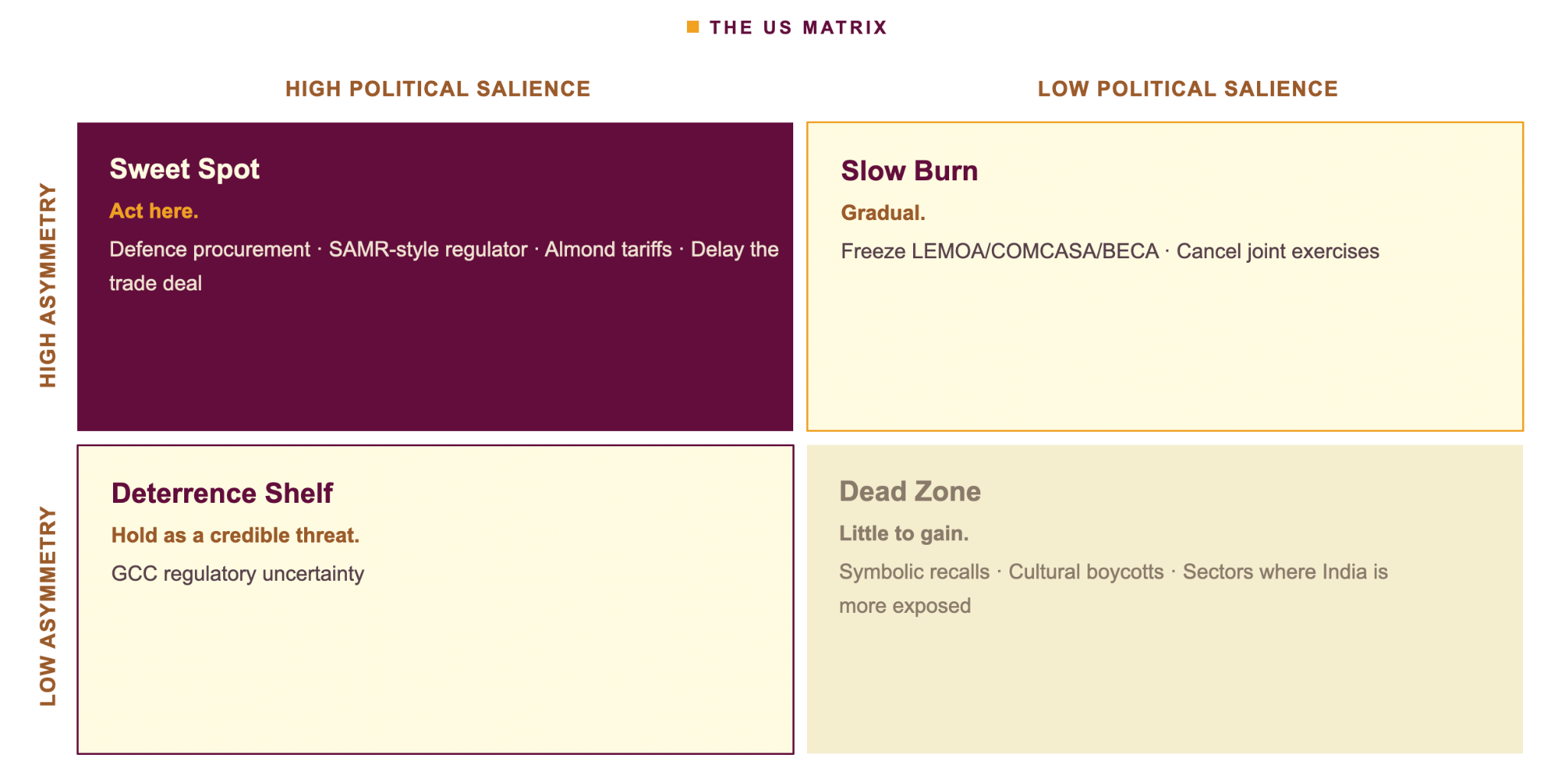 Figure 1: Matrix listing leverage options against the US
New Delhi should act against Washington in areas where there is high asymmetry of vulnerability and high political salience for the US. The quadrant that represents this intersection in the 2x2 matrix illustrated in Figure 1 is the sweet spot. It includes the following leverage options:
Altering defence procurement approach: India is a significant external buyer of military hardware produced by US defence contractors. A 2014 Financial Times report (quoting research from IHS Jane) indicated that India was the biggest buyer of US weapons in 2013, with the number pegged at $1.9 billion.16 A more recent report by Alan K. Kronstadt for the Congressional Research Service (US) states that India’s defence purchases from the US amounted to USD 25 billion in nearly the last two decades. “India is now the largest operator of C-17 Globemaster heavy transport and P-8I Poseidon maritime patrol aircraft outside of the United States,” according to the report.17 Any public announcement by India about finding alternate suppliers for big-ticket (with contracts running into billions of dollars) defence purchases would be costly for the US defence contractors. Given how enmeshed these contractors are in the US polity, with decades of lobbying experience and extensive ties to congressional delegations, they will channelise their grievances to the US Congress/administration, thereby providing one impetus for policy change vis-à-vis India. It helps India’s case that New Delhi has credible alternatives in European and domestic suppliers that can fill in for the US contractors. Another advantage of this leverage option is that it is reversible to some extent, as the hitherto sidelined US defence contractors can be engaged in future procurement cycles.
SAMR-style regulator in India: Taking a leaf out of China’s playbook, India should establish an equivalent of the State Administration for Market Regulation (SAMR) to weaponise market access for exercising leverage over countries hosting the targeted entities. China has used the SAMR instrument to target mergers and acquisitions even in cases when neither of the entities is Chinese but generates revenues from the latter’s market. As one of us (Pranay) has argued in a Takshashila blog post, “SAMR has repeatedly used its merger review process to extract concessions, protect domestic industries, force technology transfers to a third-party Chinese player, or signal political displeasure.”18 This includes blocking Intel’s acquisition of Tower Semiconductor and delaying Broadcom’s acquisition of VMware. Other investigations undertaken by SAMR include Qualcomm - Autotalks, DuPont - Rogers Corp, and Microsoft - Activision. While the per capita income varies, India is also a significant market with potential for future growth for the US companies, especially the Big Tech companies dabbling in e-commerce, social media, payments and cloud. An Indian SAMR-equivalent institution targeting the mergers and acquisitions of US companies will send a calibrated signal to US companies, which can then channelise the same to the US government.
California almond tariffs: According to a report published in the Times of India, India is the biggest buyer of California almonds in the world: “India is the largest export market for California almonds, and in the 2023-24 crop year, shipments to India exceeded 400 million pounds, marking a 21% growth compared to the previous year.”19 An immediate leverage option India has against US transgressions is to place a tariff on California’s almonds, which will likely activate the almond farming lobby. One highlight of this measure is that it is highly reversible, as tariffs can be relatively quickly imposed and withdrawn.
Delay the trade deal: Although the US and India agreed to a framework deal earlier this year, they are yet to sign a proper, comprehensive trade agreement. There are multiple reasons to delay the trade deal. First, the domestic polarisation in the US polity. As one of us (Lokendra) has argued previously in a Moneycontrol opinion piece on the India-US interim trade deal: “An unfavourable mid-term result may strengthen the US Congress’ exercise of powers over taxation and tariffs, likely leading to a reduction of Trump’s leverage in negotiations with India.”20 Further, reaching any agreement with the Trump administration does not prevent Trump from threatening more tariffs. For example, about a year after the US announced a deal with the EU, Trump has threatened 100 per cent tariffs over digital services taxes.21 There is a reason why we have not seen major headlines about a new “massive” trade deal that the US has reached after the US Supreme Court struck down the use of the International Emergency Economic Powers Act (IEEPA), 1977, by the executive for imposing tariffs. Second, any trade deal must ensure that India enjoys a comparative advantage vis-à-vis other countries in the region and beyond that export a similar set of goods to the US (apparel, for instance). In this regard, the statement by India’s commerce minister that there has to be a comparative advantage for the country for any trade deal to fructify is a welcome one.22 With IEEPA ruled out and the usage of other legal tools such as sections 122, 232 and 301 muddied, India should wait for clarity to emerge on the US side before proceeding with a trade deal. But there is also a third reason, and clubbed with effective communication, it can be used to send a signal to Washington that transgressions would be met with a further delay in signing the trade deal and a continuation of the status-quo. The outlawing of IEEPA-based tariffs has meant that the US executive is unlikely to impose discretionary tariffs on a range of countries in the way they did for much of 2025. Because affected countries are no longer trying to outdo each other in a race-to-the-bottom to please the US executive with deal offers, this also reduces the urgency for India to secure a trade deal.
Apart from the sweet spot quadrant, the other three quadrants are slow burn (high asymmetry but low political salience), deterrence shelf (low asymmetry but high political salience) and finally the dead zone (both asymmetry and political salience being low). The slow burn quadrant will include leverage measures such as freezing the implementation of foundational defence agreements that India has with the US, like the Logistics Exchange Memorandum of Agreement (LEMOA), Communications Compatibility and Security Agreement (COMCASA) and Basic Exchange and Cooperation Agreement (BECA). This will also include cancelling joint military exercises between both countries. These actions will affect the force projection capabilities of the US in the Indian Ocean region, but would not generate the political consternation that targeting of stakeholders with strong political lobbying groups would (as discussed above). The deterrence shelf includes targeting of global capability centres that India houses. There are over 2100 GCCs in the country, serving as R&D centres for some of the largest American firms. This is a low asymmetry option, as India is significantly exposed if its actions affect GCC functioning. The introduction of regulatory uncertainty around GCCs, instead of extreme measures, would be sufficient to send a signal to the US companies and their lobbies interfacing with the US government. Finally, the dead zone has measures that India should not take, as they neither have political salience nor high exposure for the US. This includes symbolic recalls of diplomatic staff, cultural boycotts (such as that of Hollywood offerings) and targeting sectors where India is more exposed than the US.
New Delhi’s Leverage Options Against Beijing
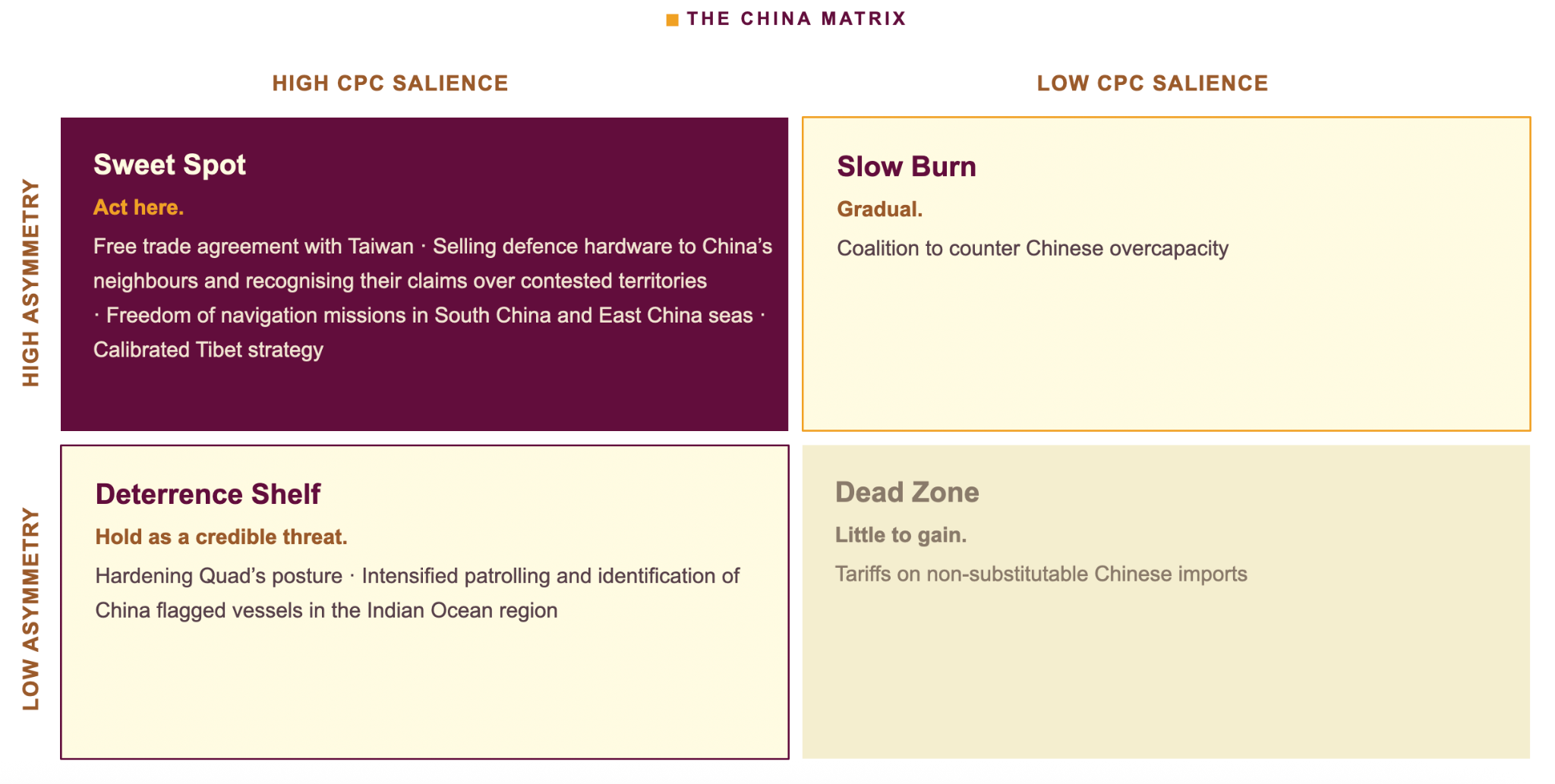
Figure 2: Matrix listing leverage options against China
With respect to Beijing, New Delhi should act in areas where there is high salience for the CPC as well as high asymmetry of vulnerability. As briefly touched on earlier in the document, there are three differences between the US and China that necessitate a different approach vis-à-vis the latter. First is that the US and China operate in different political systems. Second is that India’s relationship with the US is comparatively more interdependent, with two-way economic trade and the presence of GCCs in India. Finally, unlike a distant US, India shares a long border with China, with not infrequent skirmishes. The leverage options in the sweet spot (illustrated in Figure 2) are discussed below:
Upgrading economic relations with Taiwan by signing a free trade agreement: India and Taiwan, buoyed by the momentum of their deepening relationship,23 initiated negotiations for a free trade agreement (FTA) in late 2021. Since then, these efforts have faltered, with the Indian side recently indicating there are no plans for the FTA.24 This is despite the strong growth in imports from Taiwan for electronics, computer hardware and telecom equipment and despite Taiwan’s deputy NSA calling for an FTA in 2025.25 In response to Chinese transgressions, India should upgrade the already mushrooming economic relationship with Taiwan by finalising an FTA. This will send a clear signal to the CPC, a party for which reunification with Taiwan remains a core interest. An economic upgrade of the relationship can also be paired with a political one, with New Delhi sending high-visibility parliamentary delegations to Taiwan (similar to what the US lawmakers have done over the years).26
Selling defence hardware to China’s neighbours and recognising their claims over contested territories: Multiple neighbours of China have a difficult relationship with Beijing owing to contestations over island territories and maritime boundaries in the South China and East China Seas. India’s responses to Chinese transgressions that harm New Delhi’s interests can include ramping up defence hardware sales to China’s neighbours alluded to above and recognition of their claims in the contested areas. India is already selling the supersonic cruise missile BrahMos to the Philippines, Indonesia and Vietnam,27 and even an announcement by New Delhi of selling more defence hardware to China’s neighbours will be a credible signal to Beijing. India formally recognising claims of South Korea, Japan, the Philippines, Indonesia, Vietnam and others in the region over contested areas would have high CPC salience given the significance the party attaches to maritime boundaries.
Freedom of navigation missions in the South China Sea and East China Sea: Both the South China Sea and East China Sea are littered with not just contested areas but also chokepoints. While the Indian Navy’s primary area of operation is in the Indian Ocean region, it has projected force beyond. Over the years, the Indian Navy has regularly undertaken anti-piracy operations off the coast of Africa and West Asia. As the Ministry of Defence website notes: “The Indian Navy commenced anti-piracy patrols in the Gulf of Aden from October 2008 and since then a ship has been deployed continuously.” On the eastern side, India has sent navy missions to Southeast Asia, the South China Sea, the East China Sea and the Western Pacific over the years.28 The recent maritime security pact with Japan is set to further strengthen India’s presence in the East China Sea.29 India formally “supports freedom of navigation and over flight, and unimpeded commerce, based on the principles of international law, as reflected notably in the UNCLOS.”30 As part of the Quad grouping with Australia, Japan and the US, India has consistently supported the idea of a free and open Indo-Pacific. Building on these declaratory statements, experience of operating in the seas surrounding China and engagements with navies from Vietnam, the Philippines and Japan (among others), India should undertake freedom of navigation missions in the South and East China Seas as a leverage option against Chinese transgressions.
Calibrated Tibet strategy: India has hosted the 14th Dalai Lama since 1959.31 The country also houses a significant number of Tibetan refugees in addition to hosting the Central Tibetan Administration (the Tibetan government-in-exile). Tibet and the question of the Dalai Lama succession are a core concern for the CPC. Depending on the severity of the Chinese transgression, the Indian government should calibrate its Tibet strategy. This includes allowing visible public processions by Tibetan refugees, visits by senior Indian political functionaries to events organised by the Tibetan refugees, and facilitating the travel of the 14th Dalai Lama to Arunachal Pradesh. For severe transgressions, India can formally declare that China has no locus standi in selecting the next Dalai Lama and that only the Tibetan people have the right to decide the succession.
Like in the US case, there are three other quadrants that present more leverage options with varying degrees of effectiveness. In the slow burn quadrant (high asymmetry but low CPC salience) lies the option of India working with partners in Europe and the Americas to build a coalition to counter China’s industrial overcapacity, which is a case of an international market failure.32 The deterrence shelf (low asymmetry but high CPC political salience) includes: first, pushing for hardening of Quad’s posture vis-à-vis China by explicitly identifying the latter as a concern and also giving the alliance a formal structure; second, intensified navy patrolling using mainland and island bases in the Indian Ocean region with the objective of identifying and giving visibility to the movement of China flagged vessels in the region for sending a signal to Beijing about their vulnerability. The dead zone (both asymmetry and CPC salience being low) includes tariffs on non-substitutable Chinese exports to India, such as active pharmaceutical ingredients and other intermediate goods used by Indian industries.
Conclusion
India has had to deal with multiple transgressions by both the US and China in the past few years, placing into question the core beliefs that defined much of India’s foreign policy for the last two decades. While this has forced the Indian strategic community to re-assess approaches to either major power (especially the US), responses offered have ranged from managing the volatility, re-calibrating the relationships and building geopolitical backstops. The idea that India lacks the necessary wherewithal to respond to the machinations of Washington and Beijing, given the former’s dependence on the latter two for markets, investment, intermediate goods, etc., has been prevalent. Conversely, this has meant that solutions offered have presumed that New Delhi would have leverage against the major powers at some point in the future when India itself has grown stronger.
In this paper, we have argued that while India will have more leverage against either China or the US in the future, it also has some leverage options today. No state, irrespective of its size or economy, is fully devoid of any leverage at any given moment. India retains the ability to impose costs on both the US and China. This is the sweet spot quadrant in a 2x2 matrix where high asymmetry of vulnerability intersects with high political salience in the case of the US and high CPC salience in the case of China. Against the US, leverage options that can be exercised today include redirecting defence procurement, establishment of a SAMR-style regulator, imposition of almond tariffs, and delaying the trade deal. For China, leverage options are signing an FTA with Taiwan, selling defence hardware to China’s neighbours in addition to recognising their claims over contested areas, freedom of navigation missions in the seas around China, and finally a calibrated Tibet strategy depending on the severity of Chinese transgressions.
It is not our argument that any of these are good options in that they would not carry any consequences for India. All of them are bad options in normal times. But given the difficult moment India finds itself in from a geopolitical point of view, the leverage options we suggest can potentially work today in influencing the behaviour of the major powers. India should double down on the long-term path of ensuring economic and technological prosperity for its people in addition to building military strengths. But when faced with transgressions, it should not wait for a future moment of strength to respond when leverage options can be exercised today.
Footnotes
Sharma, Sukalp. “Tunnel boring machines: Machines for India delayed, German firm flags bottleneck at Chinese customs.” Indian Express, November 2, 2024. Link.↩︎
Cheng, Selina, and Viola Zhou. “Foxconn stops sending Chinese workers to India iPhone factories.” Rest of World, January 10, 2025. Link.↩︎
“Dragon fire extinguished! How India has successfully countered China’s fertilizer export blocks; seen as ‘supply chain weaponisation…’” Times of India, July 21, 2025. Link.↩︎
Prasad, Ashwin, and Satya S. Sahu. “Understanding US’ New Framework for AI Diffusion.” Technopolitik, 0x0E, January 16, 2025. Link.↩︎
Singh, Araudra. “India’s green shift is still made in China.” Frontline, July 8, 2025. Link.↩︎
Singh, Gurvinder. “How rare earth shortages are stalling India’s burgeoning EV sector.” Al Jazeera, August 28, 2025. Link.↩︎
“Secretary Rubio’s Call with Indian External Affairs Minister Jaishankar.” US Department of State. June 13, 2026. Link.↩︎
Priya, Priyanshu. “‘It’s a rough profession’: Trump responds to question over Indian sailors’ death in US attack.” Hindustan Times, June 18, 2026. Link.↩︎
“Anthropic Mythos AI expands to India: Which entities gained access? What we know.” Mint, June 7, 2026. Link.↩︎
“Statement on the US government directive to suspend access to Fable 5 and Mythos 5.” Anthropic, June 12, 2026. Link.↩︎
“Trump Imposes Fresh 10% US Tariff On India In New Trade Move.” NDTV, July 24, 2026. Link.↩︎
Hubbard, Kaia. “Sen. Blumenthal urges House to pass Russia sanctions bill amid a”moment of extreme urgency” in Ukraine.” CBS News, August 30, 2026. Link.↩︎
Sharma, Lokendra, Abhishek Kadiyala, Arindam Goswami, Ashwin Prasad Rao, and Nitin Pai. “India Must Architect Sectoral Plurilateral Blocs to Overcome Geopolitical Coercion.” The Takshashila Institution (Policy Brief), January 25, 2026. Link.↩︎
Schelling, Thomas C. Arms and Influence. Yale University Press, 1966.↩︎
Plimmer, Gill, and Victor Mallet. “India becomes biggest foreign buyer of US weapons.” Financial Times, February 24, 2014. Link.↩︎
Kronstadt, K. Alan. “India-U.S.: Major Arms Transfers and Military Exercises.” Congressional Research Service, March 10, 2026. Link.↩︎
Kotasthane, Pranay. “China Doubles Down on Weaponising Antitrust Regulations: Another Case of China’s Unfair Play.” The Takshashila Institution (Blog), November 3, 2025. Link.↩︎
“California almond exports to India soar 21% to reach record 400 million pounds, says senior ABC official.” Times of India, March 24, 2025. Link.↩︎
Sharma, Lokendra. “Why India should re-negotiate the interim trade deal with the US.” Moneycontrol, February 24, 2026. Link.↩︎
Velasquez, Francisco, and Kali Hays. “Trump threatens 100% tariff on European nations over tech tax.” BBC, June 27, 2026, Link.↩︎
Chatterjee, Adrija. “US trade deal to kick in the day India gets tariff edge over competitors: Goyal.” Moneycontrol, June 25, 2026. Link.↩︎
Mukhopadhyay, Abhijit. “India–Taiwan FTA in the making.” ORF, May 30, 2022. Link.↩︎
Chatterjee, Adrija. “The next chapter in India’s China-plus-one story may be Taiwan.” Moneycontrol, August 14, 2026. Link.↩︎
“Taiwan can help India reduce trade deficit with China: Taiwanese Deputy NSA.” The Hindu, March 20, 2025. Link.↩︎
Mistreanu, Simina, and Taijing Wu. “US lawmakers express support for stalled Taiwan special defense budget.” AP, March 31, 2026. Link.↩︎
Strangio, Sebastian. “India Has Signed BrahMos Missile Deal With Vietnam, Indian Minister Says.” The Diplomat, June 1, 2026. Link.↩︎
“Indian Naval Ships Delhi, Shakti, and Kiltan Completed their Visit to Manila, Philippines as a part of the Operational Deployment of the Eastern Fleet to the South China Sea.” Indian Navy, n.d. Link; Vinh, Vo Xuan, Tran Xuan Hiep, and Vo Minh Hung. “India’s Engagement in the South China Sea.” Maritime Affairs: Journal of the National Maritime Foundation of India 17, no. 2 (2021): 64-77. Link; Peri, Dinakar. “Indian Naval Ships Complete Deployment to South China Sea.” The Hindu, May 26, 2024. Link; “Eastern Fleet Ships on Overseas Operational Deployment.” Indian Navy, n.d. Link.↩︎
“India, Japan sign maritime security pact to deepen defence cooperation.” The New Indian Express, August 20, 2026. Link.↩︎
“Question No. 4832 Indian Trade Through South China Sea.” MEA, April 1, 2022. Link.↩︎
“US thanks India for principled generosity in hosting Dalai Lama.” Times of India, December 14, 2019. Link.↩︎
Kotasthane, Pranay. “#302 A Fine Imbalance.” Anticipating the Unintended, June 1, 2025. Link.↩︎