India’s Airborne Ambitions
| AUTHOR | Adya Madhavan |
| DATE | October 28, 2026 |
| CATEGORIES | National Interest Emerging Technologies Advanced Military Technologies Defence Innovation Military R&D Defence |
The author would like to disclose the use of AI for formatting citations and sidenotes.
1. Introduction
The last decade has seen a major surge in the use of drones or unmanned aerial vehicles, both for commercial and military purposes. With each war, new platforms are being battle-tested, while in parallel, drones are also being used extensively in other areas—ranging from commercial videography to agriculture. Innovations in commercial applications can often carry over into the defence-drone industry. For India, these realities became evident in 2025. Prior to Operation Sindoor, Indian planners looked at Nagorno-Karabakh and the Russia-Ukraine war. During Operation Sindoor both sides used drones extensively, consequently revealing operational gaps. Since the clashes of May 2025 and subsequent wars in West Asia, there has been a sustained push to procure more drones for the Indian armed forces.
Although it may have been catalysed by last year’s events, several domestic and external factors are shifting India’s defence drone landscape toward greater reliance on domestic manufacturers and away from import dependence. India’s civilian drone market was valued at about $1.2 billion in 2025 and is projected to reach about $2.4 billion by 2034, growing roughly 7.4% a year. Estimates vary widely: TechSci Research puts the 2025 market at about $880 million. This paper aims to understand why the Indian defence drone market is turning to domestic players, map what each manufactures and who they sell to, and finally understand the ecosystem’s challenges.
2. The Drone Push
There have been four factors over the last several years that have been largely responsible for the push towards drones, and towards their indigenous manufacturing.
The first transformation came with the 2021 Drone Rules, which declared as much as 90% of Indian airspace as ‘green zones’—allowing flights up to 400 feet without permission. The rules also allowed this as being applicable to any aircraft weighing up to 500 kg, and streamlined the issuing of Remote Pilot Certificates, thereby enabling drone pilots to skip the usual lengthier procedure.1 The following year, the Directorate General of Foreign Trade almost completely banned foreign drone imports (albeit with an exemption for defence).2 This forced domestic firms to step in and try to meet the burgeoning demand, which had been set off by the new Drone Rules. Although this surge in demand existed in the commercial drone industry, technological advancements on this front are generally beneficial for defence innovation as well. Concurrently, a ₹120 crore Production Linked Incentive (PLI) and a relatively low GST rate on drones further benefited drone companies.3
On the demand side pertaining to military drones specifically, several factors over the last eighteen months have further prodded the armed forces to actively focus on domestic drone procurement. The most obvious change came after Operation Sindoor, which was the first time drones were widely used in a confrontation between India and Pakistan. The immediate result of Operation Sindoor, was a reported ₹20,000 crore Fast Track Procurement Package for drones, for which discussions are ongoing. This package sits on top of the approximately ₹5,000 crore post-Sindoor emergency procurement orders.4
These financial commitments were followed by other policy changes that helped institutionalise these requirements. The draft Defence Acquisition Procedure 2026 (DAP), published in February and not yet finalised includes several provisions designed to help streamline domestic drone acquisitions.5 Some of its major provisions include institutionalising civil-military fusion for the production of drone swarms, and allowing the armed forces to purchase commercial off-the-shelf (COTS) platforms to help them capitalise on the innovations in the civilian drone sector. The DAP also classifies the production of domestic drone engines on par with aero and marine engines, indicating the level of the government’s interest in indigenous drone technology.
Finally, the Delegation of Financial Powers to Defence Services (DFPDS) that was released by the Ministry of Defence earlier this year helps decentralise procurement.6 One of the major issues with India’s procurement architecture is the length of bureaucratic timelines, and the DFPDS attempts to mitigate that. It allows more than a dozen command headquarters to buy runway-independent drones that cost under ₹5 crore straight from revenue budgets, instead of going through the much slower capital acquisition process.
In part due to these various factors, today, India’s defence drone ecosystem is picking up momentum. This has resulted in significant demand from the armed forces for domestically manufactured platforms and components.
This large industry is stratified into several different layers. The first tier consists of several Public Sector Undertakings (PSUs) that traditionally dominated India’s defence market. Today, they do not function as ‘companies’ selling in the marketplace, but are heavily involved in collaborative R&D processes. Then, there are the large companies that are now entering the drone industry to expand their business—such as Bharat Forge and Adani Defence. Many of these companies are offshoots themselves from large groups, and have various ventures across sectors. Additionally, there are larger, listed drone or defence-electronics companies such as IdeaForge that capture a sizeable chunk of the market share. Finally, there are defence companies specialising in drones that are often venture-backed—such as NewSpace Research and Dhaksha Unmanned Systems.
3. Major Players
3.1 State-Owned Companies
Hindustan Aeronautics Limited (HAL): Bengaluru
HAL is India’s state-owned aerospace major. It is developing the CATS Warrior, an unmanned ‘loyal wingman’ platform designed to fly alongside manned fighters, and ALFA-S, an air-launched swarm concept. HAL also helps pair its own subsidiary companies with startups in the drone ecosystem. For instance, its subsidiary Naini Aerospace works with Garuda Aerospace to scale up the manufacturing of advanced precision drones. Additionally, HAL is the industrial partner for NewSpace Research’s stratospheric surveillance drone programme.
Bharat Electronics Limited (BEL): Bengaluru
BEL is the electronics counterpart to HAL, and has historically been the supplier of choice for components such as radars and sensors. Its flagship platform is the** **D4 system (‘Detect, Deter, Destroy’), a counter-UAS platform built with technology transferred from the Defence Research and Development Organisation (DRDO). BEL’s customers are exclusively the Indian armed forces and paramilitary.7
DRDO: Bengaluru
The DRDO isn’t a commercial company, but it sets the technical agenda other companies eventually execute. Its Aeronautical Development Establishment runs the Rustom, TAPAS, Archer-NG, and Ghatak (a stealth combat drone) programmes. It also runs a separate lab which is building a jet engine for Ghatak, targeted for certification later this year. Platforms designed here get handed to HAL, BEL, or private manufacturers for production rather than being sold directly.
3.2 Large Conglomerates
Adani Defence & Aerospace / Adani Elbit Advanced Systems India Ltd: Hyderabad
Adani’s drone production is actually split into two separate programmes, run out of the same Hyderabad facility.8
On the domestic front, Adani Defence & Aerospace builds the Drishti-10 Starliner, which is an Indian version of Israel’s Elbit Hermes 900. Although on paper the Drishti-10 has impressive specifications (36-hour endurance, radar and infrared sensors, with approximately 60-70% Indian-made components), its performance till date has led to some concerns. Both Navy airframes delivered so far crashed, while the Army’s unit reportedly faced persistent satellite-link problems. The Navy’s plan to induct ten units was paused until a pending investigation resolves some of these issues.
The export side** **is a related but different entity. Adani Elbit Advanced Systems India Ltd (AEASIL) is a joint venture in which Elbit holds 49% and runs the only Hermes 900 production line outside Israel.9 Multiple independent sources, corroborated by separate reporting from The Wire and the Business & Human Rights Centre, have documented AEASIL exporting more than 20 India-made Hermes 900 units to Israel between 2019 and 2023.10 This has drawn scrutiny because Hermes 900s have been used extensively by Israel, including in Gaza. The export line has, therefore, been cited in commentary questioning India’s positioning on Israel-related UN votes. Neither government has formally confirmed the exports.
The Drishti-10 Starliner is an advanced Medium-Altitude Long-Endurance (MALE) unmanned aerial vehicle. It is designed for ISR missions; it serves the Indian Armed Forces in bolstering maritime and border security. Its NATO STANAG 4671 airworthiness certification also allows it to operate in both civilian and military airspace.
Bharat Forge / Kalyani Strategic Systems: Pune
Bharat Forge is a large, global forgings and auto-components company that manufactures across five countries including India. It has successfully built a defence-drone business, essentially from scratch, over the last few years. Its line-up includes the Omega One, Omega Nine, Bayonet, Cleaver, and the earlier Bharat 150 platforms. These span both surveillance drones and loitering munitions. The company won roughly ₹300 crore in Army and Navy contracts in January 2026, and showcased its Omega One munition mounted on an upgraded infantry vehicle at that year’s Army Day parade.11 Although there haven’t been any confirmed drone exports yet, Bharat Forge already exports other defence products like artillery systems.
JSW Defence: Hyderabad (joint venture with Shield AI, USA)
JSW’s entry into drones is unusual, and has not followed the usual path of a defence company that diversifies into drones for domestic use. Instead, a US$ 90 million joint venture with the American company Shield AI and JSW Defence was announced in late 2024 to manufacture the V-BAT at a facility in Hyderabad.1213 The V-BAT is a vertical-takeoff drone that flies using Shield AI’s Hivemind autonomy software.14 From the get-go, JSW Defence’s drone production was targeted at exports, and not just at being a domestic supplier. The Indian Army has already inducted V-BATs even before full local production is up and running. Today, JSW is uniquely placed as an Indian company positioned to re-export a US-designed, US-software platform, and is doing reasonably well domestically despite the push to procure more indigenously designed platforms.
Solar Industries India / Solar Defence & Aerospace: Nagpur
Solar Industries is primarily a large, profitable industrial-explosives company that diversified into defence back in 2010. Owing to the capital it acquired from its explosives production, it has relatively deeper pockets than most drone startups, which it invests in R&D. Its main product is the Nagastra-1, which is touted as India’s first indigenously designed loitering munition. The Nagastra is a small, GPS-guided drone that can loiter over a target and either strike or parachute back down for reuse if the strike mission is aborted. It is designed to be used alongside the larger Rudrastra VTOL (Vertical Take-Off and Landing) strike drone. The Indian Army has ordered close to 1,000 Nagastra units across two tranches, beating out Israeli and Polish competitors on the second tranche.15 Solar Industries has also secured a ₹2,039 crore defence export contract in late 2024, which is one of the largest export contracts secured by an Indian drone company.16 However, the details are unclear and it is not known at this time if the order was specific to the Nagastra platform.
3.3 Listed Drone Companies
Zen Technologies: Hyderabad
Zen started out making combat-training simulators and has pivoted into counter-drone technology over the last two years.19 It designs systems that are adept at detecting, jamming, and physically shooting down hostile drones. Its product range now spans an anti-drone system—a version built for high-altitude mountain warfare—and a kinetic interceptor drone capable of physically destroying targets. Additionally, they have announced more recently that they are also developing a directed-energy weapon. The company has been winning MoD contracts at a steady pace, and there seems to be an upward trend in its financials. Zen is also a confirmed exporter, having sold anti-drone systems to Armenia, and is reportedly working toward validation in the US market.
The anti-drone system is an integrated defence network, while the kinetic interceptor drone is a specialised weapon that is a component of it.
Zen’s anti-drone system functions as an overall platform that uses 3D radar, RF sensors, and cameras to detect, track, and neutralise targets using soft-kill electronic jamming and GPS spoofing. In contrast, the kinetic interceptor drone provides hard-kill physical destruction.
3.4 Venture-Funded Companies
Raphe mPhibr: Noida
Raphe mPhibr is arguably one of the best-funded drone startups in India. Its primary selling point lies in vertical integration. Raphe builds its own flight controllers, motors, composites, and autopilot systems in-house, with reportedly zero reliance on Chinese components. It raised US$100 million in June last year.22 That was the largest such round for an unlisted Indian defence manufacturer, shortly after its swarm drones were reportedly deployed during Operation Sindoor. It also makes the mR20, a heavy-lift logistics drone built to resupply high-altitude military outposts that are situated above 15,000 feet, making it useful for the high-altitude bases of the Indian Army. Its customer base is the government and defence only, with no civilian product line. While it has technology partnerships with major European defence firms (including Dassault, Hensoldt and Safran), these seem to be more like collaboration deals rather than export orders.
NewSpace Research & Technologies: Bengaluru
Compared to many other drone companies, Bangalore-based NewSpace works at the more experimental end of the industry. One of its most striking projects is a solar-powered drone designed to stay aloft for months at a time, providing satellite-like surveillance without the cost of actually building and deploying a satellite. Called the High Altitude Pseudo Satellite (HAPS), it is built to operate in the stratosphere. They have also developed the Medium Altitude Persistent Surveillance System (MAPSS), which is a lower-flying platform that can be utilised by the army. The Indian Army has placed a ₹168 crore order for the MAPSS.23 NewSpace is also building an AI-driven drone swarm system and an autonomous ‘loyal wingman’ platform meant to fly alongside manned fighter jets. Its funding blends venture capital with government innovation grants.
Big Bang Boom Solutions: Chennai
Big Bang Boom is a Chennai-based counter-drone specialist whose flagship product is a platform called the Vajra Sentinel System. The Vajra Sentinel was reportedly used to protect Indian Air Force assets during Operation Sindoor. In 2024, the company signed a ₹200 crore order for counter drones systems with the Indian Army and Indian Air Force under the iDEX scheme. This is reportedly one of the biggest iDEX investments in a drone company so far.24 The procurement of the Big Bang Boom systems was accelerated after their performance during Operation Sindoor .25
The Vajra Sentinel is an AI-powered, integrated counter-unmanned aerial system (C-UAS). It operates as a multi-layered, sensor-to-shooter counter-drone ecosystem, which offers both electronic warfare and hard-kill kinetic interception capabilities.
Sagar Defence Engineering: Pune
Sagar Defence Engineering is a startup that works in the maritime domain, and produces unmanned surface vessels and underwater vehicles that are developed closely with the DRDO. Its products are currently under Indian Navy evaluation. According to Sagar’s website, they have delivered an order to the Indian Navy, but further details are unavailable.26 Sagar has raised about $49 million to date, including a $25.4 million Series A in December 2024 .2728
Dhaksha Unmanned Systems: Chennai (subsidiary of Coromandel International)
Dhaksha is a subsidiary of the fertiliser and agri-inputs company Coromandel International. Its foray into the drone market also genuinely straddles both defence and agriculture rather than picking one. In terms of its production, it holds government certification for both categories. One of its more unusual products is a hybrid petrol-electric drone that trades some of the simplicity of an all-electric design for longer range and endurance. It landed a combined ₹165 crore order that was announced in August 2023—split between logistics drones for the Army, and spraying drones for the farm cooperative IFFCO.2930 It is worth noting that the Army portion was reportedly paused for an audit over concerns about Chinese-made components.31
Garuda Aerospace: Chennai
Garuda started as an agricultural drone company, and has since ventured into defence. Even today, it still holds sway over approximately 30% of India’s agri-drone market. Recently, Garuda opened up a dedicated facility in Chennai that has been set up to focus on defence.32 It is reportedly currently planning an IPO that is said to be upwards of ₹1,000 crore.33 Its defence products so far include a border-patrol drone and a manufacturing tie-up with HAL’s drone subsidiary, plus a partnership with Airbus Helicopters for a more advanced tactical platform.34 Additionally, Garuda’s international relationships to date are technology partnerships bringing capability into India, rather than confirmed export sales going out.
Indrajaal / Grene Robotics / Sigma Advanced Systems: Hyderabad
A company called Grene Robotics built Indrajaal, an AI-powered drone-defence system designed to protect large areas against a range of threats. The Indrajaal system has been acquired through a ₹100 crore order and is likely to be deployed at naval ports, as well as at bases on the Eastern border by the Indian army.35 Indrajaal has since grown into something close to its own company, known by the name of the product. Its newest platform is a mobile anti-drone patrol vehicle called the Indrajaal Ranger, which is being built and commercialised in partnership with a separately listed company called Sigma Advanced Systems.36 That partnership recently landed the Ranger about ₹155 crore in government orders, mostly from the Ministry of Home Affairs for border security, with a smaller order for VVIP convoy protection.37 No confirmed exports are reported as of now for either the original dome system, or the newer Ranger.
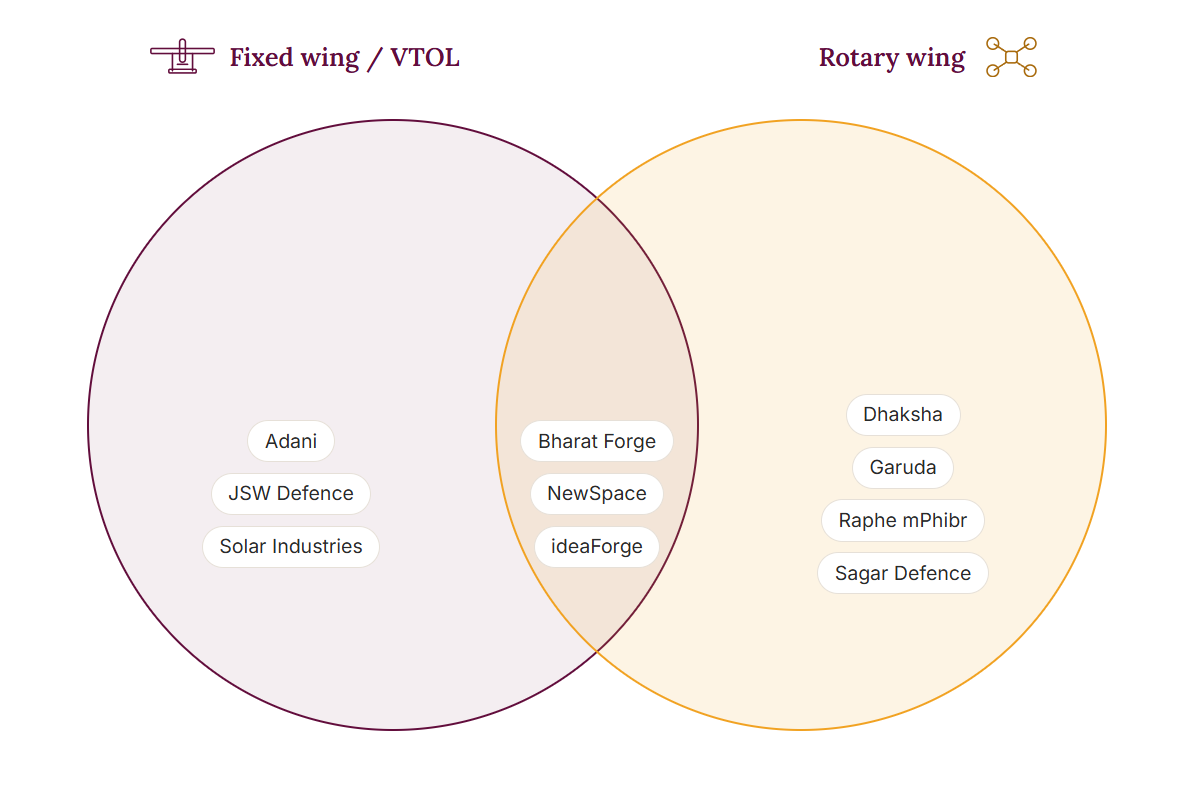
Most of these companies specialise in either rotary-wing drones, fixed-wing drones, or VTOL drones. Fixed-wing drones are platforms that are closer in design to traditional aeroplanes and have rigid wings. Due to their structure, fixed-wing drones typically need a runway or catapult launcher to take off, while some smaller platforms need to be hand launched. Their structure allows them to fly at high speeds and high altitudes, and loiter for extended periods.These are typically used for long-range surveillance, loitering munitions or persistent high-altitude monitoring.
In contrast, rotary-wing drones are generally powered by multiple rotating blades, and require no infrastructure for take-off or landing. Owing to their more compact design, they are suitable for high manoeuvrability in tight spaces or urban environments. They can be used to drop smaller explosive payloads, supply cargo to isolated or high-altitude military bases, and conduct short-range surveillance.
Vertical Take-Off and Landing (VTOL) drones are a hybrid between fixed and rotary-wing platforms. They feature propellers for lift, which eliminates the need for runways, and have a fixed-wing body. They are useful for missions which require a platform with longer range and endurance, but do not have the infrastructure to launch a traditional fixed-wing drone.
The chart below shows the distribution of companies in terms of what they produce.
4. Major Investments and Orders
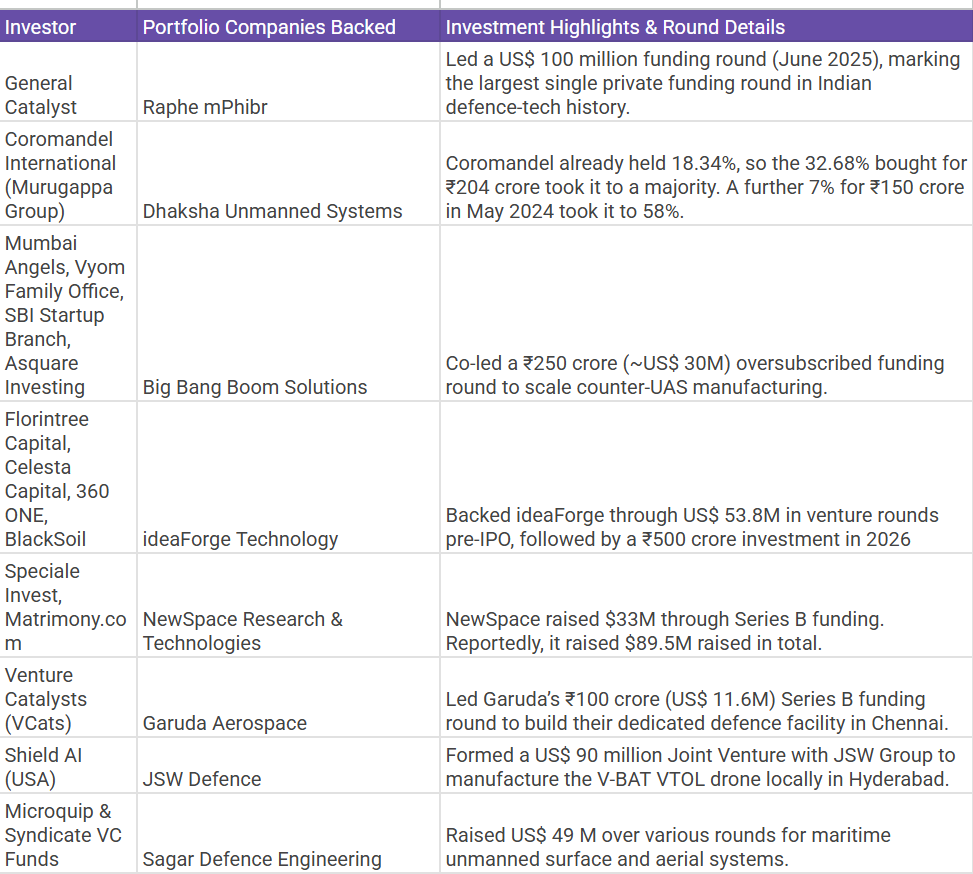
Alongside government procurement as detailed in the previous section, a lot of the investment in India’s drone sector comes from private players. This includes both large global VC firms such as General Catalyst, which led the US$ 100 million Raphe round, as well as Indian firms such as the Murugappa Group that invested in Dhaksha.
Licensed production and foreign alliances, such as JSW’s US$ 90 million joint venture with Shield AI, are another means through which foreign players are directly funding domestic production capacity. The table below shows some of the biggest investments in Indian defence drone companies.
5. Challenges
Although India’s defence drone market has shown an upward trend lately—with more startups and institutional provisions to enable them—several challenges still remain. These hurdles fall broadly into three categories: there are financial hurdles; the issue of indigenisation; and finally, structural problems that pertain to infrastructure and procurement architecture.
The first dilemma that is arguably the hardest to tackle lies in the fact that ‘indigenisation’ often ends up meaning assembly, and not sovereign design and domestic manufacturing of components. Platforms are assessed on their percentage of indigenous content but often depend on imported flight controllers, batteries and firmware. While there are some manufacturers who focus on individual components such as Astra Microwave Products (radar) and Tonbo Imaging (camera payloads and precision-guidance sensors), by and large India doesn’t manufacture components at enough scale to be completely self-sufficient yet. What further compounds this issue is that many components are of Chinese origin. China has built manufacturing depth when it comes to several components. Given the security challenges that come with using components from China for functions such as communications and navigation, it is imperative to ensure that there are adequate measures taken to prevent this.
In terms of financial challenges, while the government has taken steps to incentivise innovation and domestic drone production, there seems to be a general sentiment that there is not enough investment in R&D to enable Indian companies to transition away from assembly and towards manufacturing. In addition to this, the timeline between initial trials and final contracts tends to span as much as 18 to 36 months. This is an expensive proposition for manufacturers who are forced to fund prototype fleets, maintenance and future iterations without any guarantee of an eventual order.
Last but not least, there are the challenges with procurement and infrastructure. The biggest issue herein is that India’s procurement architecture is largely tailored to acquiring larger platforms. These platforms tend to have longer lifespans, which means the lengthy acquisition process doesn’t impede their ability to be current and competitive as much as it does with drones. The issue with drones is that they have a much shorter shelf life, and thus frequently require updates and modifications. Procurement processes struggle to keep pace, and additionally, typically involve one-off-purchases. While there have been steps taken in the right direction, for drone procurement a longer, iterative process needs to be established, with provisions for continued engagement that enables updates and modifications.
When it comes to infrastructure, the biggest challenge is access to testing facilities since unmanned platforms require significant amounts of flight testing. Given the limited number of testing facilities, long wait times, and bureaucratic hurdles, testing and certification also ends up being a long, drawn-out process.
6. Conclusion
While Operation Sindoor is widely acknowledged as the driver of change when it comes to India’s drone industry, the challenge now lies in whether this will materialise in terms of institutional change that supports this burgeoning industry. The draft DAP 2026 and DFPDS are steps in the right direction, and are likely to result in further changes that help streamline acquisitions for the armed forces, while also enabling the industry to evolve and manufacture critical components in-house.
While only a handful of Indian firms are exporting drones currently, the domestic push also enables India to capture the international market. The geopolitical churn across the world today means that many defence partnerships are in flux, and arguably, the opportunity is ripe for
India to emerge as a player in the drone industry. The other major drone manufacturers come with their own costs that leave buyers looking for alternatives. Chinese platforms come with data-security risks, American platforms generally come with high unit costs and Israel’s capacity is constrained by its own active conflicts, as well as the ideological issues that countries may have with buying from it. India should be able to produce platforms that are competitive and capitalise on this geopolitical vacuum in the market.
There is clearly momentum that exists today, which seems to be pushing both the armed forces and industry to focus on domestic drone production. Hopefully, the coming months and years will see this translate into a more robust and developed industry.
Footnotes
Bhardwaj, Prachi. 2021. “Regularisation of Provisions of Unmanned Aircraft System Vide Drone Rules, 2021.” SCC Times. August 27. Link↩︎
PTI. 2022. “Indian Govt Bans Import of Drones, Provides Certain Exceptions.” The News Minute. February 10. Link↩︎
Bhumika Indulia. 2021. “Government Approves PLI Scheme for Drones and Drone Components.” SCC Times. September 17. Link↩︎
Indian Defence News. 2025. “Army Orders ₹5,000 Crore Indigenous Drones Post Operation Sindoor Success.” Indian Defence News. December 15. Link↩︎
IMPRI Desk. 2026. “Defence Acquisition Procedure 2026: Reforming India’s Defence Procurement And The Role Of Acquisition.” IMPRI Impact and Policy Research Institute. September 22. Link↩︎
ANI. 2026. “Defence Minister Rajnath Singh Releases DFPDS-2026, Giving Armed Forces over Rs 1.25 Lakh Crore Buying Power.” ANI News. June 4. Link↩︎
Groww Team. 2024. “Best Drone Stocks in India 2026.” Groww. March 5. Link↩︎
“Adani-Elbit JV Further Steps up Their Presence in the International Markets; after the Successful Export of Hermes900, Expanding to Export Mini UAV Systems.” 2026. Adani. adanidefence.com. Accessed September 22. Link .↩︎
Business. 2025. “India: Report Alleges Adani-Elbit Advanced Systems India Ltd. & Munitions India Ltd. Were Authorised to Continue to Send Arms Products to Israel amid Continued War on Gaza - Business & Human Rights Resource Centre.” Business & Human Rights Resource Centre. Link↩︎
Mathews, Neelam. 2024. “India Sends Newly Assembled MALE UAVs to Israel.” ShephardNews. Shephard Media. February 2. Link↩︎
Press Trust of India. 2026. “Bharat Forge Secures Drone Supply Orders for Armed Forces Worth ₹300 Crore .” Business Standard. January 16. Link↩︎
Manuel, Rojoef. 2025. “India’s JSW Breaks Ground on $90M Shield AI V-BAT Factory in Hyderabad.” The Defense Post. December 3. Link↩︎
Chakraborty, Debdutta. 2026. “Indian Army Ties up with US Drone Company That Made Its Name in the Ukraine Conflict.” ThePrint. theprint. January 28. Link↩︎
Clark, Colin. 2024. “US Drone Maker Shield AI Moves into Indian Defense Market, Joint Venture with JSW Group.” Breaking Defense. November 27. Link↩︎
ANI. 2025. “Indian Army Places Order of 450 NAGASTRA-1R Loitering Munitions from SDAL.” Bsindia. Business Standard. June 23. Link↩︎
ANI. 2025. “Indian Army Places Order of 450 NAGASTRA-1R Loitering Munitions from SDAL.” Bsindia. Business Standard. June 23. Link↩︎
“ideaForge.” 2026. Ideaforgetech.Com. Accessed October 29. Link↩︎
Private Limited, Mittal Analytics. 2026. “Ideaforge Technology Ltd Share Price | About Ideaforge Tech | Key Insights - Screener.” Screener.In. October 26. Link↩︎
Groww Team. 2024a. “Best Drone Stocks in India 2026.” Groww. March 5a. Link↩︎
Iyer, Ananya. 2026. “Paras Defence FY26 Profit Jumps 52% To Rs 89.46 Cr; Recommends Rs 1 Dividend.” Whalesbook. WhalesbookCorporateNews. August 18. Link↩︎
“Multibagg AI.” 2026. Multibagg.Ai. Multibagg AI. July 10. Link↩︎
Singh, Jagmeet. 2025. “Indian Drone Startup Raphe mPhibr Raises $100M as Military UAV Demand Soars.” TechCrunch. June 26. Link↩︎
Philip, Snehesh Alex. 2026. “India’s Defence Sky Gets a Solar Boost: Army Orders iDEX Solar-Electric Drone.” ThePrint. theprint. January 8. Link↩︎
The Hindu Bureau. 2024. “Defence Ministry Signs ₹200 Crore Contract for Anti-Drone Systems under iDEX Initiative.” The Hindu. March 11. Link↩︎
PTI. 2025. “Big Bang Boom Solutions Accelerates Deployment of the Indigenous Vajra Sentinel System to the Indian Air Force in Response to Operation Sindoor.” The Wire. May 20. Link↩︎
Babbar, Mridul. 2017. “Sagar Defence Successfully Delivers Its Maiden UAV Order to the Indian Navy – Sagar Defence Engineering | Unmanned Systems.” Sagardefence.Com. May 16. Link↩︎
Buch, Himadri. 2026. “Sagar Defence Engineering Said to Explore Public Listing.” The Economic Times. Economic Times. June 5. Link↩︎
Shreyas. 2026. “Top 10 Defense Robotics Companies to Watch: 2026 Indian Investment Leaders.” Inkwood Research. January 29. Link↩︎
“CIL - Dhaksha Unmanned Systems Bags Rs 165 Crores for Defence and Agri Drones - Dhaksha.” 2024. Dhaksha. January 11. Link↩︎
Coromandel International Limited. 2023. “Coromandel International’s Subsidiary Dhaksha Unmanned Systems Bags Rs. 165 Crores Order for Defence and Agri Drones.” Press release. Link↩︎
Mitra, Shubha. 2024. “Army Halts Dhaksha Drone Contract Amid Chinese Components Concerns.” Electronics For You BUSINESS. September 2. Link↩︎
“Garuda Aerospace Inaugurates Defence Drone Facility in Chennai,” Machinist, August 2025,Link.↩︎
“Garuda Aerospace IPO: Company Files DRHP Confidentially.” 2026. Kotak Neo. April 7. Link↩︎
Butterworth-Hayes, Philip. 2026. “Indian MoD ‘Awards Indrajaal a USD10 Million C-UAS Port Defence Contract.’” Unmanned Airspace - The Information Portal for Unmanned Air System Traffic Management (UTM) and Counter-UAS (C-UAS) Systems. January 9. Link↩︎
George, Jose K. 2026. “Indian Army Orders Mobile Anti-Drone System: What Can Indrajaal Ranger Do?.” Theweek. The Week. August 17. Link↩︎
Sharma, Shivani. 2026. “India Orders Rs 155 Crore Mobile Anti-Drone Systems for Borders, Urban Security.” India Today. August 17. Link↩︎