China is Armed for an Age of Protracted Economic Warfare
| AUTHOR | Amit Kumar |
| DATE | September 5, 2026 |
| DOCUMENT | Takshashila Discussion Document 2026-27 |
| VERSION | Version 1.0, September 2026 |
| CATEGORIES | Regulation Supply chain Geopolitics Geostrategy China Strategic Studies Security Architecture Geoeconomics |
Executive Summary
- Within a span of a decade, China has constructed an extensive toolkit of economic coercion, at times mirroring the US instruments, but also innovating on existing mechanisms.
- At the centre of this effort lies China’s National Security Law (NSL) enacted in 2015, which forms the foundation of each coercive economic instrument unveiled thereafter.
- Beijing’s toolkit could be categorised into four broad instruments, namely market restrictions, export controls, data restrictions, and countermeasures.
- To weaponise its market, Beijing has resorted to anti-dumping and countervailing duties, inbound investment screening, and mergers and acquisitions review mechanisms.
- Export controls emerge as the second instrument of coercion, and also the most popular of all. They extend to goods, technologies and outbound investments.
- The third instrument entails the weaponisation of data, governed by China’s cybersecurity and data security regimes that double as instruments of coercion against both foreign and domestic enterprises.
- The fourth category comprises countermeasures aimed at foreign entities and states that seek to undermine China’s national interests and discriminate against Chinese entities.
- China’s weaponisation of dependencies is not solely a response to “containment” by the US, but also reflective of its intrinsic character.
- The end goal of China’s tools of economic coercion isn’t limited to mere compellence, but also extends to capability denial.
- Whether supply chains concentrate or diffuse will depend on the ability of afflicted states to sustain a horizontal alignment among themselves and a vertical alignment with their business houses for long enough to build viable alternatives.
- While sustained pressure by Beijing gives the coalition a reason to hold together, selective relief on the other hand, granted to some actors and withheld from others, creates the conditions for defection, thereby thwarting the whole de-risking process.
1. Introduction
Even before China established itself as a peer competitor of the US, it had accumulated enough power to deter American coercion by military means. However, the US’ enormous economic and financial might meant that it could still pursue coercion through economic means. Over the years, the US has weaponised its dominant economic and financial position to carve out several coercive measures, including the Entity List, Section 301 mechanism, Office of Foreign Assets Control (OFAC) sanctions regime, Foreign Direct Product Rule, dollar clearing and control over financial messaging infrastructure (SWIFT), among others. This capability has allowed the US to resort to coercion against its adversaries during peacetime as well.
The author would like to thank Pranay Kotasthane and Manoj Kewalramani for their review and feedback.
Notwithstanding its rising clout, even China couldn’t manage to escape this form of coercion. As late as 2018, despite being the second-largest economy, Beijing was coerced into acquiescing to the Trump administration’s demands.1
Later in 2024, when the US-led West threatened secondary SWIFT sanctions on entities continuing to do business with sanctioned Russian companies, Chinese financial institutions ceased transactions with their Russian counterparts. The fear of being sanctioned kept the Chinese and Russian trades from settling for almost a year.2
Washington has a long record of deploying similar instruments of economic coercion against its adversaries, often to complement its coercive military capabilities.3 Years of application have enabled the US to build, develop, expand and perfect the toolkit.4 For a long time, no other country could claim to operate a toolkit of economic statecraft as extensive as the US.
But this reality may be changing fast. Or perhaps it has already changed. The period since 2018 has witnessed an unprecedented scale of economic sanctions exchanged between the US and China.5 Not only has recourse to such measures become more frequent and intense, but they have also been guided by geopolitical moorings.
China became a nuclear state in 1964, but it acquired credible survivable second-strike capability with road-mobile ICBMs in the mid-2000s only. Establishing credible conventional deterrence near China’s coast took longer. The 1996 Taiwan Strait Crisis exposed China’s inability to counter US carrier deployments, triggering an acceleration in PLA modernization. With the induction of the DF-21D anti-ship ballistic missile into its arsenal by 2010, China fielded the world’s first land-based weapon capable of targeting a moving carrier group. The clearest US admission of this shift came via the AirSea Battle Concept, formalised in Washington’s February 2010 Quadrennial Defence Review, which aimed to counter China’s growing anti-access and area denial capabilities. By 2010, China had established credible deterrence against US military coercion along its periphery.
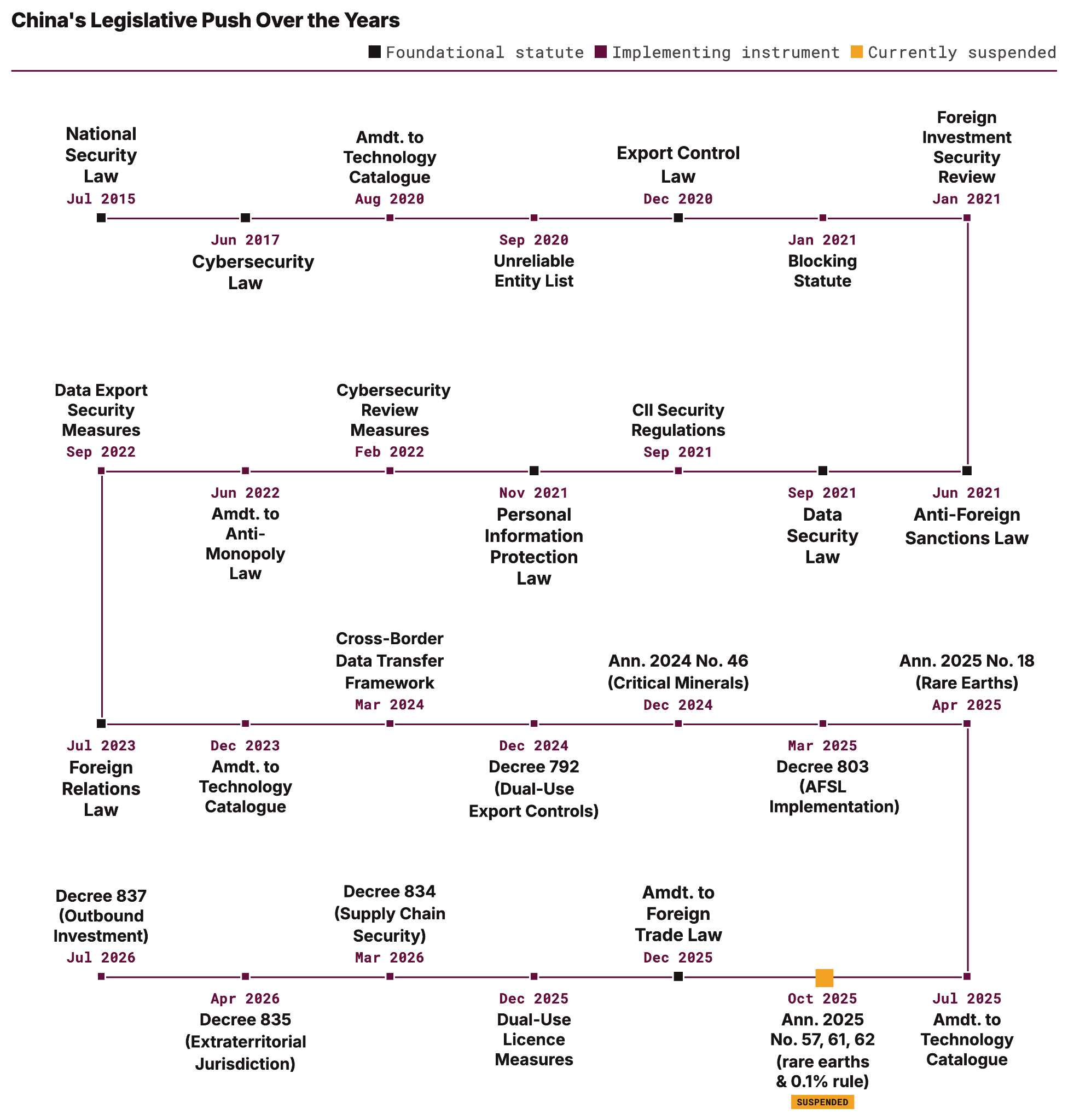
Within a span of a decade, China has constructed an extensive toolkit of economic coercion, at times mirroring the US instruments, but also innovating on existing mechanisms. Beijing is laying down an extensive legal architecture around its coercive economic instruments to strengthen its economic warfare capabilities. Click here to view China’s expanded economic statecraft toolkit.
At the centre of this effort lies China’s National Security Law (NSL) enacted in 2015,6 which forms the foundation of each coercive economic instrument unveiled thereafter. It was perhaps the first serious attempt under Xi Jinping’s presidency to construct a legal architecture for economic statecraft. In 2015, China’s National People’s Congress (NPC) Standing Committee repealed the existing National Security Law or State Security Law, of 1993, and replaced it with a new and much more comprehensive law.
The NSL expanded the scope and definition of national security beyond its traditional reach to envisage an all-domain concept. Article 2 defines national security as:
A state in which the regime, sovereignty, unity, territorial integrity, welfare of the people, sustainable economic development and social development, and other major interests are relatively free from danger.7
This definition establishes national security as an all-encompassing concept, which is broad and vague enough to include any act, event or decision within its scope. Under this all-encompassing approach, the concept of national security spans across political, territorial, military, economic, financial, cultural, social, technological, ecological, resource and nuclear security.
But more importantly, the NSL forms the foundational law for China’s economic statecraft, owing to its heavy focus on economic security and encouragement of a whole-of-society approach to safeguard it.
The law makes economic security, alongside political security, the foundational basis of national security. Article 8 explicitly underlines that “national security shall be coordinated with economic and social development.”8 It also underscores the importance of “safeguarding security in important industries and fields that influence the populace’s economic livelihood, key production, major infrastructure and major construction projects, as well as other major economic interests.” Across several articles, it directs the state to safeguard economic, financial and resource security.9
The NSL directs the state to establish national security review and oversight mechanisms, “covering foreign investment, specific items and key technologies, network information technology products and services, construction projects involving national security matters, and other major activities that affect or may affect national security.”10 It is this mandate outlined in Article 59 of the NSL from which several of Beijing’s security review mechanisms draw their legitimacy and legal authority.11
Accordingly, since the enactment of the NSL, Chinese authorities, at various levels, have unveiled several legislative instruments to build an architecture of economic statecraft and coercion.
These legislative instruments fall broadly under four categories in the order of hierarchy: laws, administrative regulations, departmental rules or orders, and announcements. Laws refer to the legislative instruments passed by China’s highest legislative body, the NPC. But since this body meets only once annually, the NPC Standing Committee is also empowered to enact laws. More often than not, it is the NPC Standing Committee which enacts laws. The same are promulgated by Presidential order.
The next in hierarchical order are administrative regulations or decrees, which are issued by the State Council and bear the Premier’s signature. Departmental rules or orders are third in order and are issued by relevant departments within the State Council, i.e. respective ministries or commissions, such as the Ministry of Commerce (MOFCOM), the National Development and Reform Commission (NDRC), the Cyberspace Administration of China (CAC), or the State Administration for Market Regulation (SAMR). At the bottom are normative documents, also issued by respective ministries but not concerned with rule-making and procedures, such as MOFCOM Announcement No. 59.
Over the last 10 years, China has built an extensive toolkit of economic statecraft. This paper is an attempt to map that toolkit, and to assess what it reveals about the kind of economic power China is becoming. It begins with a detailed survey and mapping of Beijing’s coercive economic toolkit. The succeeding section then deals with three questions that underpin China’s coercive economic behaviour. These include what drives Beijing’s weaponisation of dependencies, what its end goal is, and what its actions mean for the future of global supply chains.
2. China’s Instruments of Economic Coercion
There are two ways to analytically approach China’s coercive economic toolkit. The first involves a legislation-led approach, wherein one begins with a single law that regulates and provides for coercive economic measures. It treats the law as the primary node of analysis, and subsequently explores the decrees, orders, and announcements that flow from the overarching law. The second entails a domain-led approach, wherein one begins instead with a specific domain or weaponised tool—such as trade, technology, or supply chains—and draws together the various legislative instruments that impact it.
The limitation of the legislation-led approach is that a single law or decree may regulate multiple domains or tools, just as a single domain or tool may be regulated by more than one law or decree. Anchoring the analysis to an individual statute is thus likely to yield an incomplete picture of any given domain or tool. The domain-led approach resolves this difficulty. By drawing the relevant segments from across the entire legislative pool, it assembles every instrument of coercion relating to one domain into a single assessment.
Thus, the paper adopts this domain-led approach in mapping China’s coercive economic toolkit. It classifies Beijing’s toolkit into four broad instruments—namely market restrictions, export controls, data restrictions, and countermeasures.
Beijing has weaponised its market via anti-dumping and countervailing duties, inbound investment screening, and mergers and acquisitions review mechanisms. The common thread tying them is a restriction on entry into the Chinese market. Export controls emerge as the second instrument of coercion, and also the most popular of all. It extends to goods, technologies and outbound investments. The tie that binds them is restriction on what leaves the Chinese borders. The third instrument entails the weaponisation of data, and the underlying infrastructure governed by China’s cybersecurity and data security regimes that double as instruments of coercion against both foreign and domestic enterprises. The fourth category comprises countermeasures aimed at foreign entities that seek to undermine China’s national interests and discriminate against Chinese entities. Unlike the first three, which operate on grounds of national security, these countermeasure instruments openly address discriminatory measures and long-arm jurisdiction directed at Beijing. In addition to foreign entities, they also target foreign states themselves in some cases.
2.1 Market Restrictions
Relevant legislative instruments: Foreign Trade Law, Anti-Dumping Regulations, Countervailing Duty Regulations, Foreign Trade Barrier Investigation Rules of 2005, Foreign Investment Security Review Mechanism 2020, Anti-Monopoly Law, SAMR rules.
Weaponisation of the market is one of the oldest and most conventional forms of coercive economic instruments. The overarching laws governing China’s market are the Foreign (FTL) Trade Law and the Anti-Monopoly Law (AML). The FTL sets the terms of trade and selling into the Chinese market. It entrusts MOFCOM with the power to investigate trade barriers, injury from dumping and subsidies, and circumvention of trade remedies. The AML deals with preventing monopolistic practices and protecting fair market competition. Together, these have allowed Beijing to carve out two instruments of coercion by weaponising dumping and countervailing duty regulations on one hand, and anti-monopoly and competition laws on the other.
2.1.1 Duties
China’s Anti-Dumping and Countervailing Duty Regulations serve as prominent instruments of economic coercion. First released in 2001 and revised in 2004, these regulations govern the issue of unfair imports. MOFCOM’s Trade Remedy and Investigation Bureau is the nodal agency responsible for investigating dumping cases and subsidy allegations. However, while they are legitimate tools to counter unfair economic means like price wars and deliberate hollowing out of the importing country’s manufacturing base, they have also been used to settle political battles.
For instance, several cases piled up against Australia within weeks after Canberra demanded an investigation into the origins of COVID-19. The anti-dumping and countervailing duties imposed on Australian barley reached 80.5 per cent, while those on wine ranged from 116 to 218 per cent from March 2021.12 The measures were withdrawn in August 2023 and March 2024, respectively, once China-Australia relations witnessed normalisation. Canberra also withdrew its WTO complaints against Beijing as part of the mutually agreed solution.13
A related instrument is the Foreign Trade Barrier Investigation Rules of 2005,14 which mirrors the US’ Section 301 mechanism. It allows MOFCOM to unilaterally determine if an action by a foreign state constitutes a trade barrier or not. If so, the rules authorise retaliatory measures without WTO adjudication or involvement. Using these coercive powers, China suspended tariff concessions to Taiwan on 12 products from January 2024, followed by a further 134 tariff lines from June 2024.15 China opened a trade and investment barrier investigation against the EU’s Foreign Subsidies Regulation using the same instrument, and later invited the bloc for consultations instead of choosing to retaliate.16 Similarly, MOFCOM initiated an investigation against EU dairy and pork in 2024, following the EU’s decision to open an anti-subsidy investigation into Chinese electric vehicles.17
2.1.2 Inbound Investment
The Foreign Investment Security Review Mechanism 2020 governs the controls on inbound investment.18 The regulation empowers a Working Mechanism, set up by NDRC and led by MOFCOM, to review and screen all decisions on inbound capital on grounds of national security.
The rules require a declaration to be made to the working mechanism before investing in military industry, or fields related to national defence and security. It also mandates a similar declaration before an investment in important agricultural products, energy sources and resources, equipment manufacturing, infrastructure, transportation services, important information technology, financial services and key technologies. The objective is to disallow any controlling stakes or voting rights to foreign investors in these ‘important’ sectors, which the rules conveniently leave open-ended.
While this instrument appears to be a defensive measure to safeguard national interests, its wide applicability—coupled with the lack of clarity over what qualifies as important—allows the screening rules to be used as a coercive instrument against foreign enterprises.
2.1.3 Mergers and Acquisitions
But Beijing’s most innovative weapon in this category is the reimagined role of the State Administration for Market Regulation (SAMR).19 Since its establishment in 2018 following a reorganisation of roles, SAMR has been entrusted with promoting market order, antitrust enforcement, curbing monopolies, and consumer protection. Consequently, it is also the designated authority for reviewing mergers and acquisitions. It is precisely this review mechanism that equips SAMR with a coercive power it can wield well beyond its borders.
The Anti-Monopoly Law empowers SAMR to clear, block, or attach binding conditions to any merger or acquisition that meets the turnover thresholds set by the State Council. The threshold is placed deliberately low to enable SAMR oversight over foreign firms with modest sales into China.20 Furthermore, the law also applies to deals between two non-Chinese parties as long as their decision to merge or acquire (decision to concentrate) affects competition in the Chinese market. And the authority to decide whether it does so rests solely with the SAMR. Since almost every large global company has some market presence in China, SAMR effectively holds a veto over even those transactions or deals that have no involvement of a Chinese party at all.
The evolving pattern suggests that SAMR exercises this power largely through indecision and delay. The 2022 amendment to the Anti-Monopoly Law offers SAMR the power to suspend the review clock on the pretext of incomplete application, absolving itself of the mandated 180-day deadline, with no limit on how long the suspension may last. Thus, it can freeze a review indefinitely. SAMR has relied on these powers to scuttle several deals as the parties themselves default on their deadline to secure approvals. Thus, the transaction dies of its own accord. The parties have no recourse to any appeal mechanism as no decision was ever issued. And the parties cannot move ahead without SAMR’s approval, as doing so invites a fine of up to a tenth of their annual turnover where the concentration is found to harm competition, and up to RMB¥ 5 million otherwise.
SAMR’s record is replete with such patterns. In 2016, Qualcomm announced a US$ 44 billion deal to acquire Dutch chipmaker NXP Semiconductors.21 The transaction required regulatory clearances from nine jurisdictions as the two companies had a global presence. While eight regulators granted clearance, China’s newly formed SAMR, which inherited the merger and acquisition review powers in 2018, dragged the application. It repeatedly told Qualcomm that its proposal failed to address anti-competitive concerns and instructed Qualcomm to withdraw and resubmit its application. Qualcomm resubmitted the application twice, which effectively reset the statutory regulatory clock of 180 days on both occasions. Over the two years since it made its acquisition plan public, Qualcomm extended the deadline for finalising the deal multiple times. When SAMR chose to remain silent even as the final deadline of July 2018 approached, Qualcomm exited the deal, paying NXP US$ 2 billion in compensation. The timing of the case coincided with the unravelling of the US-China trade war.
Another similar instance entailed Intel walking away from its acquisition of Israel’s Tower Semiconductor in 2023.22 Other foreign deals to have met the same fate include Applied Materials’ bid for Japan’s Kokusai Electric in 2021,23 and DuPont’s US$ 5.2 billion purchase of Rogers in 2022. Each of these three companies had to pay a hefty termination fee.24
Alternatively, in cases where SAMR did grant approval, it did so only after gaining concessions. For instance, it cleared the Synopsys-Ansys merger in 2025 only after Washington eased its curbs on chip-design software. China also placed additional conditions requiring Synopsys and Ansys to divest some of their businesses.
SAMR resorted to a similar playbook during Broadcom’s US$ 69 billion takeover of VMware in 2023. It allowed the deal to go through only after securing a commitment that the interests of Chinese buyers would be protected.
SAMR is also empowered by the 2022 AML amendment, citing breach of conditions, to reopen closed deals that it previously approved. Nvidia’s case is instructive in this regard. In 2020, SAMR had cleared the firm’s acquisition of Mellanox on the condition that it keep supplying its chips and networking equipment to Chinese customers on fair terms.25 However, it reopened the deal on 9 December, 2024—merely a week after the US tightened its export controls—and added 140 Chinese entities to its blacklist.26
Ironically, the same US controls had made it impossible for Nvidia to honour the supply commitment in the first place. Beijing used the outcome to form the basis of its case. The case carries a penalty of up to a tenth of Nvidia’s annual sales.27 In September 2025, just days before a fresh round of US-China trade talks, SAMR announced a preliminary finding that Nvidia had breached the law and 2020 conditions, and opened a further investigation.28 The case remains open, held in deliberate abeyance as a bargaining chip.
The larger pattern emerging from SAMR’s operation is that both the initiation of investigation and its closing are tightly synchronised with the events unfolding in the geopolitical arena. SAMR has become increasingly selective in its intervention, and has assumed a role deeply motivated by geopolitical realities rather than market realities.
2.2 Export Controls
Relevant legislative instruments: Export Control Law, Foreign Trade Law, Dual-use Export Control Regulations, Catalogue of Prohibited and Restricted Technologies, MOFCOM Announcements.
Export controls are the most popular tool of economic coercion that countries often resort to. These controls can range from mandatory licensing requirements and inspections to quotas and blanket bans. Naturally, this tool emerges as the most extensive of all the options in China’s arsenal.
The Export Control Law, enacted in 2020, kicked off the broader attempt to turn this measure into a strategic and coercive instrument.29 The law is China’s first comprehensive legislation to regulate export controls. For the first time, it expanded the scope of export controls beyond non-proliferation-specific goods or technologies to authorise their use on national security and national interest grounds. It also sanctioned the use of export controls in retaliation against similar measures by other countries aimed at harming China’s national security and interests. The measures also apply to a third country re-exporting a product that contains Chinese-origin controlled components, mimicking US Foreign Direct Product Rules. In addition, it places a certification requirement to confirm the end-use of the goods and technologies exported in certain cases.
The overall objective received further backing through the amendment to China’s Foreign Trade Law.30 The law was first introduced in 1994 and substantially overhauled in 2004 after China’s accession to the World Trade Organisation (WTO) in late 2001. The 2025 revision, however, overturned the 2004 revisions, which represented a more WTO-aligned, liberalised trade regime, to reflect the securitised trade regime of the current times.31 The amendment elevated safeguarding “national sovereignty, security, and development interests” as a core legislative objective for the first time.32 It provided for mechanisms to restrict trade in sensitive goods and technologies, along with countermeasures against foreign economic coercion.
2.2.1 Dual-use Goods
But even before the amendment to the Foreign Trade Law took effect, China unveiled new Dual-Use Export Control Regulations, which govern the export of strategic goods with dual-use applications.33 Also referred to as State Council Decree 792, it came into effect on December 1, 2024. Currently, the list includes close to 700 items across 10 industrial categories, each comprising five sub-categories: equipment and components, test and production equipment, materials, software, and technologies.34 The regulation has a catch-all clause that empowers China’s MOFCOM to include any unlisted item suspected of military-grade end-use.
The strict licensing requirements extend to gallium, germanium, graphite, antimony and superhard materials (MOFCOM Announcement 2024 No. 46),35 and seven medium and heavy rare earth elements—namely terbium, dysprosium, samarium, gadolinium, lutetium, scandium and yttrium (Announcement No. 18 of 2025).36 Interestingly, the controls extend beyond these elements to include their oxides, alloys, and finished permanent magnets containing terbium and dysprosium.
The restrictions do not stop at mere licensing requirements. The rules mandate an individual licence for every shipment and destination. Also, the rules do not allow for a one-time or multi-year approval either. Lastly, licensing applications can be refused without a reason.
Beijing employed these restrictions to a great effect vis-à-vis the US. A gamut of restrictions on the export of critical minerals and rare earths eventually forced the US to come to the negotiating table in November 2025, where both made concessions to each other.37
The set of concessions included the suspension of Announcement No. 57, which had added five more elements to the list.38 But before it could come into effect on November 8, 2025, it was suspended a day before, until November 10, 2026. China also suspended the clause (until November 27, 2026), which blocked sales of gallium, germanium, antimony, and superhard materials to the US.39
Finally, among the suspended orders was Announcement No. 61, which was set to come into effect in December 2025.40 The order mandated a licence issued by Beijing for goods manufactured entirely outside China by non-Chinese firms, if the Chinese-origin rare earth content made up 0.1 per cent of the value of the finished item. This rule mirrored the US’ de minimis and Foreign Direct Product Rule, which impose similar restrictions.
2.2.2 Strategic Technology
China has a similar control list for certain technologies aimed at “safeguarding the economic and technological interests of the state.” The Catalogue of Prohibited and Restricted Technologies has undergone several rounds of revisions (2001, 2008, 2020, 2023, and 2025).41 As per the latest revisions, the list contains 132 technologies falling into either of the two categories: prohibited and restricted.
The prohibited category has about 23 technologies whose export is banned. The restricted category technologies may have multi-tiered licensing requirements, with approvals needed from both the Ministry of Commerce (MOFCOM) and the Ministry of Science and Technology (MOST), in conjunction with the Ministry of Industry and Information Technology (MIIT) for decisions relating to information and communications technology.
The regulation defines export as the “transfer of technology from China to a foreign country by any means ranging from trade, investment, or economic and technical cooperation.”42 Thus, not only is the physical export of listed technology regulated, but also licensing arrangements, technical assistance, joint venture contributions, and outbound investment structures that might otherwise move a listed technology out of China indirectly. Interestingly, the regulations place similar prohibitions and restrictions on a Chinese company transferring a listed technology to its overseas subsidiaries.
The scope of the list now includes technologies relating to extraction, processing, refining, and use of rare earth elements, non-ferrous metal metallurgy, and design and construction of large-scale high-speed wind tunnels, and bulk material loading and unloading conveying technology.
In July 2025, China brought non-ferrous metallurgy within this ambit as well to cover lithium extraction from spodumene, metallic lithium preparation and brine lithium extraction.43 It also added battery cathode material preparation technology to the restricted tier, thereby mandating a licence to export it.
Rare earth mining, separation, smelting, magnet manufacturing and recycling technologies are separately controlled under Announcement No. 62 of 2025, but remain suspended for a year as part of the November 2025 truce.44
The consequences of violation scale with the tier. Engaging in the export of prohibited technology, or restricted technology without a licence, is a criminal offence at par with smuggling, illegal business operation, and divulging state secrets.
2.2.3 Outbound Investments
The other coercive instrument Beijing unveiled to secure its continued dominance in global supply chains relates to outbound investments. The Regulations of the State Council on Outbound Investment, or Decree 837, published on June 1, 2026 and effective from July 1, 2026, is China’s first State Council-level administrative regulation that oversees outbound investment.45 It sits above the departmental rules of MOFCOM, NDRC and SAFE that also govern China’s outbound direct investment. The rules define an outward investment as any investment contributing “money, equity, financing, or guarantees to gain ownership, control, or management rights over a company or asset in another country.”
The decree envisages controls at two levels. First, it seeks to outline the investment environment and risk levels of relevant countries or regions. This would supposedly guide investors to decide whether a country is worth investing in from a national economic and social development standpoint. Second, it directs the investment and commerce departments of the State Council—conventionally NDRC and MOFCOM, acting with other relevant departments—to classify three categories for outbound investment: encouraged, restricted and prohibited. The prohibited category bars any outward investments that entail the export or use of goods, technologies, services and related data that are banned by relevant laws. Similarly, investments entailing the transfer of items restricted by laws and requiring prior approval from relevant authorities must apply for licences beforehand.
Further, the relevant authorities are empowered to act against a foreign organisation or individual who endangers China’s national sovereignty, security, or development interests, or discriminates against Chinese parties. It allows them to prohibit or restrict China-related imports or exports, and its investment in or from China.
Thus, the legislative instruments suggest that Beijing has developed “investments” into a coercive weapon as well. Two things are noteworthy. First, China seeks to use the restrictions on outbound investment to prevent the transfer of industrial capacity and technological know-how—where Chinese enterprises enjoy a comparative advantage—which could eventually undermine or undercut Chinese competitiveness in the global market. Second, China also seeks to use these restrictions as carrots and sticks, evident in its attempt at profiling countries and regions by risk and classifying investments into encouraged, restricted and prohibited. It is effectively communicating that if the actions of an entity are regarded as harming China’s sovereignty, security or development interests, it may restrict or prohibit outbound investments to those locations.
Two things are worth noticing about Beijing’s controls that make them different from others. First, as the definition of strategic and critical has itself expanded across the world, the list has not remained limited to traditional dual-use goods or technologies. Beijing’s list of dual-use goods now includes critical minerals and rare earth elements. China’s decision to classify them as strategic goods is not merely driven by the fact that governments around the world have recognised them as such, but also because Beijing’s overpowering dominance in the production and processing of these elements equips it with leverage. Accordingly, China has resolved to weaponise it.
Thus, export controls are not confined to goods that have genuinely dual-use applications. Often, the controls have been applied to goods with widespread consumer applications but only minor defence applications, under the pretence of curbing the sale of dual-use goods. At this rate, Beijing’s definition could classify even steel as a dual-use good. The same is true for technologies.
Another thing that sets China’s regulations apart is their inherent inconsistency in application. Much of China’s actions were a response to the US’ export control measures. And while the intention was to hurt the US, China imposed blanket licensing requirements. Consequently, states with no connection to the issue or dispute with China found themselves in the crossfire. The lack of transparency, deliberate vagueness, and inconsistent application together create an uncertain business environment.
2.3 Data Restrictions
Relevant legislative instruments: Cybersecurity Law, Data Security Law, Personal Information Protection Law, Cybersecurity Review Measures.
As cybersecurity threats have amplified across the world, China, like several others, has also put in place a legal architecture to ensure data security. The Cybersecurity Law (2017),46 Data Security Law (2021),47 and the Personal Information Protection Law (2021) together form the trinity that governs China’s data governance.48
Three coercive instruments flow from this architecture. The first weaponises China’s information infrastructure. The second weaponises the overseas listing mechanism that determines which firms may access foreign capital markets. And the third weaponises the transfer of data.
2.3.1 Network Security Review
The Cybersecurity Law of 2017 established a new class of infrastructure, referred to as the Critical Information Infrastructure (CII), comprising seven sectors. It included telecom, energy, finance, transport, water, public services, and electronic governance. The law mandated that the “purchase of network products and services for the operation of critical information infrastructure should pass national security review.”49 The law and the Cybersecurity Review Measures, published in 2022, entrusted the reviewing powers to the Cybersecurity Review Office (CRO), a 13-agency committee led by the Cyberspace Administration of China (CAC).
Thus, beyond its legitimate use case, the rules also allow Beijing to wield it as a coercive weapon. For instance, in March 2023, China initiated a network security review of products sold by major US chipmaker Micron Technology. The company manufactured DRAM chips, flash memory and solid-state hard drives and derived 16 per cent of its total revenue from China and Hong Kong in the previous year.50
The timing, however, was a giveaway. Beijing’s response came against the backdrop of the US’ decision to tighten export controls on the sale of chips to China. A few weeks later, in May 2023, the CRO directed all CII operators to stop buying Micron products without providing any technical evidence against the company.
The US cybersecurity company, Palo Alto Networks, is the latest to be caught in the same rules.51 On August 6, 2026, the CRO announced a review of the company’s products sold in China. Even before the announcement came in, the CRO had informally instructed domestic operators in January 2026 to stop using US and Israeli cybersecurity products, including those of Palo Alto. Although, China’s actions against Palo Alto are driven more by legitimate security reasons than geopolitical ones.
Recent reports confirmed that Palo Alto’s Unit 42 threat intelligence team had intelligence-sharing arrangements with the US authorities, and aided the US Department of Justice in indicting Chinese nationals. Further, Palo’s Unit 42 had also submitted a report to the US authorities accusing a certain Asian country—hinting at China—of orchestrating a cyber espionage campaign in 37 countries. These reasons give China enough reason to put Palo Alto under review.
Nevertheless, these cases are a testament to the fact that Chinese regulatory bodies can evolve into a geopolitical body like the SAMR.
2.3.2 Overseas Listing Review
Cybersecurity or network security reviews can be weaponised in more ways than one. The Cybersecurity Review Measures outline relevant rules that relate to mandatory cybersecurity review of network platform operators, which process data of over a million users before listing offshore.52 The grounds for review are legitimate, given concerns around losing control over CII, weaponisation of data, etc. At the outset, the rules again appear to be aimed at domestic players.
Yet, the DiDi instance shows that these rules can very well be weaponised against foreign entities, especially American firms.53 In June 2021, China’s major ride-hailing platform DiDi raised a record US$ 4.4 billion on the New York Stock Exchange—the largest ever Chinese listing in the US since Alibaba. The underwriting group included the likes of Goldman Sachs, Morgan Stanley and JP Morgan. Two days after DiDi’s listing, CAC opened a cybersecurity review of its overseas listing. Moreover, it ordered DiDi to stop registering new users and ordered the removal of the company’s app from all Chinese app stores, leading to a collapse in its stock value. After the investigation, CAC imposed a fine of RMB¥ 8 billion on DiDi and ordered it to delist from the New York Stock Exchange. In the process, DiDi lost over 80 per cent of its listing value. While the whole affair had a semblance of punishing a Chinese company, the eventual monetary losses were absorbed by the American investors who bought the shares, American banks that marketed the offerings and American guarantors who underwrote the offering. Beijing used the cybersecurity review mechanism to inflict a multi-million dollar loss on US capital markets. The brilliance of such measures lies in the fact that, even though a Chinese entity would be under direct fire from the administration, the eventual cost is borne by foreign and overseas investors.
One would think that Chinese entities’ exposure to overseas markets would make Beijing vulnerable. But this case study shows that, unlike American corporations, which can influence the American state and act as a buffer between the US and China during heightened tensions, Chinese firms hold little sway over the party-state. Alternatively, Beijing weaponised a tool which was considered leverage against itself.
2.3.3 Data Classification for Cross-border Transfer
To further tighten control over data and information, the Data Security Law was passed in 2021 to establish a data classification and security system.
As countries around the world reconceptualise data as infrastructure in the age of AI, data security also figures as a strategic priority for Beijing. The data regime governed by the Data Security Law, Cybersecurity Law, and Personal Information Protection Law establishes a three-tier data classification system of core state data, important data, and general data.
Core state data is defined as data covering national security, the national economy, people’s livelihoods and major public interests, and is subject to the strictest management regime. The central government is the designated authority to identify what constitutes core data. Important data is defined as data whose leakage, destruction or illegal use would harm national security, public interest or individual rights, and requires periodic risk assessments and designated security personnel. Each department is entrusted with the responsibility of identifying data within its own domain. General data forms the residual base category.
Accordingly, the conditions for cross-border transfer of data vary by classification. While general data can be freely exported, transfer of core state data is strictly prohibited. Transfer of important data requires certification or security assessment. The export of data from CII operators is also subject to the same classification. Any breach or violation of the rules carries hefty penalties and can attract criminal prosecution.
2.4 Countermeasures
Relevant legislative instruments: Foreign Trade Law, Anti-Foreign Sanctions Law, Unreliable Entity List, Decree 803, Decree 835, and MOFCOM Blocking Order.
Next, there are coercive measures that can be clubbed as countermeasures. The reason for naming this category of instruments ‘countermeasures’ is that they are overtly aimed at countering coercion directed at Beijing. Unlike other instruments, which operate on grounds of national security—even though they are routinely used as retaliatory measures—the nature of these countermeasure instruments is such that they drop the pretext and directly address economic coercion.
Several features bind the instruments under this domain. Entities, including states, are at the centre of these instruments. All these instruments are countermeasures against perceived injustice and discrimination against China. These injustices and discrimination are directed against Chinese individuals, enterprises, and organisations whose interests must be protected. And each of these countermeasures seeks to counter an action with long-arm jurisdiction of the foreign state in some form or the other. And needless to say, these actions are aimed at “safeguarding national sovereignty, security and development interests” and “protecting the legitimate rights and interests of enterprises, other organizations, and individuals of China.”54
2.4.1 Adversarial Entities
The first among such lists is the Unreliable Entity List (UEL) and traces its source in the Foreign Trade Law. Mirroring the US’ BIS Entity List, China’s MOFCOM promulgated the UEL provisions in 2020.55 The listing is overseen by a multi-agency working mechanism comprising NDRC, MIIT, MOFA, and MSS, and is chaired by MOFCOM.
The target of the order is any foreign entity—defined as an enterprise, organisation, or individual of a foreign country—that seeks to disrupt or refuse normal business dealings with Chinese companies without, what Beijing considers to be, a legitimate reason. It includes any discriminatory measures against Chinese companies, organisations or individuals or actions regarded as harming China’s sovereignty, security, or development interests.
Even though the legislation does not explicitly say so, one can extend the logic to justify the addition of even foreign enterprises choosing to comply with the anti-China sanctions regime to the UEL.
Once designated, the entities can be barred from any import or export dealings with any Chinese entity, and excluded from investment opportunities and from availing market access. Chinese entities are also legally barred from transacting with listed entities, and any violation can attract severe consequences. Executives of listed entities aren’t exempt from punitive measures either, which may include restricted entry into China or revocation of work permits and residence status. As with other instruments, no independent appeals mechanism exists against the working group’s decision.
The number within the list grew from under 10 in 2024 to more than 50 by mid-2025, with the bulk of designations occurring in early 2025.56 The designated entities were predominantly American and Taiwanese firms, in addition to foreign think tanks. In October 2025, MOFCOM added 14 foreign entities to the list for engaging in military technical cooperation with Taiwan, publishing malicious content against China, and assisting foreign governments in suppressing Chinese enterprises.57 The most notable of the 14 entities is, however, TechInsights, along with its 10 subsidiaries and branches worldwide. TechInsights—a research and intelligence firm that has carried out several teardown analyses of Chinese-origin semiconductors and the capabilities of SMIC, Huawei and other related enterprises.58
2.4.2 Extraterritorial Jurisdiction
Beijing has also enacted a series of laws to counter extraterritorial measures. The MOFCOM Blocking Statute of 2021 was the first such effort.59 It deals with the extraterritorial application of foreign legislation that prohibits Chinese citizens or entities from engaging in normal economic, trade and related activities with a third state or its citizens or entities. The rules establish a working mechanism led by the Commerce Department of the State Council, which is empowered to review such actions. If the body is satisfied that the foreign legislation violates the principles of international law and the basic principles of international relations, or undermines China’s national interests, sovereignty and development interests, it may issue a prohibition order against complying with such extraterritorial legislation. Interestingly, however, the rules also allow for granting an exemption from compliance with the prohibition order. Furthermore, the rules allow the aggrieved Chinese party to initiate legal proceedings against, and claim compensation from, those who complied with the extraterritorial application of foreign legislation.
Lately, in April 2026, Beijing expanded on the MOFCOM blocking statute by enacting Decree 835, or the Regulations on Countering Improper Extraterritorial Jurisdiction.60 The decree marks a clear escalation compared to the MOFCOM blocking statute. In hierarchical terms, the decree sits above the MOFCOM order given that it is a State Council regulation signed by the Premier. But most importantly, the decree adds a stricter response toolkit. While the MOFCOM blocking statute could only issue prohibitory orders to Chinese parties to not comply with the offending foreign measures, Decree 835 also empowers Beijing to place foreign organisations and individuals who implement or support such measures on a Malicious Entity List. Further, it subjects them to harsher measures. These range from visa denial and entry bans to the freezing of assets and restrictions on trade, investment and data flows.
Thus, in addition to issuing a blanket prohibition against improper extraterritorial measures, the decree introduces a blocking injunction, a targeted order which the Ministry of Justice can issue to a named Chinese entity, thereby compelling it to cease compliance with the offending foreign measure. The MOFCOM blocking statute had no equivalent of this entity-specific enforcement tool. Finally, and most significantly, Article 4 of Decree 835 asserts that as part of the response, Beijing has a right to exercise extraterritorial jurisdiction over conduct with an “appropriate connection” to China.
In addition, there exists Decree 803 on Provisions for the Implementation of the Anti-Foreign Sanctions Law of the People’s Republic of China to counter foreign sanctions.61 The ambit of this Decree is much wider than Decree 835, which only seeks to counter improper extraterritorial measures by foreign states.
It draws its origins from the Anti-Foreign Sanctions Law, which seeks to counter “hegemony and power politics” and “any country’s interference in China’s internal affairs by any means and under any pretext.”62 It differs from the MOFCOM Blocking Statute in two respects. First, while the MOFCOM blocking order is a ministerial-level regulation, Decree 803 is State Council legislation and sits higher in the hierarchy. Second, Decree 803 goes beyond mere blocking extraterritorial orders, which the MOFCOM order does, to include punishment for those who comply and aid in compliance with such measures.
The instrument—as outlined in Decree 803—is triggered when a foreign state, in violation of international laws and norms, undertakes means (including legislative measures) to “contain or suppress China, take discriminatory or restrictive measures against Chinese citizens or organisations, or interfere in China’s internal affairs.” The scope of the instrument extends to “foreign states, organisations, or individuals that assist or support such acts that endanger China’s sovereignty, security or development interests.”
At this point, it is important to distinguish Decree 803 from UEL and Decree 835. With respect to the UEL, where Decree 803 differs is in the scope of the target and the trigger. Decree 803 expands the scope to include foreign states, unlike the UEL, which only targets foreign entities, including individuals, enterprises and organisations. Second, while the UEL mechanism kicks in when normal business dealings with Chinese companies are disrupted, or discriminatory measures against Chinese entities are adopted, Decree 803 has additional grounds for triggering. These include acts of containing or suppressing China. Moreover, even aiding and abetting such efforts makes foreign individuals, organisations, and states a target of the instrument.
While the UEL envisions largely trade and investment restrictions as a retaliatory measure, Decree 803 envisages an expansive set of countermeasures. These include visa refusal, entry bans and deportation; seizure and freezing of all forms of property including cash, securities, bank deposits, equity, intellectual property and accounts receivable; and prohibitions on transactions and cooperation across sectors spanning education, science and technology, legal services, trade, culture, health and sports.
In addition, the instrument also empowers authorities to ban investment in China, restrict exports of specified items, cut off access to data and personal information, revoke work permits and residency qualifications, and impose fines. It also carries punishment for those who refuse to comply with countermeasures. At the same time, it allows for waivers and exceptions under special circumstances.
Similarly, Decree 835 is triggered against any improper extraterritorial jurisdiction, i.e. a defined legal instrument. Decree 803, on the other hand, is triggered against any effort that is aimed at containing or suppressing China— including assisting and aiding—which may also include discriminatory or restrictive measures, and interference in internal affairs. The scope extends to anyone who assists or supports such acts. The countermeasures outlined in Decree 803 and Decree 835 are more or less similar.
Finally, Decree 803 also envisages a listing mechanism, referred to as the Countermeasures List. In addition to announcing countermeasures against foreign entities, the MFA is empowered to place foreign individuals and organisations on the Countermeasures List. While the list is administered by the Ministry of Foreign Affairs, Decree 803 establishes a broader coordination mechanism spanning MFA, MOFCOM, NDRC and the Ministry of Justice.
Importantly, listing and the imposition of countermeasures are two distinct powers, and not a single sequential process. Decree 803 empowers State Council departments to place entities on the Countermeasures List, and to adopt countermeasures as two separate actions. Beijing has often imposed entry bans, asset freezes and transaction prohibitions through MFA press statements without any formal listing of the entities. The listing can be viewed as an escalation over just announcing countermeasures to impart greater formality and permanence.
The listing record reflects the instrument’s political character. The first formal designations under the MFA order system came in December 2022. The designations accelerated sharply thereafter, with the number of foreign companies, individuals and institutions on the list rising from seven in 2023 to around 100 in 2024.63 The listed entities fall largely into three clusters—companies related to Taiwan arm sales, foreign officials and legislators linked to Xinjiang, Tibet and Hong Kong sanctions, and entities connected to actions Beijing perceives as interference in its internal affairs.
2.4.3 Supply Chain Security
The last of such measures entail countering actions (perceived as coercive) to undercut China’s dominance in global supply chains. Amidst the call for de-risking—ranging from friend-shoring and near-shoring to reshoring, owing to growing concerns around vulnerability vis-à-vis China—Beijing has grown anxious. As such calls gain traction across the West, including Europe, China unveiled specific legislation in April 2026—the Regulations on Industrial and Supply Chain Security, or Decree 834—to curb and dissuade such attempts.64
The objective is to prevent security risks in industrial and supply chains, and enhance supply chain resilience. It links the idea of industrial and supply chain security with national security and developmental security. It directs the state to strengthen the security of industrial and supply chains in key sectors without defining them.
The rules have a domestic component and a foreign component. On the domestic front, it enjoins the state to undertake a range of measures—from orderly layout, mobilisation capability, and emergency stocks to early-warning and risk-monitoring systems—in order to enhance the security of industrial supply chains. It directs governments to take targeted measures to prevent such risks to that security.
But the regulations do not stop there. They also assign liability to foreign individuals and organisations. First, they envisage strict punishment on individuals and organisations that attempt to conduct “investigations or other information collection activities related to industrial and supply chains within the territory of China.” Second, they provide that Chinese authorities reserve the right to respond to any discriminatory prohibitions, restrictions or other similar measures by a foreign state, region or international organisation that harm China’s industrial and supply chains, or assist in harming them.
The retaliatory measures could range from restricting trade of relevant goods, technologies or services, along with restrictions on investment or transactions. Finally, restrictions could also extend to entry, commute, work, stay, or residence of relevant personnel in China.
The scope is all-encompassing, i.e. the term ‘threat to industrial supply chain’ by design is too vague and wide, such that any act driven by business interests that somehow aren’t favourable to China can be perceived as an act of undercutting China’s position within the global supply chains. Finally, this decree gives the authorities the powers to use all means at their disposal—including the ones mentioned above relating to Decree 803 and Decree 835—to counter such efforts.
3. The Three Questions: Drivers, Endgame, Future
As one glances over China’s instruments of economic statecraft that it now wields, three key questions emerge. First, what does this reveal about China’s behaviour? Second, what does China’s behaviour reveal about its end goal? Is it merely an attempt to enforce a withdrawal by the West or something broader? Lastly, and most importantly, the question arises: what do China’s actions imply for the future of global supply chains?
3.1 What Explains China’s Motives? Intrinsic or Extrinsic
As China’s effort to craft a coercive economic toolkit becomes more sophisticated, it becomes imperative to assess whether its motivation to weaponise dependencies is driven by extrinsic or intrinsic factors. In other words, whether China’s pursuit of a coercive economic toolkit is a reaction to a wider geopolitical reality, which has turned hostile, or whether it is a reflection of the kind of power Beijing is evolving into. It is worth investigating if Beijing would have undertaken this route regardless of how the global order was shaping up.
On the surface, if one broadly looks at the period after 2018—the year to which most scholarship largely traces the advent of widesweeping US-China trade tensions—it may seem that China’s behaviour is largely reactionary, given it was the US under Trump 1.0 that fired the first salvo.
One could thus argue that Beijing’s actions are a response to the US’ attempt to contain China, and the pattern of China’s response broadly conforms to this assessment. China’s export control restrictions on critical minerals, especially gallium, germanium, antimony and graphite, were a retaliation against US export controls on semiconductors. Similarly, China’s 2025 round of export control restrictions on rare earth elements, heavy rare earths, their magnets, and rare earth separation and processing technologies were a response to a range of US export control measures—including BIS’ 50 per cent Affiliates Rule that expanded restrictions to Chinese corporate subsidiaries—and restrictions on Chinese access to Electronic Design Automation (EDA) software and AI microprocessors.
The fact that China’s aggressive legislative push towards constructing a coercive economic toolkit also coincided with the period after 2018 further reinforces the assessment that Beijing’s actions are more of a response to the US’ attempt to besiege China.
But if one were to look more closely, it becomes clear that China’s recourse to coercive economic actions is not always in retaliation for being targeted by similar measures. Beijing has resorted to such measures not only to signal displeasure, but also to enforce behavioural alignment to suit its interests. The decision to impose tariffs on Australian wine and barley in response to Canberra’s demands for a WHO investigation into the origins of COVID-19 is one such instance.
The Lithuania case offers more clarity on Beijing’s intrinsic drive to resort to coercive economic measures. In 2021, Lithuania decided to open a Taiwan Representative Office (TRO) in Vilnius, going against the conventional nomenclature of using “Taipei” instead of “Taiwan” as other countries do.65 Infuriated by Lithuania’s move, China downgraded diplomatic relations with the country and recalled its Ambassador. Chinese customs officials subsequently began obstructing Lithuanian goods, and as a result of this informal blockade, Lithuanian exports to China fell by 91 per cent by the end of the year.66 Reports also emerged that Chinese SOEs reneged on contracts with Lithuanian companies in the aftermath of the episode. Beijing further extended the threat to exclude third-country parties, such as German auto parts makers, from the Chinese market for continuing business ties with Lithuania.67
China’s conduct toward India following the imposition of licensing restrictions on rare earth and magnet exports also suggests that Beijing’s motivations to weaponise dependence are not purely defensive, but serve as a tool for signalling displeasure and extracting compellence. While the controls were aimed at the US, the general licensing requirement meant that every trader with a relationship with Chinese suppliers got caught in the crossfire.68 Gradually, as American and European buyers secured licences for their suppliers, their Indian counterparts were left hanging. Despite guarantees issued by the Government of India, the Indian automotive industry failed to secure approvals from Chinese authorities for a prolonged period.
In one instance, while the Chinese authorities granted clearance to American and German subsidiaries of a global company, it kept the application of its Indian subsidiaries in abeyance. It was a stark case of arbitrariness and discrimination in which India—which had nothing to do with the dispute—absorbed an enormous cost, while the US—against which the restrictions were initially directed—secured quick approvals.
These three instances together show that China’s weaponisation of dependencies is not solely a response to “containment” by the US, but also reflective of its intrinsic character. This distinction matters because if the motivations are purely extrinsic and a defensive reaction to American pressure, the solution is straightforward, i.e., withdrawing or mitigating said pressure. But if its motivations are also intrinsic, as the above cases suggest, no degree of de-escalation by the West will discourage China’s recurrent recourse to economic coercion.
3.2 What is China’s Endgame? Denial or Compellence
The next aspect that flows from the nature of China’s motivations is the end goal of China’s coercive measures, for it will determine the shape of the global geoeconomic order. Parallelly, what constitutes China’s end goal will have a bearing on whether supply chains continue to remain concentrated in China or diffuse over time.
Most forms of economic coercion operate through denial, be it of market access or exports. But the end goal may still differ depending on whether denial of access or exclusion is pursued for its own sake, or to compel behavioural change.
Generally, all non-proliferation regimes have denial as their end goal. The NPT, the Wassenaar Arrangement, the Australia Group and the Missile Technology Control Regime (MTCR) each share the same objective—keeping technological secrets contained within a small group of trusted nations and preventing their spillage outside the clique.
Lately, even US’ coercive economic actions vis-à-vis China, notwithstanding frequent recourse to traditional means such as tariffs and entity listing, have increasingly taken the form of denial. The current US export controls on advanced chips and chip manufacturing equipment are built around the same logic—to deny China access. The goal is not so much to shape the adversary’s behaviour, but to deny its capability, and thus sustain the knowledge gap in Washington’s favour.
Hence, a sustained capability differential is a necessary precondition for successful access denial. In its absence, the adversary can find alternatives with relative ease.
China’s coercive economic actions, by contrast, are largely geared towards compellence, i.e., inflicting economic pain to shape or influence the adversary’s behaviour. The export controls imposed on critical minerals, rare earths, their magnets, and associated processing technologies were designed to raise the economic cost for American enterprises, not to permanently foreclose their access. Beijing cannot deny access to these controlled items in perpetuity for two reasons. First, it would eventually hurt Chinese suppliers and exporters, thereby undermining exports’ contribution to the national economy. Second, given that the capability differential underpinning the weaponised item or technology is not always decisive, alternate players can emerge if China withdraws from the market long enough.
But as the global resolve to de-risk from China has grown stronger, particularly in the US and the EU, Beijing has moved to complement compellence with what might be termed denial by delay and dissuasion. It is an effort to retain its capability to compel by discouraging the emergence of the very alternatives that would erode it. China is pursuing this through two channels. The first is to deny the flight of technical and industrial know-how that could create viable alternatives elsewhere, and thereby undermine its supply chain dominance. The legislative architecture for this is already in place. The 2025 revisions to the Catalogue of Prohibited and Restricted Technologies bar the export of rare earth mining, separation, smelting, magnet manufacturing and recycling technologies, alongside lithium extraction and battery cathode material preparation techniques. Similarly, Decree 837 directs Chinese enterprises against transferring industrial capacity or know-how abroad.
The second is to dissuade diversification by manipulating market prices, suppressing them sufficiently to make alternative investment unattractive. China has resorted to such measures to fluctuate prices for solar panels and lithium-ion batteries in order to wage a price war against new entrants.
The end goal of China’s tools of economic coercion, thus, now combines compellence with protracted denial. Decree 837 and the amended technology catalogue represent Beijing’s long-term effort to lock in its supply chain position.
3.3 What does the Future Hold? Concentration or Diffusion
If China’s coercive instruments increasingly pursue denial by delay and dissuasion, the future of global de-risking efforts is worth contemplating.
There are two plausible outcomes that sit at either end of this spectrum. The first, the optimistic view, holds that China’s increasing weaponisation of its dominance and others’ dependence will ultimately result in the erosion of that very dominance. This proposition rests on the argument that China’s dominant position in global value chains is a product of its competitiveness, lax environmental standards, and efficient supply chains, but not a product of its surplus knowledge gap over others. There are players who can enter the market but can’t survive competition against China at prevailing prices. If Beijing chooses to weaponise its position and push prices up, it can make the market sufficiently lucrative for other players to enter. Further, if governments around the world continue to support alternatives, as is already being seen, China’s dominance will witness further erosion over time.
The pessimistic view holds that Beijing’s efforts constitute a preemptive intervention, in light of a worsening external environment, to discourage any attempts to diversify away from China. The logic here is that if restrictions are comprehensive and severe enough, they can impose huge costs on firms and enterprises, whose decisions are driven by quarterly numbers rather than long-term interests. Beijing believes that if it can inflict such high costs, relocation or flight will seem unreasonable. It is perhaps thinking that it may not be able to prevent new investments from going away from China, but it definitely can prevent existing investments and supply chains from relocating.
Beijing cannot alone determine which trajectory the world takes. Several key stakeholders are at play, and how they interact among themselves and with the market will decide the fate of de-risking efforts and the extent to which the balance tilts either way.
There are four major stakeholders, namely the Chinese party-state, Chinese enterprises, foreign states and foreign enterprises. The latter two form the larger group, comprising countries that are victims of China’s weaponisation. The longer this list, the better the prospects, but at a minimum this group must include the US, the EU, Japan, Australia and India. This paper treats these five as necessary to mounting any meaningful challenge.
The degree of alignment, or the lack of it, between these stakeholders is the other important factor. China’s advantage is that its party-state and its enterprises exhibit strong alignment, and thus behave as one. The diktat of the party-state is supreme, and the enterprises mould their behaviour accordingly. A similar alignment between states and enterprises is extremely difficult to achieve in democracies. This is evident in the sharp dissonance between the approach of the state and that of enterprises in the US, the EU, and even India with regard to a common China policy. The strategic interests of states and the commercial interests of business often fail to align, thereby creating divergences in approach.
Mounting a successful challenge to China and pursuing actual de-risking would thus require both horizontal and vertical alignment—horizontal alignment among the states as a whole, and vertical alignment between each state and its respective enterprises. This has to be operationalised through capital support and market guarantees. Enterprises need to commit to building capabilities. States need to commit to ensuring them a market, and to not pulling away support midway when competition from Chinese players becomes stiff.
The challenge is also to sustain this alignment for long enough to achieve results. This remains feasible so long as China’s behaviour remains constant, that is, so long as it remains willing to resort to economic coercion. But Beijing can regulate and vary its behaviour by concluding side deals with some actors, granting concessions to others, or withdrawing the restrictions partly or on the whole. This creates conditions for defection, to which both states and enterprises are prone. The resulting rifts could break the alignment across and within countries, and a fragile coalition could crumble.
Two examples are instructive in this regard. The US-China thaw in November 2025 following the Trump-Xi meeting in Busan,69 further reinforced during Trump’s visit to Beijing in May 2026 shows how quickly the ground can shift.70 From containing China when Trump assumed office for the second time in January 2025, the narrative has shifted to managing relations by 2026. The unfolding of the NVIDIA episode exposes the second vulnerability. Even as states have shown a greater willingness to force their businesses to align with larger national goals and interests, this does not mean that businesses cannot influence them back into accepting their own positions71. The US administration has both managed to coerce NVIDIA, and be influenced by it. Thus, whether supply chains concentrate or diffuse rests on the coalition’s durability and its ability to sustain itself.
4. Conclusion
Over the last decade, China’s coercive economic toolkit has rapidly evolved. Beijing has assembled a legal architecture spanning market restrictions, export controls, data restrictions and countermeasures. Rooted in the National Security Law of 2015, these operate through a hierarchy of laws, decrees, departmental rules and announcements.
The mapping yields three findings. First, Beijing’s motivations to seek recourse in coercive means are not solely reactive, as the cases of Australia, Lithuania and India suggest. China’s recourse to these instruments to signal displeasure and enforce behavioural alignment is as much driven by its intrinsic character. Accordingly, any de-escalation by Washington will not have a bearing on China’s willingness to resort to economic coercion.
Second, China’s end goal with the toolkit has evolved. What began as compellence, i.e. inflicting economic pain to shape the adversary’s behaviour, now combines with protracted denial. Instruments such as Decree 837 and the amended technology catalogue are designed to prevent the emergence of alternatives rather than to extract a concession.
Third, the outcome of this coercive economic order, constructed by China, on global supply chains is worth investigating. Whether supply chains concentrate or diffuse will depend on whether afflicted states can sustain a horizontal alignment among themselves and a vertical alignment with their business houses for long enough to build viable alternatives. However, China possesses all the means to disrupt this coalition. While sustained pressure by Beijing gives the coalition a reason to hold together, selective relief—granted to some actors and withheld from others—removes that reason and creates the conditions for defection, thereby thwarting the whole de-risking process.
Footnotes
Office of the United States Trade Representative, Economic and Trade Agreement Between the Government of the United States of America and the Government of the People’s Republic of China (Phase One Agreement), January 15, 2020, Link. Chad P. Bown, “US-China Trade War Tariffs: An Up-to-Date Chart,” Peterson Institute for International Economics, September 20, 2019 (updated November 14, 2025), Link. Bureau of Industry and Security, U.S. Department of Commerce, “Order Activating Suspended Denial Order Relating to Zhongxing Telecommunications Equipment Corporation and ZTE Kangxun Telecommunications Ltd.,” Federal Register 83, no. 78 (April 23, 2018): 17644–17647, Link.↩︎
Office of the United States Trade Representative, Economic and Trade Agreement Between the Government of the United States of America and the Government of the People’s Republic of China (Phase One Agreement), January 15, 2020, Link. Chad P. Bown, “US-China Trade War Tariffs: An Up-to-Date Chart,” Peterson Institute for International Economics, September 20, 2019 (updated November 14, 2025), Link. Bureau of Industry and Security, U.S. Department of Commerce, “Order Activating Suspended Denial Order Relating to Zhongxing Telecommunications Equipment Corporation and ZTE Kangxun Telecommunications Ltd.,” Federal Register 83, no. 78 (April 23, 2018): 17644–17647, Link.↩︎
Reuters, “Delays and Rising Costs Hamper Russia-China Trade in August,” Reuters, August 30, 2024, republished by The Moscow Times, Link; Dominic Culverwell, “Chinese Banks Curb Russian Transactions as US Sanctions Bite,” Kyiv Independent, September 2, 2024,Link. Kommersant, “80% of Yuan Payments Reportedly Being Sent Back to Russia,” summarized by Ukrainska Pravda, July 29, 2024,Link. U.S.-China Economic and Security Review Commission, China-Russia Fact Sheet: A Short Primer on the Relationship, Washington, DC: USCC, 2024,Link.↩︎
Daniel W. Drezner, “Economic Sanctions, Economic Coercion, and Economic Statecraft,” Annual Review of Political Science 27 (2024): 9–24,Link. Henry Farrell and Abraham L. Newman, “Weaponized Interdependence: How Global Economic Networks Shape State Power,” International Security 44, no. 1 (Summer 2019): 42–79,Link.↩︎
Daniel W. Drezner, “The United States of Sanctions: The Use and Abuse of Economic Coercion,” Foreign Affairs 100, no. 5 (September/October 2021): 142–54,Link.↩︎
Daniel W. Drezner, “Economic Statecraft in the Age of Trump,” The Washington Quarterly 42, no. 3 (2019): 7–24,Link..Henry Farrell and Abraham L. Newman, “Weaponized Interdependence: How Global Economic Networks Shape State Power,” International Security 44, no. 1 (Summer 2019): 42–79,Link. Chad P. Bown, “The 2018 Trade War and the Collapse of Global Trade Growth,” The World Economy 42, no. 1 (2019): 1–31,Link.↩︎
Standing Committee NPC, “National Security Law (2015)”↩︎
Standing Committee NPC, “National Security Law (2015)”↩︎
Article 19-21 of National Security Law. See, Standing Committee NPC, “National Security Law (2015)”↩︎
Standing Committee NPC, “National Security Law (2015)”↩︎
Standing Committee NPC, “National Security Law (2015)”↩︎
Penny Wong, Don Farrell, and Murray Watt, “Resolution of Barley Dispute with China,” Joint Media Release, Australian Department of Foreign Affairs and Trade, August 4, 2023,Link.↩︎
Penny Wong and Don Farrell, “Removal of Duties on Australian Wine,” Joint Media Release, Australian Department of Foreign Affairs and Trade, March 28, 2024,Link.↩︎
University of International Business and Economics, Institute of International Economic Law, “Title of Page/Law,” accessed May 14, 2026,Link.↩︎
Link. Also see, “China to Suspend Tariff Concessions on 134 Taiwanese Imports from June 15,” Reuters, May 31, 2024,Link.↩︎
Ministry of Commerce of the People’s Republic of China], July 10, 2024,Link.↩︎
Ministry of Commerce of the People’s Republic of China], June 17, 2024,Link. Joe Cash, “China Targets EU Pork in Anti-Dumping Probe as Trade Tensions Escalate,” Reuters, June 17, 2024,Link. Mei Mei Chu and Joe Cash, “China Targets EU Dairy in Anti-Subsidy Probe as Trade Row Escalates,” Reuters, August 21, 2024,Link.↩︎
“Measures for the Security Review of Foreign Investment,” translated by China Law Translate, China Law Translate, December 19, 2020,Link.↩︎
“Anti-Monopoly Law of the People’s Republic of China (2022),” translated by China Law Translate, China Law Translate, June 27, 2022,Link.↩︎
Even after the thresholds were doubled in January 2024 to RMB¥ 12 billion in combined worldwide turnover or RMB¥ 4 billion in China, with at least two parties above RMB¥ 800 million each, they remain low enough to capture foreign firms with modest sales into China.↩︎
Qualcomm Incorporated, “Qualcomm and NXP Agree, at MOFCOM Request, to Withdraw and Refile Application for Chinese Regulatory Approval,” Press release, April 18, 2018,Link. Qualcomm Incorporated, “Qualcomm Announces Termination of NXP Acquisition and Board Authorization of $30 Billion Stock Repurchase Program,” Press release, July 25, 2018,Link.↩︎
Tower Semiconductor, “Tower Announces Termination of Intel Acquisition Agreement,” Press release, August 16, 2023,Link.↩︎
Applied Materials, Inc., “Applied Materials Announces Termination of Kokusai Electric Acquisition Agreement,” Press release, March 29, 2021,Link.↩︎
DuPont, “DuPont Announces Termination of Intended Rogers Acquisition,” Press release, November 1, 2022,Link.↩︎
State Administration for Market Regulation, “市场监管总局关于附加限制性条件批准英伟达公司收购迈络思科技有限公司股权案反垄断审查决定的公告” [SAMR Announcement No. 16 of 2020 on the Decision of Anti-Monopoly Review Approving the Acquisition of Equity Interests in Mellanox Technologies, Ltd. by Nvidia Inc. Subject to Restrictive Conditions], April 16, 2020, Link. Nvidia Corporation, “NVIDIA Receives Approval to Proceed with Mellanox Acquisition from China’s Antitrust Authority,” Press release, April 16, 2020,Link.↩︎
State Administration for Market Regulation, “市场监管总局依法对英伟达公司涉嫌违反反垄断法及附加限制性条件决定案立案调查” [SAMR Initiates Investigation into Nvidia Inc. Over Suspected Violations of the Anti-Monopoly Law and Restrictive Condition Decisions According to Law], Press release, December 9, 2024, Link. “Nvidia Shares Fall as China Launches Antitrust Investigation into Company,” The Guardian / Reuters, December 9, 2024,Link.↩︎
Standing Committee of the National People’s Congress, “中华人民共和国反垄断法” [Anti-Monopoly Law of the People’s Republic of China] (2022 Revision), President of the People’s Republic of China Order No. 116, arts. 58, 62, June 24, 2022 (effective August 1, 2022), Link↩︎
State Administration for Market Regulation, “市场监管总局发布关于英伟达公司涉嫌违反反垄断法反垄断审查决定附加限制性条件案初步调查结果的公告” [SAMR Announcement on Preliminary Investigation Findings Regarding Nvidia Inc.’s Suspected Violation of Anti-Monopoly Law and Restrictive Conditions Decisions], September 15, 2025, Link.↩︎
Standing Committee of the National People’s Congress, “中华人民共和国出口管制法” [Export Control Law of the People’s Republic of China], Presidential Decree No. 58, adopted October 17, 2020, China Export Control Information Network, Ministry of Commerce of the People’s Republic of China, Link↩︎
Standing Committee of the National People’s Congress, “中华人民共和国对外贸易法” [Foreign Trade Law of the People’s Republic of China], Presidential Decree No. 67, adopted December 27, 2025, Ministry of Commerce of the People’s Republic of China, Link.↩︎
China Briefing, “China’s Revised Foreign Trade Law Is Now in Effect: What Businesses Need to Know,” China Briefing, Dezan Shira & Associates, 2026,Link.↩︎
China Briefing, “China’s Revised Foreign Trade Law Is Now in Effect: What Businesses Need to Know,” China Briefing, Dezan Shira & Associates, 2026,Link.↩︎
State Council of the People’s Republic of China, “中华人民共和国两用物项出口管制条例” [Regulations of the People’s Republic of China on Export Control of Dual-Use Items], State Council Decree No. 792, promulgated September 30, 2024, Ministry of Ecology and Environment of the People’s Republic of China, Link.↩︎
Ministry of Commerce of the People’s Republic of China, “中华人民共和国两用物项出口管制清单” [Dual-Use Items Export Control List of the People’s Republic of China], MOFCOM Announcement No. 51 of 2024, November 15, 2024, effective December 1, 2024, Link.↩︎
Ministry of Commerce of the People’s Republic of China and General Administration of Customs, “商务部 海关总署公告2024年第33号 关于对锑等物项实施出口管制的公告” [Announcement No. 33 of 2024 of the Ministry of Commerce and the General Administration of Customs on Implementing Export Controls on Antimony and Related Items], August 15, 2024, China Export Control Information Network, Link.↩︎
Ministry of Commerce of the People’s Republic of China and General Administration of Customs, “商务部 海关总署公告2025年第18号 关于对部分中重稀土相关物项实施出口管制的决定” [Announcement No. 18 of 2025 of the Ministry of Commerce and the General Administration of Customs on the Decision to Implement Export Controls on Certain Medium and Heavy Rare Earth-Related Items], April 4, 2025, Ministry of Commerce of the People’s Republic of China, Link.↩︎
Névine Schepers, “China’s Strategic Use of Trade Controls,” CSS Policy Brief, Center for Security Studies, ETH Zürich, April 23, 2026,Link. Center for Strategic and International Studies, “China’s New Rare Earth and Magnet Restrictions Threaten US Defense Supply Chains,” CSIS Critical Questions, October 2025,Link.↩︎
Ministry of Commerce of the People’s Republic of China and General Administration of Customs, “商务部 海关总署公告2025年第57号 公布对部分中重稀土相关物项实施出口管制的决定” [Announcement No. 57 of 2025 of the Ministry of Commerce and the General Administration of Customs on the Decision to Implement Export Controls on Certain Medium and Heavy Rare Earth-Related Items], October 9, 2025, Ministry of Commerce of the People’s Republic of China,Link.↩︎
Ministry of Commerce of the People’s Republic of China, “商务部公告2025年第72号 公布调整实施商务部公告2024年第46号的决定” [Announcement No. 72 of 2025 of the Ministry of Commerce on the Decision to Adjust the Implementation of MOFCOM Announcement No. 46 of 2024], November 9, 2025, Ministry of Commerce of the People’s Republic of China,Link.↩︎
Ministry of Commerce of the People’s Republic of China, “商务部公告2025年第61号 公布对境外相关稀土物项实施出口管制的决定” [Announcement No. 61 of 2025 of the Ministry of Commerce on the Decision to Implement Export Controls on Overseas Rare Earth-Related Items], 2025, Ministry of Commerce of the People’s Republic of China,Link.↩︎
State Council of the People’s Republic of China, “中华人民共和国技术进出口管理条例” [Regulations of the People’s Republic of China on the Administration of Technology Import and Export], 中华人民共和国国务院公报 [State Council Gazette of the People’s Republic of China], December 31, 2019,Link. Ministry of Commerce and Ministry of Science and Technology of the People’s Republic of China, “商务部科技部公告2023年第57号关于公布《中国禁止出口限制出口技术目录》的公告” [Announcement No. 57 of 2023 of the Ministry of Commerce and the Ministry of Science and Technology on Publishing the “Catalogue of Technologies Prohibited and Restricted from Export by China”], 中华人民共和国科学技术部 [Ministry of Science and Technology of the People’s Republic of China], December 21, 2023,Link. Ministry of Commerce and Ministry of Science and Technology of the People’s Republic of China, “商务部科技部公告2025年第28号关于调整发布《中国禁止出口限制出口技术目录》的公告” [Announcement No. 28 of 2025 of the Ministry of Commerce and the Ministry of Science and Technology on Adjusting and Publishing the “Catalogue of Technologies Prohibited and Restricted from Export by China”], 中华人民共和国科学技术部 [Ministry of Science and Technology of the People’s Republic of China], July 15, 2025,Link.↩︎
MOFCOM and MOST, “Announcement No. 28 of 2025 (Catalogue of Technologies Prohibited or Restricted from Export)”.↩︎
MOFCOM and MOST, “Announcement No. 57 of 2023.”↩︎
Ministry of Commerce of the People’s Republic of China, “商务部公告2025第62号公布对稀土相关技术实施出口管制的决定” [Ministry of Commerce Announcement No. 62 of 2025 on the Decision to Implement Export Controls on Rare Earth-Related Technologies], 中华人民共和国商务部 [Ministry of Commerce of the People’s Republic of China], October 9, 2025,Link. In addition, MOFCOM Announcement 55, 56, 57, 58, and 61 also remain suspended. Ministry of Commerce and General Administration of Customs of the People’s Republic of China, “商务部、海关总署公告2025年第70号公布暂停实施商务部、海关总署公告2025年第55号、56号、57号、58号及商务部公告2025年第61号、62号的决定” [Announcement No. 70 of 2025 of the Ministry of Commerce and the General Administration of Customs on the Decision to Suspend the Implementation of Announcements No. 55, 56, 57, and 58 of 2025 of the Ministry of Commerce and the General Administration of Customs, and Announcements No. 61 and 62 of 2025 of the Ministry of Commerce], 中华人民共和国商务部 [Ministry of Commerce of the People’s Republic of China], November 7, 2025,Link.↩︎
Xinhua News Agency, “受权发布丨国务院关于对外投资的规定” [Authorized Release: Regulations of the State Council on Outbound Investment], June 1, 2026, Link.↩︎
“Cybersecurity Law of the People’s Republic of China,” translated by China Law Translate, China Law Translate, November 7, 2016,Link. ”↩︎
Data Security Law of the People’s Republic of China,” translated by China Law Translate, China Law Translate, June 10, 2021,Link.↩︎
“中华人民共和国个人信息保护法” [Personal Information Protection Law of the People’s Republic of China], Cyberspace Administration of China, August 20, 2021, Link.↩︎
State Council of the People’s Republic of China, “关键信息基础设施安全保护条例” [Regulations on Critical Information Infrastructure Security Protection] (State Council Decree No. 745), August 17, 2021, Link.↩︎
Dan Milmo and Graeme Wearden, “China Bans US Chipmaker Micron from Vital Infrastructure Projects,” The Guardian, May 22, 2023,Link.↩︎
“Caught in the Crossfire: Palo Alto Networks Under China’s Cybersecurity Review,” Geopolitechs, August 6, 2026,Link.↩︎
Cyberspace Administration of China et al., “网络安全审查办法” [Cybersecurity Review Measures], State Council of the People’s Republic of China, January 4, 2022, Link.↩︎
Mingli Shi, “Forum: Unpacking the DiDi Decision,” DigiChina, Cyber Policy Center, Stanford University, July 22, 2022,Link.↩︎
Refer to Decree 803, 834, MOFCOM 2021 Blocking Order.↩︎
Ministry of Commerce of the People’s Republic of China, “MOFCOM Order No. 4 of 2020 on Provisions on the Unreliable Entity List,” September 19, 2020,Link.↩︎
Ministry of Commerce of the People’s Republic of China, “不可靠实体清单工作机制公告2025年第1号” [Announcement No. 1 of 2025 of the Working Mechanism on the Unreliable Entity List], January 2, 2025; Ministry of Commerce of the People’s Republic of China, “不可靠实体清单工作机制公告2025年第16号 关于将斯凯迪奥公司等美国企业列入不可靠实体清单的公告” [Announcement No. 16 of 2025 of the Working Mechanism on the Unreliable Entity List on Including U.S. Enterprises Such as Skydio Inc. on the Unreliable Entity List], April 4, 2025, Link.↩︎
Joe Cash, “China Commerce Ministry Adds 14 Foreign Entities to Unreliable Entity List,” Reuters, October 9, 2025, Link.↩︎
Anton Shilov, “China Bans Research Company That Helped Unearth Huawei’s Use of TSMC Tech Despite US Bans,” Tom’s Hardware, October 10, 2025, Link.↩︎
Ministry of Commerce of the People’s Republic of China, “MOFCOM Order No. 1 of 2021 on Rules on Counteracting Unjustified Extra-Territorial Application of Foreign Legislation and Other Measures,” January 9, 2021,Link.↩︎
State Council of the People’s Republic of China, “外国不当域外管辖应对条例” [Regulations on Countering Improper Foreign Extraterritorial Jurisdiction] (State Council Decree No. 835), April 2026, Link.↩︎
State Council of the People’s Republic of China, “实施《中华人民共和国反外国制裁法》的规定” [Provisions on Implementing the Anti-Foreign Sanctions Law of the People’s Republic of China] (State Council Decree No. 803), March 25, 2025, Link.↩︎
- State Council of the People’s Republic of China, “Provisions on Implementing the Anti-Foreign Sanctions Law.”
Huan Zhu, “China Trade Monitor Database of Chinese Government Sanctions,” China Trade Monitor, October 8, 2024,Link. OpenSanctions, “Chinese Counter-Measures List,” OpenSanctions Sanctions Data Engine, updated August 2024,Link.↩︎
State Council of the People’s Republic of China, “国务院关于产业链供应链安全的规定” [Regulations of the State Council on the Security of Industrial and Supply Chains], April 2026, Link.↩︎
Matthew P. Goodman and Matthew Reynolds, “China’s Economic Coercion: The Case of Lithuania,” Center for Strategic and International Studies (CSIS), February 2, 2022,Link.↩︎
Finbarr Bermingham, “China Customs Data Shows 91 Per Cent Plunge in Exports from Lithuania in December Amid Taiwan Row,” South China Morning Post, January 20, 2022,Link.↩︎
Philip Blenkinsop and Sabine Siebold, “China Threatens German Auto Parts Maker Over Lithuania Link - Source,” Reuters, December 17, 2021,Link↩︎
Deepak Patel, “China Begins Issuing Rare-Earth Magnet Export Licences to India,” Business Standard, December 26, 2025, summarized in Outlook Business,Link. “Delay in Supply of Rare Earth Magnets From China Adversely Impacts Indian Automobile Industry,” The Wire, September 12, 2025,Link. Deepak Patel, “Rare-Earth Magnet Issue Showed How a Country Can Hold Us to Ransom: Kapoor,” Business Standard, September 3, 2026,Link.↩︎
The White House, “Fact Sheet: President Donald J. Trump Strikes Deal on Economic and Trade Relations with China,” November 1, 2025,Link.↩︎
“Trump, Xi, and the Media: How China Covered the Summit,” The New York Times, May 14, 2026,Link.↩︎