Navigating India’s Subsea Cable Governance
| AUTHOR | Anwesha Sen |
| DATE | July 20, 2026 |
| DOCUMENT | Takshashila Discussion Document 2026-22. |
| VERSION | Version 1.0, July 2026. |
| CATEGORIES | India High Tech Geopolitics |
Executive Summary
Anwesha Sen manages the GCPP (Tech and Policy) programme and researches AI governance, tech infrastructure, and open technology geopolitics. She can be reached at anwesha[at]takshashila[dot]org[dot]in.
Subsea cables are the fibre-optic networks laid across the ocean floor that carry approximately 95% of all intercontinental digital communications, serving as the essential, yet often invisible, backbone of the modern global internet. In India, the subsea cable ecosystem—comprising the physical fibre-optic networks, landing stations, and the essential repair and manufacturing infrastructure required to maintain them—is constrained by regulatory gaps, procurement hurdles, and structural commercial barriers, resulting in significant vulnerabilities in the nation’s digital connectivity.
India’s subsea cable infrastructure faces four compounding threats:
- An extreme concentration of landing infrastructure at a single coastal location
- A complete absence of Indian-flagged repair vessels
- A near-complete dependence on a foreign oligopoly for the manufacturing of deep-sea cable components
- The lack of a critical national infrastructure designation for subsea cables
The author would like to express her gratitude to Nitin Pai and Pranay Kotasthane for their valuable feedback and research guidance.
The author acknowledges the use of generative AI tools for assistance in analysis, copy-editing, and causal loop analysis.
These threats limit the legal protections, security resources, and emergency response authority that can be implemented in the event of a cable cut. This paper proposes a strategic, multi-phase roadmap to strengthen the ecosystem and address these threats including the following:
- Classify subsea cables as Critical National Infrastructure, fast-track repair vessel deployment, and create emergency plans to prioritise essential internet traffic during outages.
- Reduce dependence on single-location landing sites by developing new hubs.
- Utilise distributed acoustic sensing to pre-emptively detect threats to cable integrity.
- Measures for greater self-reliance such as building and funding a domestic repair fleet through public-private partnerships with telecom operators and hyperscalers, mandating 50% Indian ownership of cable bandwidth landing in India, and developing indigenous manufacturing for deep-sea components.
- Integrate cable fault detection with naval and coast guard interdiction systems to protect against sabotage and enhance underwater domain awareness.
Treating this architecture as a national security priority is essential to guarantee the resilience and continuity of critical communication channels.
Introduction
Subsea cables represent the most critical, yet largely invisible, infrastructure of the modern global economy. Far surpassing satellite networks in terms of speed, reliability, and bandwidth capacity, these fibre-optic networks laid across the ocean floor carry approximately 95% of all transcontinental digital communications,1 thereby supporting roughly USD 10 trillion in daily international financial transactions.2 Acknowledging this dependency, the United Nations has formally designated subsea communications cables as “critical communications infrastructure”.3
For India, the stakes associated with subsea infrastructure are exceptionally high. As one of the world’s fastest-growing digital economies, India is significantly reliant on this subsea architecture. But despite consuming 20% of intercontinental internet traffic,4 India currently hosts only 3% of the world’s subsea cables (18 out of 600, as of 2024).5 11 of these 18 were laid more than 20 years ago, and are nearing the end of their 25-year operational lifespans.
There are currently zero cable repair vessels that are Indian-flagged, Indian-owned, or permanently stationed within Indian maritime zones. When a cable breaks, India depends entirely on foreign repair fleets, mobilising from depots in Singapore or the UAE, a dependence that produces repair timelines of four to five months on average.6 During periods of geopolitical tension, foreign commercial vessels may refuse to enter high-risk maritime zones and repair damaged cables. India’s ability to restore its cables during a conflict or coordinated hybrid attack is, under current arrangements, virtually non-existent.
As India transitions into a technology hub, fuelled by investments in domestic carrier-neutral data centres and artificial intelligence infrastructure, it has become a national security and geoeconomic imperative to expand, modernise, and secure the subsea cable ecosystem. Treating this architecture as a national security priority is essential to guarantee the resilience and continuity of critical communication channels.
The Indian Subsea Cable Ecosystem
India’s intercontinental connectivity infrastructure is characterised by a mix of legacy systems, a geographically concentrated landing topology, and an evolving stakeholder landscape where traditional national telecom operators are increasingly partnering with, or being supplanted by, global technology hyperscalers.
The Technical Supply Chain
To understand the vulnerabilities of the subsea infrastructure, the underlying technology has been outlined below. The subsea architecture is broadly categorised as the dry plant and the wet plant.
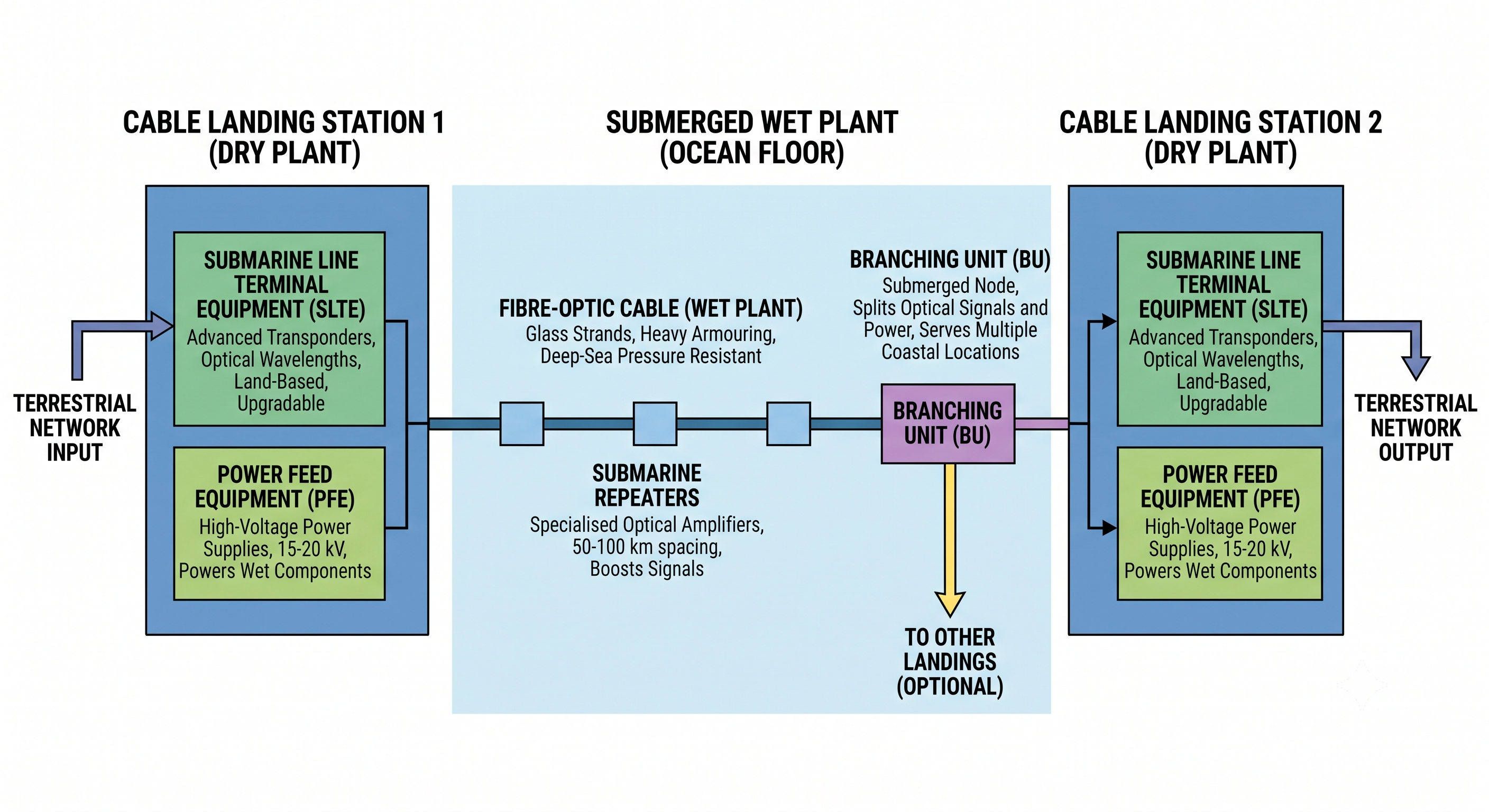
This image was generated using Gemini (3.5 Thinking).
The Terrestrial Dry Plant
The dry plant is located within the Cable Landing Station (CLS), housing the equipment to power cables and process optical signals. Its primary components are:
- Submarine Line Terminal Equipment (SLTE): Advanced transponders that convert terrestrial network signals into optical wavelengths. As they are land-based, these can be readily upgraded to increase capacity without replacing the underwater fibre.
- Power Feed Equipment (PFE): High-voltage power supplies (15–20 kV) that provide the essential electricity required to operate the underwater components.
The Submerged Wet Plant
The wet plant is the submerged infrastructure, accounting for most capital expenditure and logistical complexity. Its key components include:
- Fibre-Optic Cable: The transmission medium, consisting of glass strands protected by heavy armour to withstand deep-sea pressure.
- Submarine Repeaters: Specialised optical amplifiers, placed every 50–100 km, that boost signals to maintain data integrity over long distances.
- Branching Units (BUs): Submerged nodes that split optical signals and power, allowing a single main trunk cable to serve multiple coastal locations.
The Global Oligopoly and India’s Supply Chain Deficit
India possesses significant domestic expertise in terrestrial optical infrastructure. For instance, Sterlite Technologies Limited holds over 700 patents globally for optical fibre preforms and high-density ribbon cables used in 5G and land-based networks.10 Additionally, companies like HFCL, Polycab, and Finolex also manufacture and distribute optical fibre cables and telecom equipment.
However, this capability does not translate to the submerged wet plant environment. Manufacturing deep-sea systems requires specialised extrusion for heavy armouring and, most critically, the proprietary technology for submarine repeaters designed to operate reliably for 25 years under extreme hydrostatic pressure. This high-barrier, niche market is controlled by a tightly guarded global oligopoly of four vertically integrated providers: SubCom (US), Alcatel Submarine Networks (France), NEC (Japan), and HMN Tech (China).11
For major intercontinental projects like the India-Asia-Xpress and India Europe Xpress systems, Indian operators remain entirely dependent on these foreign contractors for wet plant manufacturing. India therefore depends entirely on foreign suppliers for deep-sea cable components.
Critical Landing Nodes
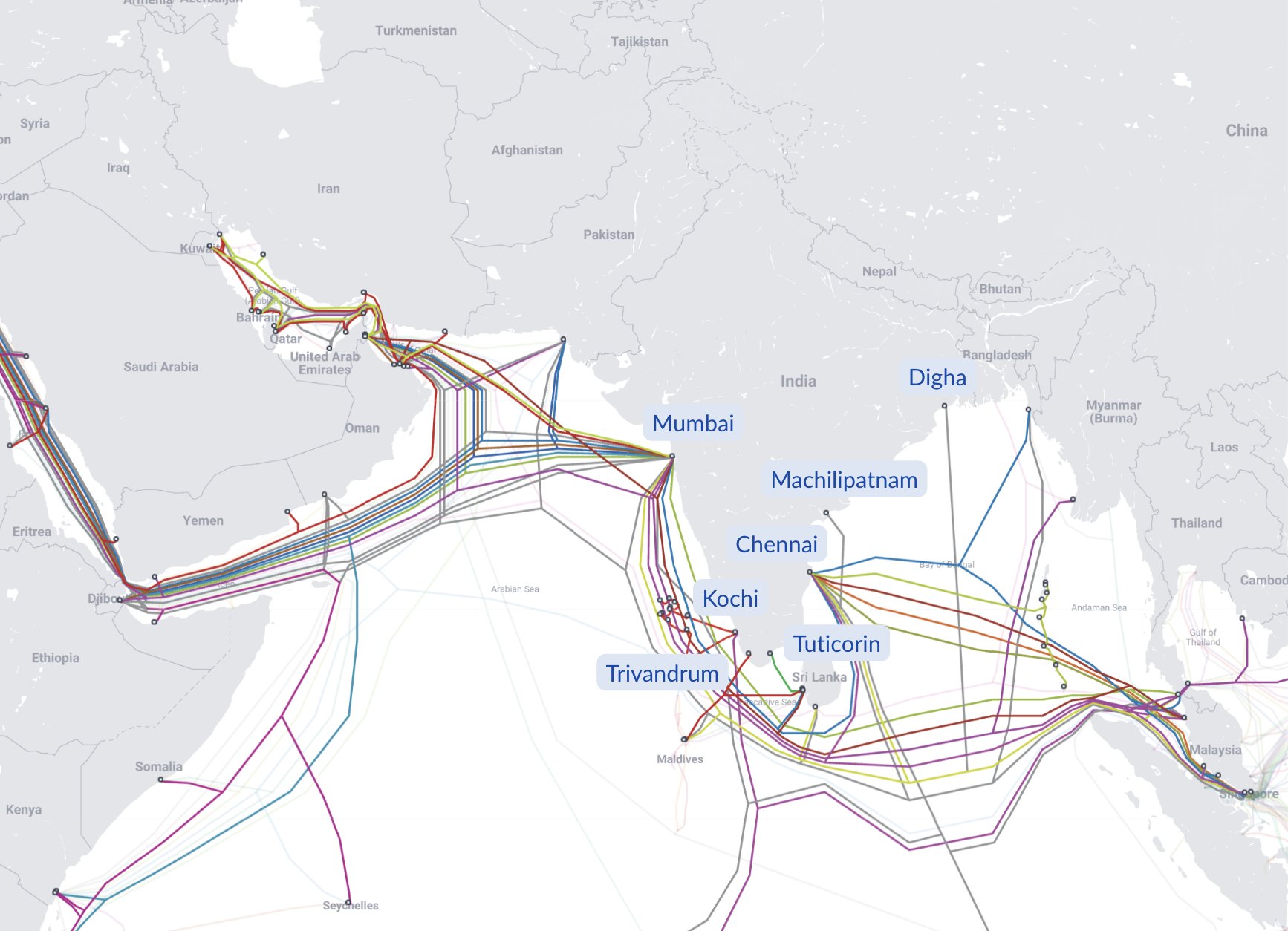
CLS’s bridge oceanic wet plant infrastructure with terrestrial dry plant networks. India’s 18 intercontinental subsea cables land at CLSs across five cities: Mumbai, Chennai, Cochin, Tuticorin, and Trivandrum.
This network faces a critical vulnerability due to severe geographic concentration. At least 13 of these cables land within a six-kilometre stretch at Versova beach, Mumbai, carrying most of India’s intercontinental bandwidth.12 This creates a single point of failure for westward traffic to West Asia, Africa, and Europe and a multi-cable failure at Versova could cut off the bulk of India’s international bandwidth for months, not hours. While no cable-specific cost per hour estimate exists, subsea cable traffic underpins cross-border payments and cloud services relied on across sectors. Chennai acts as a vital secondary hub for Southeast Asian connectivity.
To address this bottleneck, new landing stations are being developed in non-metropolitan locations, including Digha, Bhubaneshwar, Puducherry, and Visakhapatnam. Additionally, strategic cables like the Chennai-Andaman & Nicobar Islands (CANI) and Kochi-Lakshadweep Island (KLI) systems have successfully integrated remote island territories into the national grid.
Evolving Stakeholders: Operators, Hyperscalers, and Data Centres
Historically, the high capital expenditure required for intercontinental subsea cables necessitated their construction by consortia of national telecom operators like Tata, Airtel, Jio, and BSNL. This landscape is shifting, as global hyperscalers take the lead in funding and operating new cables to connect their data centres directly.
India’s Telecommunications (Authorisation for Captive Telecommunication Services) Rules support this by introducing Captive General Service authorisations. This allows enterprises to build private networks, bypassing the requirement to land cables at telco-owned stations (which would then charge premium fees to move data inland).13 This regulatory shift has driven the growth of carrier-neutral data centres and Open CLS architectures, with firms like Yotta, CtrlS, Equinix, STT GDC, and AdaniConnex building major hubs in Mumbai and Chennai for direct high-volume traffic exchange.
However, India remains a premium-priced connectivity market compared to international open-access hubs, a disparity driven largely by disproportionately high infrastructure fees. Subsea cable landing costs account for approximately 20% of India’s total International Private Leased Circuit cost structure, according to the Broadband India Forum (BIF) — a rate the industry group attributes to regulatory and infrastructure bottlenecks rather than global norms. By contrast, Singapore regulates landing station access on a cost-oriented basis with open, unbundled access for all operators, and hosts 28 cables across three competitively allocated landing sites — a model BIF cites as a benchmark for reducing India’s cost disparity.14
The cost of landing subsea cables in India is further driven up by high Access Facilitation Charges (AFC), combined with taxes on a revenue-sharing basis. According to the TRAI ‘International Telecommunication Cable Landing Stations Access Facilitation Charges and Co-Location Charges’ Regulations, AFCs represent mandatory interconnection fees paid to a legacy pool of CLS owners to “light up” intercontinental bandwidth, acting as a gatekeeper that inflates landing overheads compared to global open-access norms.1516
Geopolitical and Operational Challenges
The physical nature of subsea cables makes them inherently vulnerable to unintentional maritime disruptions as well as deliberate strategic sabotage. For India, these vulnerabilities are magnified by geographically concentrated landing points, the lack of domestic repair capabilities, and a regulatory environment that slows down repair time.
Strategic Chokepoints and Cable Damage
International maritime law, codified in the United Nations Convention on the Law of the Sea (UNCLOS), was drafted in an era when threats to subsea cables were overwhelmingly accidental. 70 to 80% of cable faults globally continue to be caused unintentionally by human activities—primarily commercial fishing trawlers dragging bottom nets and merchant ships dragging anchors.17 However, in the current strategic landscape, subsea cables have emerged as a primary domain for geopolitical competition.
India’s intercontinental data routes are heavily reliant on two strategic and highly congested maritime chokepoints: the Strait of Hormuz (connecting the Persian Gulf to the Gulf of Oman) and the Bab el-Mandeb Strait (connecting the Red Sea to the Gulf of Aden). Both corridors are shallow, narrow, dense with intersecting cable routes, and located in zones of intense geopolitical and military volatility.
It is important to note that subsea cable cuts do not result in an immediate and complete internet blackout. The architecture is designed to reroute traffic. However, dependence on specific concentrated routes results in latency and performance degradation during outages. The objective of securing this infrastructure is to improve network redundancy and reduce repair timelines.
The February 2024 Red Sea incident where the AAE-1, EIG, and SEACOM cables were severed simultaneously, disrupting traffic between Asia, Europe, and West Asia illustrates chokepoint concentration risk. Whether this was deliberate or accidental remains uncertain.18 Furthermore, state-backed sabotage presents a growing grey zone threat. The 2022 Nord Stream gas pipeline incident in the Baltic Sea,19 alongside repeated and suspicious severing of communication cables connecting Taiwan to its outlying islands,20 demonstrates the tactical ease of subverting underwater infrastructure with high anonymity and plausible deniability.21
Global powers now have technological capabilities that can cut cables. For instance, Chinese state entities have recently unveiled deep-sea cable-cutting devices compatible with their Fendouzhe and Haidou series of manned submersibles, which are capable of operating at extreme depths.22 In a hypothetical conflict or hybrid warfare scenario, coordinated physical severance of the concentrated cable clusters converging at Versova beach in Mumbai, or within the shallow straits of the Andaman Sea, could significantly disrupt the Indian digital economy, financial markets, and military communications.
Cable Ship Deficit
Despite the growth in global cable deployment, the global maintenance fleet has remained stagnant and ageing. As of 2022, there were only about 61 active cable repair ships worldwide. Ownership of this specialised fleet is highly concentrated among a few private corporations flagged in countries such as France, Japan, the United Arab Emirates, the UK, and the US.23
This limited workforce is divided by function:
- Maintenance: 19 vessels are bound to active maintenance contracts globally.
- Installation: 26 ships are occupied entirely with laying down brand-new systems.
- Ad-Hoc Support: 16 vessels shift between laying and fixing cables as needed.24
There are zero cable repair vessels that are Indian-flagged, Indian-owned, or permanently stationed within Indian maritime zones. Instead, Indian telecom operators and hyperscalers rely entirely on zone-based maintenance consortia agreements. The primary providers for Indian waters operate out of Singapore and Dubai.25
This complete operational dependence on foreign fleets introduces severe operational delays and national security risks. On average, the time required to repair a cable in Indian maritime zones is between four and five months.26 These delays are primarily driven by the long transit times required for a vessel to mobilise from a distant depot in Singapore or Dubai, load required repair or replacement equipment, and sail to the fault location off the Indian coast.
During periods of geopolitical tension, foreign-flagged commercial vessels may simply refuse to enter the area due to prohibitive maritime insurance premiums or direct threats to the safety of their crews.27 In such scenarios, standard Service Level Agreements (SLAs) between Indian telcos and foreign repair consortia are rendered legally unenforceable through force majeure clauses. Without state-backed repair capabilities, India lacks the ability to lay or repair cables.
Regulatory Ecosystem
While India’s physical lack of repair vessels and cable laying capabilities creates an initial bottleneck, the administrative side of subsea cable maintenance has also been subject to a complex regulatory environment spanning multiple ministries.28 However, under the current regulatory regime, the Union Government has implemented a series of structural overhauls that digitise and accelerate these workflows.
Cabotage Licenses for Cable Repairs
Foreign-flagged ships require specific licenses, called cabotage licenses, to transport goods or passengers within another country’s domestic borders. Foreign-flagged cable repair ships also fall in this category and require licenses from the Director General of Shipping under Sections 406 and 407 of the Merchant Shipping Act, 1958.35 This mandate requires verifying the unavailability of domestic vessels—which is a bureaucratic redundancy given the complete absence of Indian-owned cable repair ships. These bureaucratic processes prolong cable repairs.
To mitigate these vulnerabilities, the International Cable Protection Committee recommended a flag-neutral framework that prioritises operational velocity over domestic vessel mandates. Policy reforms should eliminate the Indian National Shipowners’ Association No Objection Certificate requirement, granting immediate maritime access to specialised repair ships regardless of flag or crew nationality. Furthermore, the Committee recommended an expedited permitting pipeline, standardised and transparent turnaround times, and simplified customs protocols to align national maritime policy with global best practices.36
While these are positive developments, fundamental challenges such as the lack of a domestic-flagged cable repair vessel fleet, heavy concentration of cable landing points in Mumbai, and the lack of wet plant systems manufacturing capabilities remain.
Recommendations
India’s subsea cable architecture is not merely an infrastructure problem, but rather a strategic vulnerability. Most of the CLSs are concentrated in Mumbai. No domestic repair vessel exists. No unified crisis protocol connects telecom operators with the Navy and Coast Guard. No emergency legal framework governs how surviving bandwidth is allocated when a cut occurs. Each of these gaps is serious individually, and together, they constitute a systemic failure.
Figure 3 maps these gaps broadly in a causal loop diagram. At its center is a single node: an outage event. Everything else in the diagram either feeds into that event or responds to it.
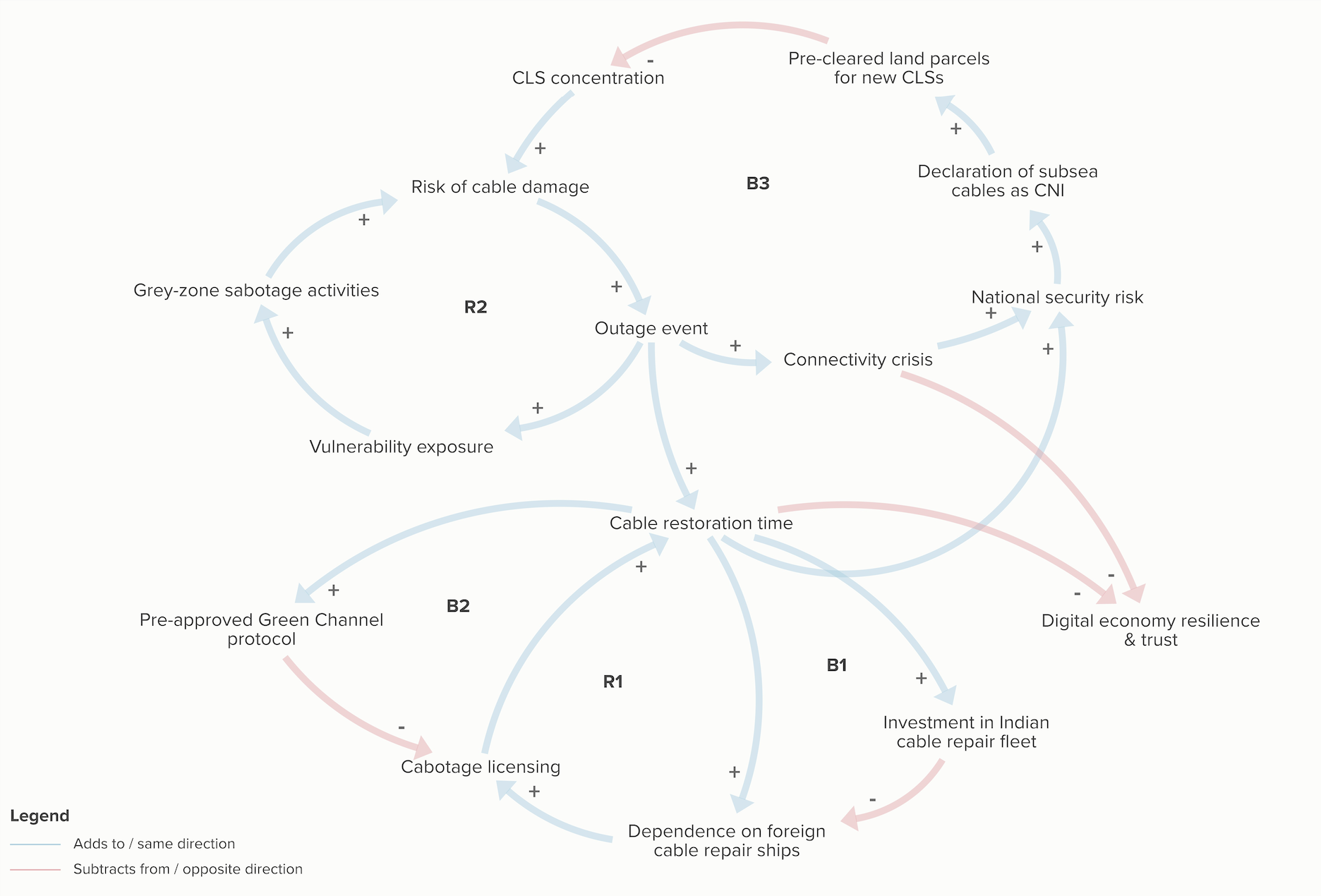
Two reinforcing loops show how the problem compounds on itself. Cable concentration at Mumbai raises the risk of damage, which invites grey-zone sabotage, which raises exposure further, making the next outage more likely. Concurrently, India’s dependence on foreign repair ships and time-consuming cabotage licensing rules slow down cable restoration.
Three balancing loops show where intervention can mitigate these risks. Investing in an Indian repair fleet cuts reliance on foreign vessels, while a pre-approved Green Channel protocol removes the licensing delay. Most importantly, declaring subsea cables Critical National Infrastructure helps unlock pre-cleared land for new landing stations, addressing the concentration problem at its root. The recommendations that follow are a roadmap to achieving this.
CNI Declaration
The core recommendation of this paper is that India should designate subsea cables and CLSs as critical national infrastructure (CNI). This will enable high-priority security enforcement measures, such as the deployment of paramilitary forces to CLSs, the establishment of protected cable zones, and the activation of a “Green Channel” for repair vessel access. Implementing this designation is a necessary prerequisite for security enforcement, emergency protocols, and administrative reforms, and therefore should be issued immediately.
However, CNI designation is not a costless administrative act. Formal designation triggers obligations including mandatory security audits, inter-ministerial coordination structures, and liability frameworks, each requiring budget allocation and bureaucratic bandwidth. DoT is the natural candidate as the lead ministry; in addition, however, an enforcement mechanism and a funding line need to be established. DoT must commission a legal opinion on whether the Telecommunications Act, 2023, enables CNI designation by executive order, or whether amendment or supplementary legislation is required. Until this is resolved, the implementation timeline for Clusters One through Three of the recommendations below is uncertain.
The clustering of cables reflects a legacy of commercial logic, driven by established terrestrial backhaul networks, dense interconnection points, and available real estate for landing facilities. However, the rationale for state intervention emerges from a fundamental market externality: while private firms internalise the commercial risk of connectivity failures, the broader national security implications of a systemic outage are socialised across the economy.
Cluster One: Survive The First 72 Hours
Outcome: Ensuring India can manage a major cable cut without a national connectivity crisis. An emergency Quality of Service (QoS) protocol should be activated within 6 hours, and repair authorisation for a declared fault should be issued within 72 hours of fault declaration.
Commission a National Cable Asset Inventory (Immediate, DoT-led): A classified national mapping of all subsea cable assets such as routes, landing points, capacity, ownership, condition, backhaul infrastructure, and Internet Exchange Point interconnections is the prerequisite for every operational decision that follows a fault.
Establish the Green Channel for Repair Vessel Deployment (Immediate, DoT + MHA + Customs): Under current cabotage law and customs clearance requirements, foreign repair ships take weeks to legally operate in Indian waters. A pre-approved Green Channel would cut that significantly. The protocol should pre-clear vessel entry, equipment imports, and naval permission in a single standing order initiated as soon as a fault is declared.
Deploy Emergency QoS Protocol (Immediate, DoT-led): If a major cut occurs and surviving cables carry only a fraction of normal capacity, bandwidth allocation cannot be left to market mechanisms. The emergency QoS protocol, which is activated when declared capacity falls below a threshold, automatically limits consumer traffic and guarantees bandwidth for defence communications, financial settlement networks, and government systems.
Mandate AI-Driven network rerouting system (Immediate, DoT-led): Mandating an AI-driven network rerouting system across all major telecom operators that enables surviving cables to absorb rerouted traffic instantly. This is a technical standard that DoT can impose through existing licensing conditions.
Audit and Integrate Navy/Coast Guard/CLS Protocols (Immediate, DoT + MoD + MHA): No unified protocol currently connects a cable operator’s fault detection system with a Coast Guard response. An immediate audit of communication protocols that covers vessel tracking, incident reporting, and response coordination can close this gap. Physical security upgrades at cable landing stations, including restricted access and insider-threat vetting, should be completed in the same exercise.
Cluster Two: Reduce Concentration Risk
Outcome: A single-point failure at Versova or Chennai does not take down India’s intercontinental connectivity. No single landing location carries more than 40% of intercontinental bandwidth by 2030.
- Develop the Vizag-Hyderabad Terrestrial Backhaul Corridor (6 months, DoT + DBN Fund): Visakhapatnam has a new cable landing station under development. Aggressively developing the Vizag-Hyderabad terrestrial backhaul corridor using Digital Bharat Nidhi funds would mean that if Chennai’s landing stations are disrupted, the eastern gateway remains open. This geographic diversification is the inland link to major data centres that can be achieved in the short term.
The Digital Bharat Nidhi (formerly known as the Universal Service Obligation Fund) is a government mechanism funded by a 5% fee on the revenue of telecom companies. Its main purpose is to fund essential phone and internet infrastructure in rural, remote, and commercially unviable areas.37
Upgrade Island Transit Capacity (2 years, DoT + MoD + Island Administrations): The Andaman & Nicobar and Lakshadweep islands are currently endpoints, i.e. they receive connectivity but do not contribute to it. Upgrading their subsea links to high-capacity transit hubs would mean they could route traffic to whichever mainland port has the least congestion at any given moment. This converts the CLSs at the islands into distributed nodes that provide rerouting options.
Deploy Distributed Acoustic Sensing (DAS) on all cables (6 months, DoT mandate): DAS technology turns the fibre optic cable itself into a continuous acoustic sensor which is capable of detecting the signature of an anchor drop or an approaching uncrewed underwater vehicle (UUV) before a cut occurs. Mandating DAS integration on all new cables and retrofitting existing systems enables pre-emptive warnings for crisis responders.
Establish Binding Capacity-Sharing Agreements Among Operators (Immediate, DoT-led): Such agreements can ensure that if one operator’s system fails, others are legally obligated to provide temporary routing capacity for priority traffic.
Pre-Clear Land Parcels for New Cable Landing Stations (Immediate, DoT + state governments): Pre-identifying and pre-clearing coastal parcels removes land acquisition constraints for private and consortium investments.
Cluster Three: Build Sovereign Repair and Manufacturing Capability
Outcome: India can repair its own cables and is not dependent on foreign operators for critical infrastructure maintenance. At least one Indian-flagged cable repair vessel operational and stationed in the Arabian Sea by 2027 and 50% Indian ownership of intercontinental cable bandwidth achieved by 2030.
Build an Indian Cable Repair Fleet Under PPP (2 years, DoT + Ministry of Ports, Shipping, and Waterways): Under a public-private partnership structure, India should commission cable repair ships permanently stationed in the Arabian Sea and the Bay of Bengal. Ships must be capable of reaching any fault location within India’s EEZ within 48 hours. In the interim, existing naval and coast guard vessels should be equipped with modular cable repair kits to provide stopgap capability while the dedicated fleet is built.
Equip Naval and Coast Guard Vessels with Modular Repair Kits (6 months, DoT funding + Navy): While modular kits on existing multipurpose vessels do not provide full cable repair capability, they can perform emergency temporary repairs sufficient to restore partial connectivity while a dedicated ship is en route.
Mandate 50% Indian Ownership of Intercontinental Cable Bandwidth (2 years, DoT policy): A formal policy requiring that at least 50% of India’s total intercontinental subsea cable bandwidth be contracted to Indian entities under Indefeasible Right of Use agreements — supported by viability gap funding for qualifying projects — reduces dependence on foreign-owned systems. While this is partly satisfied as existing foreign-owned cables have Indian consortium members, it is a significant market intervention. The threshold should be introduced in phases with a mandatory review of foreign investment impact before each step-up, which reduces the risk of non-compliance.
Indefeasible Right of Use agreements grant buyers in the telecommunications sector the exclusive right to use a specific portion of network capacity for an extended period.
- Initiate Domestic Cable Manufacturing (2 years, DoT + industrial policy): Building an indigenous supply chain that reduces import dependency for a strategic asset can enhance domestic cable manufacturing. The immediate goal should be to fast-track the development of domestic armouring and Branching Unit capabilities, with repeater indigenisation as a long-horizon objective. A supply chain risk assessment covering all components, with geopolitical risk profiling and a diversification strategy favouring Quad and EU suppliers, should accompany procurement planning.
Cluster Four: Attract Global Cable Investment
Outcome: India becomes a preferred cable landing destination, increasing route diversity and commercial redundancy by design.
Implement Single-Window Clearance for Friendly Consortia (Immediate, DoT-led): A single-window clearance system that is available to consortia from trusted jurisdictions can help Indian CLSs become faster and cheaper to land in than neighbouring countries, facilitating a natural pivot for cables to land in Indian shores. This is a regulatory reform with the potential for a structural shift in how global cable infrastructure is developed in the Indian Ocean.
Publish a National Subsea Cable Masterplan (6 months, DoT + MEA): A DoT-MEA National Subsea Cable Masterplan signals to investors, consortia, and foreign governments that India’s cable expansion is a deliberate strategic project, and not an ad hoc accumulation of commercial decisions. This framing positions India as a hub by design and creates the policy anchor around which bilateral Cable Landing Agreements can be negotiated.
The third recommendation in Cluster Four requires its own dedicated feasibility study before it can be actioned. It is included here to signal strategic direction rather than as an immediately actionable policy step.
- Initiate a Sovereign Pan-IOR Cable Network (6 months groundwork, MEA + PMO + DoT): India should begin the diplomatic and financial groundwork for a sovereign-backed cable network connecting East Africa to India and onward to ASEAN — running through the Indian Ocean rather than through the Strait of Hormuz or Malacca. This is a long-horizon project, but the groundwork (route studies, bilateral agreements, financing structures) must begin now if India is to have a structurally independent connectivity architecture by 2035. Co-investment with the EU in an alternative westward cable route bypassing the Red Sea forms the western complement to this initiative.
Cluster Five: Strategic Deterrence and Underwater Domain Awareness
Outcome: India can detect, attribute, and deter hostile interference with its subsea infrastructure by 2030.
Integrate Fault Detection with Naval Interdiction (2 years, DoT + MoD): Linking telecom operators’ DAS alerts and fault detection systems directly to Coast Guard and Navy command structures and triggering the automatic dispatch of maritime patrol units to fault coordinates helps provide stopgap capabilities in the event of a cable cut.
Cable Protection Corridors Data Feed (2 years, MoD + ISRO + DoT data feeds): Integrating commercial and military surveillance data into a single feed focused on cable protection corridors provides the situational awareness necessary for coordinated response. Furthermore, AI integration can be used in the Underwater Domain Awareness framework to differentiate seismic events from trawlers from hostile UUV activity.
Commission a Dedicated Seabed Warfare Platform and uncrewed underwater vehicle (UUV) Capability (Long-term strategic horizon, Navy + DRDO): Building a long-term security architecture for subsea cables involves commissioning a dedicated seabed warfare ship, comparable to the UK’s RFA Proteus, to serve as a platform for autonomous underwater vehicles. Additionally, equipping Kalvari-class submarines for enhanced monitoring roles and developing an autonomous UUV picket at strategic chokepoints can build comprehensive underwater domain awareness capabilities, establishing a credible deterrent that protects Indian infrastructure from grey-zone interference.
Conclusion
India’s subsea cable ecosystem serves as the backbone of its digital economy, yet the nation’s current architecture remains defined by significant structural challenges. With subsea cables approaching end-of-life and zero domestic-flagged repair vessels, India is critically exposed to prolonged, foreign-dependent maintenance timelines that leave its cables vulnerable. As India scales its domestic data centre and artificial intelligence infrastructure, it can no longer treat subsea cables as mere commercial utilities. Securing, modernising, and building domestic capabilities within the subsea ecosystem is a national security and geoeconomic imperative.
Footnotes
“Submarine Cables,” National Oceanic and Atmospheric Administration, n.d. (last updated March 5, 2024). Link.↩︎
Yoni Tobin and VADM Michael J. Connor, USN (ret.), “To Protect Undersea Cables in the Middle East, US Needs a New Hub,” JINSA (originally published in Breaking Defense), April 2025. Link.↩︎
“Oceans and the law of the sea,” Resolution A/RES/77/248 adopted by the UN General Assembly, United Nations, January 2023. Link.↩︎
Ajay Banerjee, “Quad partners discuss addition of undersea cables for India,” The Tribune, July 2025. Link.↩︎
“Key Takeaways from India’s 1st International Subsea Cable Systems Conference,” Broadband India Forum and Global Digital Inclusion Partnership, April 2025. Link.↩︎
“Severed cables disrupt Internet,” BBC News Online, January 2008. Link.↩︎
Dan Swinhoe, “Subsea cable repairs in Houthi-controlled waters in the Red Sea completed,” DatacenterDynamics, July 2024. Link.↩︎
“Media Enquiries & Frequently Asked Questions,” International Cable Protection Committee (ICPC), May 2026. Link.↩︎
“STL reports Q2 FY’26 results; driven by innovation, records strong order book growth,” STL (Sterlite Technologies Ltd), November 2025. Link.↩︎
Joscha Abels and Milan Babić, “Cable wars? Mapping the political economy of submarine cables in an era of geoeconomic competition,” Globalizations, January 2026. Link.↩︎
Sahil Mohan Gupta, “India’s Cheap Internet Runs Through the World’s Most Dangerous Waters,” BW Businessworld, 2026. Link.↩︎
“Telecommunications (Authorisation for Captive Telecommunication Services) Rules, 2025,” Ministry of Communications (Department of Telecommunications), Government of India, September 2025. Link.↩︎
“Key Takeaways from India’s 1st International Subsea Cable Systems Conference,” Broadband India Forum and Global Digital Inclusion Partnership, April 2025. Link.↩︎
“Idea Response to TRAI Consultation Paper on Access Facilitation Charges & Co-location Charges at Cable Landing Stations,” Telecom Regulatory Authority of India, 2012. Link.↩︎
“RCOM Comments : Consultation Paper on “Estimation of Access Facilitation Charges and Co-location Charges at Cable Landing Stations”,” Telecom Regulatory Authority of India, January 2012. Link.↩︎
“Media Enquiries & Frequently Asked Questions,” International Cable Protection Committee (ICPC), May 2026. Link.↩︎
Dan Swinhoe, “Subsea cable repairs in Houthi-controlled waters in the Red Sea completed,” DatacenterDynamics, July 2024. Link.↩︎
“The Nord Stream Incident: Open Briefing,” Security Council Report, August 2025. Link.↩︎
Brian Hioe, “What Actually Caused the Latest Submarine Cut Near Taiwan?,” The Diplomat, May 2026. Link.↩︎
Taylar Rajic, “Building Cooperative Frameworks for Subsea Cable Security in the Indo-Pacific,” Center for Strategic and International Studies (CSIS), March 2026. Link.↩︎
“China unveils underwater ‘kill switch’ for the internet: How this tech could sever global connectivity,” Economic Times, 2025. Link.↩︎
Taylar Rajic, “Building Cooperative Frameworks for Subsea Cable Security in the Indo-Pacific,” Center for Strategic and International Studies (CSIS), March 2026. Link.↩︎
Taylar Rajic, “Building Cooperative Frameworks for Subsea Cable Security in the Indo-Pacific,” Center for Strategic and International Studies (CSIS), March 2026. Link.↩︎
“Consultation Paper on Licensing Framework and Regulatory Mechanism for Submarine Cable Landing in India,” Consultation Paper No. 15/2022, Telecom Regulatory Authority of India, December 2022. Link.↩︎
“Key Takeaways from India’s 1st International Subsea Cable Systems Conference,” Broadband India Forum and Global Digital Inclusion Partnership, April 2025. Link.↩︎
“Key Takeaways from India’s 1st International Subsea Cable Systems Conference,” Broadband India Forum and Global Digital Inclusion Partnership, April 2025. Link.↩︎
“Key Takeaways from India’s 1st International Subsea Cable Systems Conference,” Broadband India Forum and Global Digital Inclusion Partnership, April 2025. Link.↩︎
“Telecommunications (Authorisation for Captive Telecommunication Services) Rules, 2025,” Ministry of Communications (Department of Telecommunications), Government of India, September 2025. Link.↩︎
Winston Qiu, “India’s Telecommunications (Authorisation for Captive Telecommunication Services) Rules 2025: A Game-Changer for Subsea Cable,” Submarine Networks, March 2026. Link.↩︎
Winston Qiu, “India’s Telecommunications (Authorisation for Captive Telecommunication Services) Rules 2025: A Game-Changer for Subsea Cable,” Submarine Networks, March 2026. Link.↩︎
“Recommendations on Licensing Framework and Regulatory Mechanism for Submarine Cable Landing in India,” Telecom Regulatory Authority of India, June 2023. Link.↩︎
“Understanding Right of Way as per Telecommunications Act 2023 & Right of Way Rules 2024,” Department of Telecommunications, Government of India, October 2024. Link.↩︎
“National Single Window System for Business Approvals,” Invest India / Department for Promotion of Industry and Internal Trade, Government of India, n.d. Link.↩︎
“The Merchant Shipping Act, 1958,” Government of India, October 1958. Link.↩︎
“Consultation Paper on Licensing Framework and Regulatory Mechanism for Submarine Cable Landing in India, No.15/2022,” International Cable Protection Committee (ICPC), submitted to Telecom Regulatory Authority of India, January 2023. Link.↩︎
“Universal Service Obligation Fund,” Press Information Bureau, Ministry of Communications, Government of India, November 2024. Link.↩︎