One switch, many businesses
| AUTHOR | Arindam Goswami |
| DATE | August 13, 2026 |
| CATEGORIES | High Tech Geopolitics UPI DPI |
This recent piece on UPI pricing made some very good arguments which I agree with, but which could also create some confusion. It said open up the protocol, which is very logical and seems the correct thing to do. But what does an open protocol have to do with whether a transaction carries a fee? Leave the fee to whoever maintains the infrastructure. Moreover, there could be several NPCIs, which was the original plan before the finance ministry shelved it, and the protocol only needs to be one and interoperable. We charge for water and electricity because user charges align incentives better than tax-funded spending does. So why not do this with UPI pricing too?
Let’s look at these arguments and see where they might break down. The water analogy is also wrong in an interesting way.
The one mandatory layer
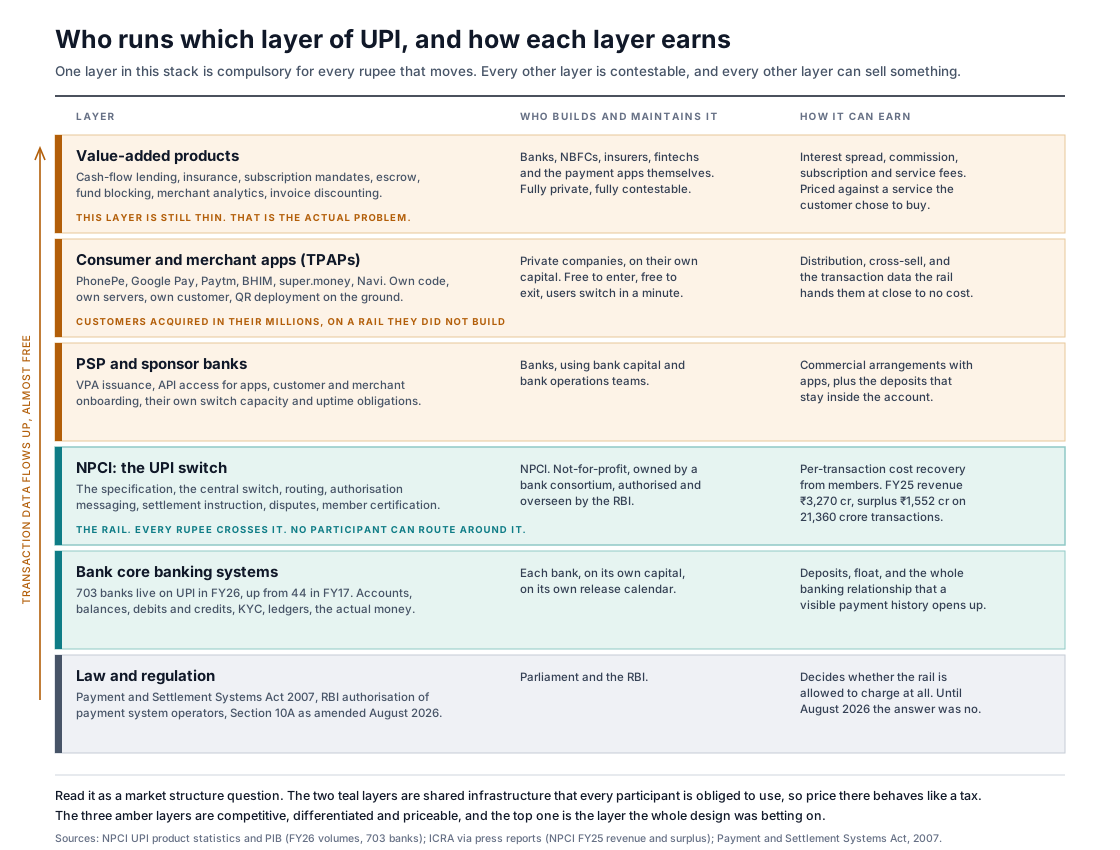
Figure 1: Who runs which layer of UPI, and how each layer earns.
Sharma’s claim in the above cited piece is that UPI was built as a protocol carrying a private industry on its back. The policy design treated a frictionless payment as a public good. The technical design separated custody of money from collection of consent, so the bank kept the account while the app took the authorisation and got to watch the transaction go by. Earnings were supposed to happen above the rail, on credit and insurance and investments sold to customers acquired through a transfer that cost nothing.
Now, look at the stack in the diagram above. A merchant can change apps this afternoon and a customer can change banks, but every transaction still needs to go through the NPCI switch. Pricing power on a mandatory layer is a different beast altogether from pricing power anywhere else in the picture, which is why the openness question and the fee question are the same question. They can’t be kept apart.
The water tariff analogy breaks
The water tariff works because a litre I draw is a litre you cannot. There is marginal cost involved, and it rises with congestion, and a price does useful work by rationing the resource and signalling where the next pipe should go. A UPI message costs a fraction of a paisa to switch, and my sending one takes nothing away from you. Payments then add a wrinkle which other utilities don’t have: each extra user raises the value of the network for everyone already on it, and when use throws off a positive externality you want more of it at the margin. Every new person on UPI makes the network more useful to everyone already on it, and none of them pay him for that. He is already under-rewarded for joining. Charging him is pushing in the wrong direction. In economic theory terms, goods with positive externalities are undersupplied in a free market and warrant a Pigouvian subsidy, which is the mirror image of a carbon tax. Payment networks are the textbook case because the externality is direct rather than diffuse: the value of a network to any one member rises with the number of other members.
Fixed costs, of course, still have to be paid for. Utility pricing theory says recover them from the margin least likely to walk away, which is nowhere near the forty-rupee chai payment. A water utility is a regulated natural monopoly whose tariff a regulator holds close to cost, because competition doesn’t apply on a single pipe network. Applying this logic to UPI should lead to a cost-recovery pricing on the switch rather than a percentage of every transfer.
There will not be several NPCIs
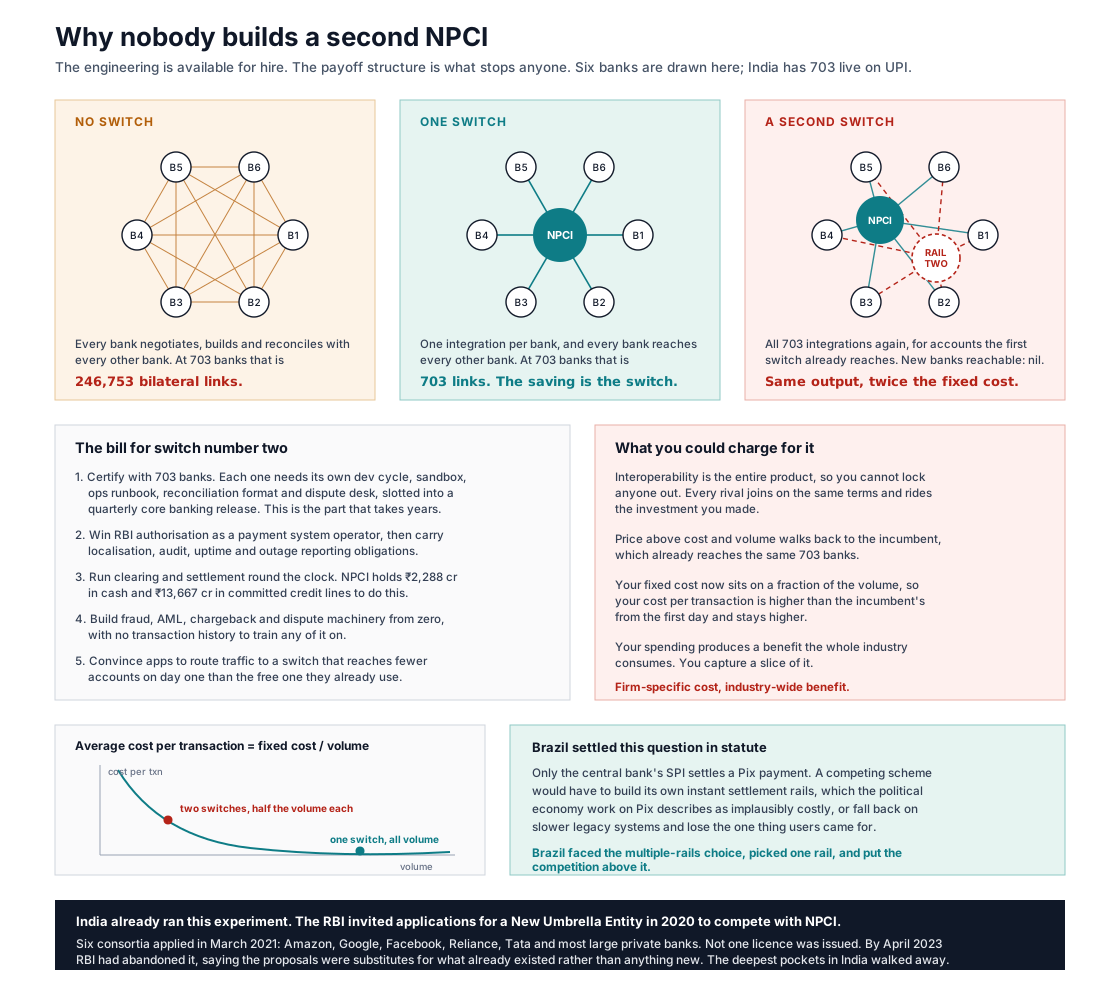
Figure 2: Why nobody builds a second NPCI.
This is an important point to ponder over. There are 703 banks and other UPI participants live on UPI. Without a hub they would need 246753 bilateral relationships; the switch collapses that into 703. Writing such a switch is a solved engineering problem and a competent team could ship one in a year. The moat sits elsewhere. Each of those 703 banks has to build to your specification, test it, staff a dispute desk for it, fit it into a quarterly core banking release, and keep it alive at three on a Sunday morning. Multiply that tedium by 703 and you are counting years. UPI’s current hub-and-spoke architecture avoids the need for every participant to maintain a direct connection with every other participant.
Then look at the payoff. The whole value proposition of a second switch is reaching accounts the first one already reaches, so on day one it offers less for the same effort. Interoperability is the product, so the builder cannot lock rivals out. Everybody joins on identical terms and rides a rail they never paid for. But the moment you charge above cost, the volume risks drifting back to the incumbent. Split the traffic and fixed cost per transaction rises for both switches, so duplication buys the same output at a worse unit price. A private firm would be funding an asset whose benefits the whole industry consumes while the cost sits on one balance sheet. The result would be underinvestment.
All these plans once existed, and also got tested. The RBI put out a New Umbrella Entity framework in 2020, invited applicants to build a retail payments system that would compete with NPCI, and six consortia filed in March 2021. Amazon, Google, Facebook, Reliance, the Tata group and most large private banks were in those consortia. Not one licence was issued. By April 2023 the deputy governor said the proposals were substitutes for what already existed rather than anything new, and the scheme was dropped. The deepest pockets in the country looked at a second rail and every one of them walked. Put the RBI’s stated reason next to the arithmetic above and it fits.
Brazil put the same conclusion in statute. Only the central bank’s settlement system clears a Pix payment, and the political economy work on Pix describes building a rival instant-settlement rail as implausibly costly. Brazil faced the very choice that we are discussing now for India, and chose one rail, and moved the competition upstairs.
What a percentage does to a forty-rupee payment
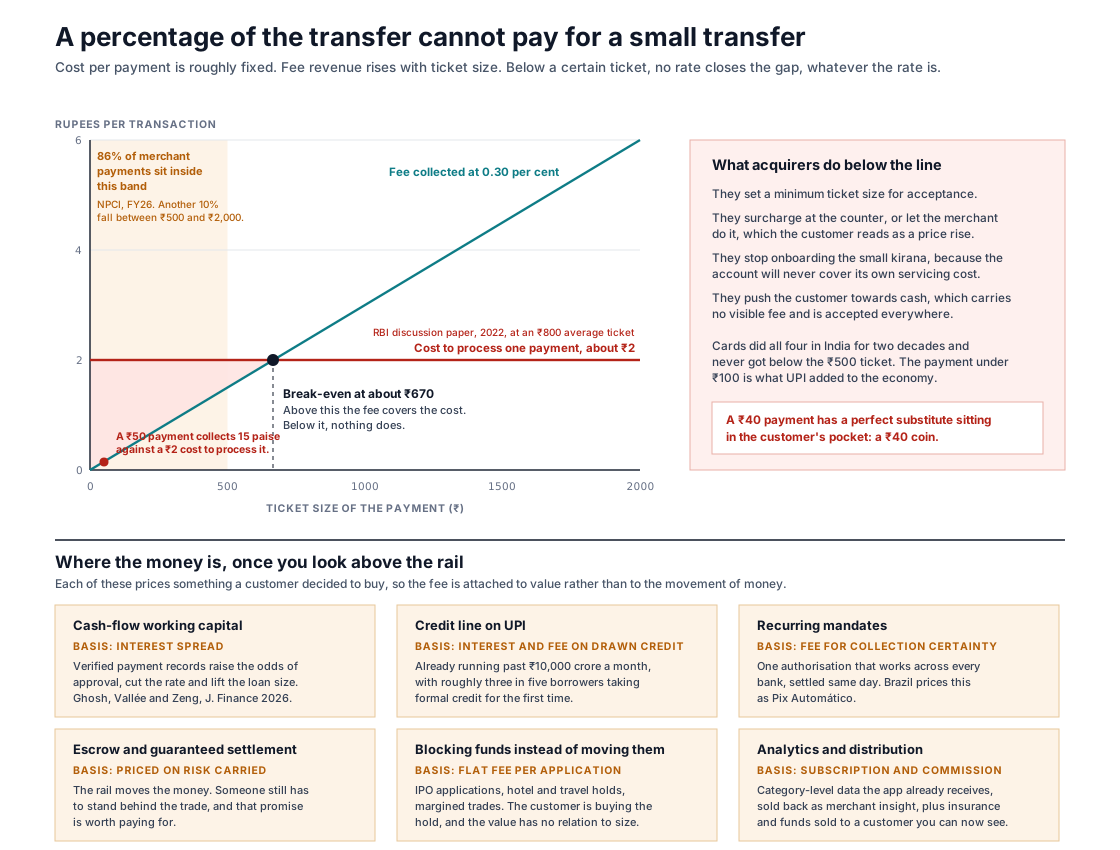
Figure 3: Break-even for an ad valorem fee, and the value layer above the rail.
The RBI’s 2022 discussion paper put the cost of processing an eight-hundred-rupee merchant payment at about two rupees, shared across the payer bank, the beneficiary bank, the app and NPCI. Cost per transaction is roughly fixed while revenue under an ad valorem fee is proportional to value, so at thirty basis points the two curves cross near six hundred and seventy rupees, and below that crossing no rate covers the cost. Meanwhile 86 per cent of merchant payments on UPI are under five hundred rupees.
So the fee does not gently price the small payment. Acquirers respond the way they always have, with minimum ticket sizes, counter surcharges, refusal at the till, and no onboarding for the kirana whose account will never cover its servicing cost. Cards behaved exactly like this in India for two decades and never got below the five-hundred-rupee ticket. The payment under a hundred rupees is what UPI added to this economy, and it has a perfect substitute waiting in the customer’s pocket. This is the goose.
Sell something instead
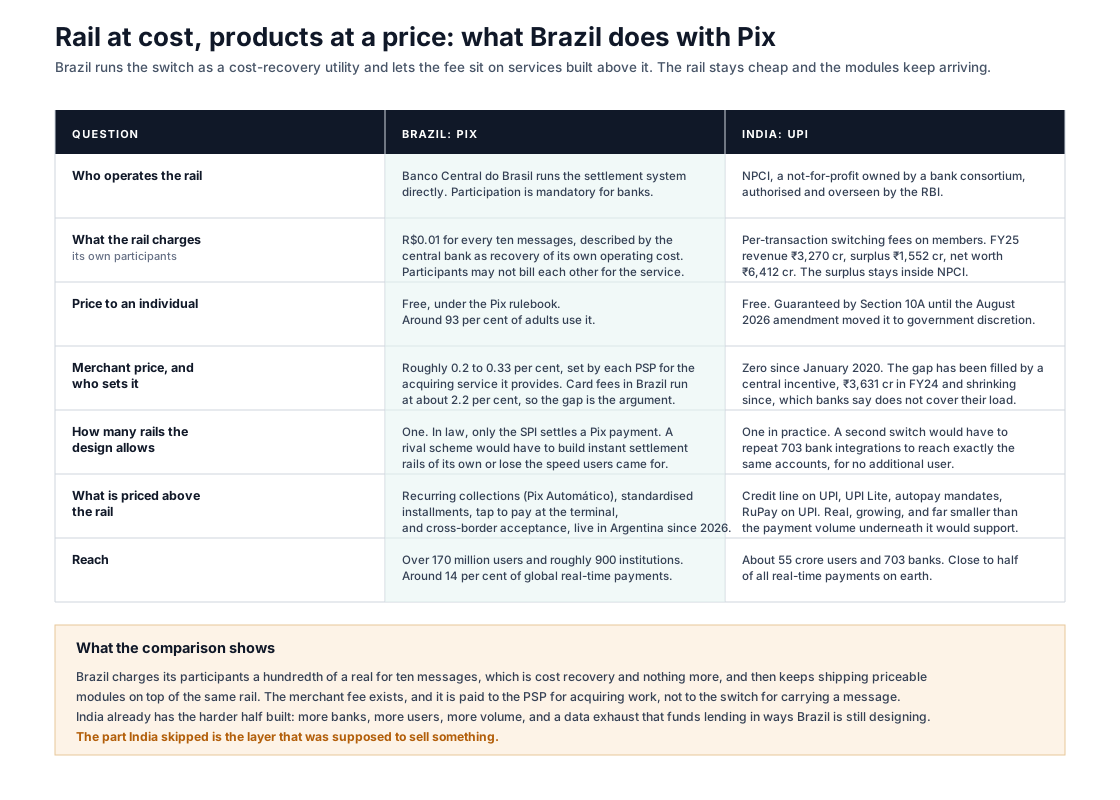
Figure 4: Rail at cost, products at a price: what Brazil does with Pix.
The apps acquired hundreds of millions of customers on infrastructure they did not build, and they receive the transaction data almost free. That position was meant to be sold against. Ghosh, Vallée and Zeng, in the Journal of Finance this year, show what the data is worth: a firm’s use of cashless payments raises its odds of loan approval, lowers the rate it pays and increases the amount it gets, because payment records are verifiable and hard to fake. Sharma adds that districts where UPI grew fastest saw consumer durable lending compound around ten times faster, on data already sitting on the banks’ own servers.
Brazil charges its participants one centavo per ten messages, pure cost recovery, and keeps adding priceable modules on top: recurring collections, standardised installments, tap to pay, cross-border acceptance. The merchant fee there goes to a PSP for acquiring work rather than to the switch for carrying a message.
Which gives the general rule for digital public infrastructure. Keep the compulsory layer dull, cheap and open, and let firms fight it out where differentiation is possible. A percentage on the mandatory layer becomes a tax on everything above it, and it lands hardest on the smallest transaction, the one you spent a decade dragging into the formal system. Publish the specification under an open licence, hand it to a body that does not also run the switch, and most of this argument goes away.
Nobody is going to build a second NPCI. The engineers are available for hire; the return is not there for anyone who tries. Which is exactly why the one switch we have should stay a protocol, and why the fee question deserved a harder look than a voice vote on a Thursday afternoon.