The Wars Revealed Some Uncomfortable Vulnerabilities for India
| AUTHOR | Anupam Manur |
| DATE | July 25, 2026 |
| CATEGORIES | Geoeconomics Trade |
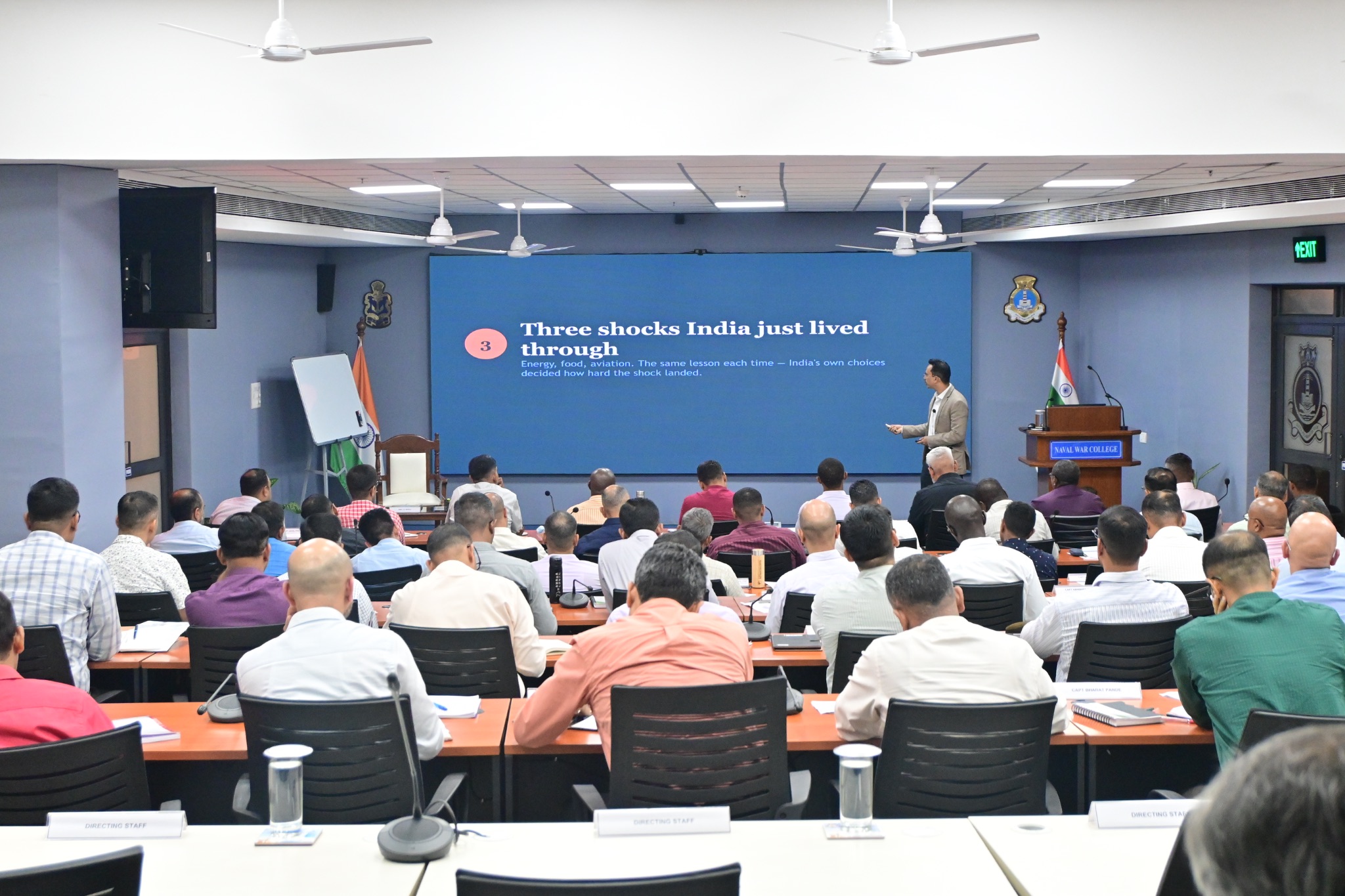
Notes from a lecture at the Naval War College, INS Mandovi, 16 July 2026
The last three years have been a natural experiment in how conflict travels. A war in one region no longer stays there; it moves down supply chains, through insurance markets and payment systems, and arrives in an Indian kitchen, an airline’s fuel bill, or a farmer’s fertiliser sack. Here are seven things I have witnessed:
1. The world has rewired, and this is the new normal.
The era of stable, rules-based international relations is giving way to assertive self-interest. The WTO’s appellate body is paralysed; industrial policy has revived in every major economy; tariffs, export controls and secondary sanctions are now routine instruments rather than emergencies. India’s growth from 1991 to 2008 rode on a kind of benign global neglect, a diplomatic dividend that let us integrate cheaply into world markets. That dividend is now spent. The world that lifted India out of the slow rate of growth simply no longer exists, and planning as though it might return is the most expensive mistake available.
2. Distant wars arrive as bills
A distant conflict reaches you through four channels: prices (crude, LPG, fertiliser, edible oil), logistics (chokepoints, freight, war-risk insurance), payments (sanctions, dollar clearing, reserve freezes) and rules (export controls, tariffs). The distinction that matters is duration. Prices mean-revert. Freight and insurance premia are episodic, though stickier than the threat that caused them. But the rules (the regulatory regime itself) are structural. The rule changes is far more stickier than all others and a country must prepare for that.
3. Interdependence can be used against you.
The comfortable post-1945 assumption was that heavy trade restrains conflict, because war would hurt both sides. The correction, courtesy of Farrell and Newman’s work on weaponised interdependence, is that trade networks are hub-and-spoke and whoever holds the hub acquires two powers. They can see what flows through it, and they can cut you off from it. In other words, the map of your trade is the map of your (potential) vulnerabilities. Openness is still worth defending, but it is no longer free of strategic cost, and pretending otherwise leaves you exposed on someone else’s terms.
4. Domestic Policy Accentuates the Vulnerabilities
This is the uncomfortable centre of the argument. Three shocks, one structure. Energy: crude held up because India buys from 35–40 countries and refines at home, but LPG broke because roughly 90% of it transits one strait, storage is measured in days, and the molecule itself is not fungible. Food: a distorted fertiliser subsidy inflates demand far beyond what the soil actually needs, so India imports more than it should and carries that inflated bill through straits it does not control. Aviation: because India taxes jet fuel as a percentage of price, when the price doubles the tax doubles with it, amplifying the shock instead of cushioning it. Each time, a domestic design choice turned an external tremor into a domestic crisis. We can and must reform these.
5. Suppressing a visible price shock distorts further.
Through the worst of the crisis, petrol prices barely moved and the system looked calm. The shock did not vanish; it was displaced onto the currency, the fisc and public-sector balance sheets. The rupee fell hard, wholesale inflation ran high, and capital left. A price cap is not a subsidy that makes a cost disappear, but it is a decision to convert a targeted, visible cost into a diffuse, invisible one paid by everybody, including people who own no vehicle and buy no cooking gas. Protect people with cash transfers, not with caps.
6. Insurance is stickier than ordnance.
The single finding that should most trouble anyone thinking about naval deterrence: in the Red Sea, after Houthi attacks largely stopped, traffic still did not come back. Bab el-Mandeb’s share of global seaborne trade had fallen sharply, and ships kept taking the long route around the Cape, which added days, distance and fuel cost, because the reconfiguration was being driven by insurance markets and contract structures, not by the live presence of the threat. Deterrence can reopen a sea lane and still fail to restore the trade that used it. Physical security and commercial confidence are not the same variable, and they recover on very different clocks.
7. Dedollarisation is more complex than we think.
It has three distinct elements. Untangle them and the picture clarifies. Settlement in non-dollar currencies is barely happening: the rupee-rouble experiment stalled on balances that piled up unusable and drifted back to dirhams and yuan. Plumbing alternatives (CIPS, mBridge and the rest) are being built, but slowly; their real power right now is that the mere threat of exclusion changes behaviour long before a working substitute exists. Reserves are where something genuine is underway: central banks are quietly moving, and the escape is not to a rival currency but to gold, which is an asset with no issuer and no jurisdiction. This is also the right time to think about crypto as a genuine national security alternative.
Many of these chokepoints have always been there. THe extent of our exposure and vulnerability could have perhaps been managed better. The answer is not autarky, but diversification: more sources, more routes, more trade agreements, fewer single points of failure, and a willingness to let prices tell people what things actually cost while protecting the vulnerable directly. Fix the amplifiers, because they are the part within our control. The next shock is coming regardless.