Pathways to Technology Substitution of Heavy Rare Earth Magnets
| AUTHOR | Tannmay Kumarr Baid, Shobhankita Reddy |
| DATE | November 20, 2026 |
| DOCUMENT | Takshashila Issue Brief 2026-24 |
| VERSION | Version 1.0, November 2026 |
| CATEGORIES | HTG Critical Minerals China |
Executive Summary
China’s April 2025 export licensing of dysprosium and terbium showed how exposed the rest of the world is on heavy rare earths. These elements are refined almost entirely in China and used mostly in the permanent magnets of electric motors. This brief accompanies our interactive dashboard, which shows how these motors work and what could replace them. It sets out three pathways to technology substitution: using less or none of these elements, changing the magnet, and changing the motor. All three will take years to scale.
Introduction
One of our theses about how critical mineral geopolitics will play out is that, ultimately, technology substitution—making these minerals obsolete through alternative technology adoption—will be a clear pathway for the world to de-risk from China. This is particularly applicable for heavy rare earth elements (HREE).
In our analysis of India’s 51 critical minerals, we scored each mineral on ten vectors.1 The HREEs, together with tellurium, came out as the tightest group in the dataset, where India’s exposure is most acute and its options fewest. Each mineral scored at or near the maximum on three vectors at once: refining concentration, reserve concentration and extraction complexity. The refining process, which involves multi-stage solvent extraction of chemically near-identical elements, is so complex that there is currently only one commercially operational HREE separation facility outside China, run by Lynas in Malaysia.
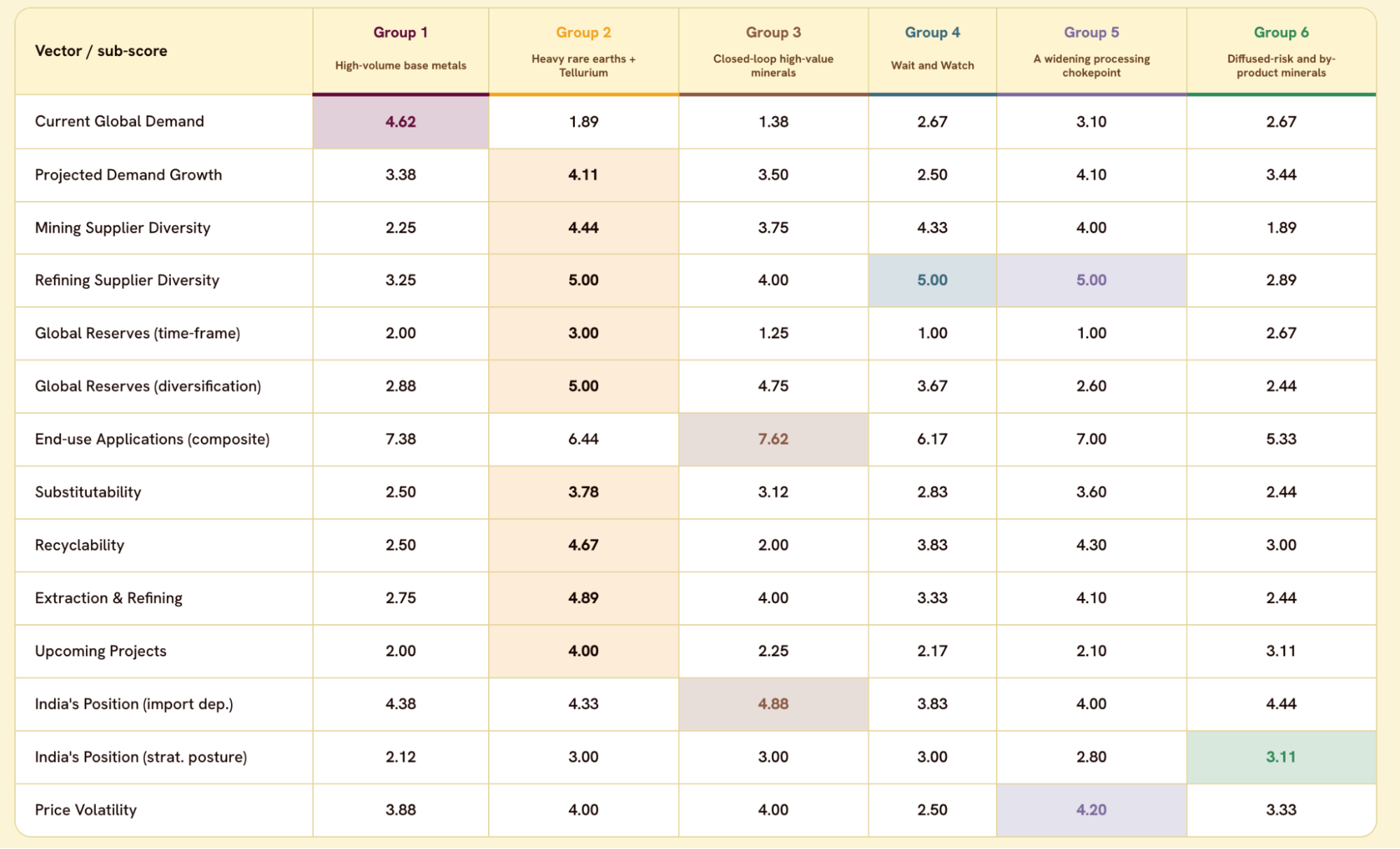
Because these minerals are needed in such small quantities—a few hundred to a thousand tonnes annually—blocking their exports hurts other countries more than it does China. In April 2025, China placed seven medium and HREE, including dysprosium and terbium, under export licensing, along with magnets containing them.2 Those requirements continue to remain in effect, and the initial supply chain disruptions affected some carmakers in Europe and India.3
Heavy Rare Earths in Electric Motors
To visualise the available substitutes and how permanent magnet synchronous motors (PMSM) work, we built a 3D interactive walkthrough.4 It reads best on a desktop.
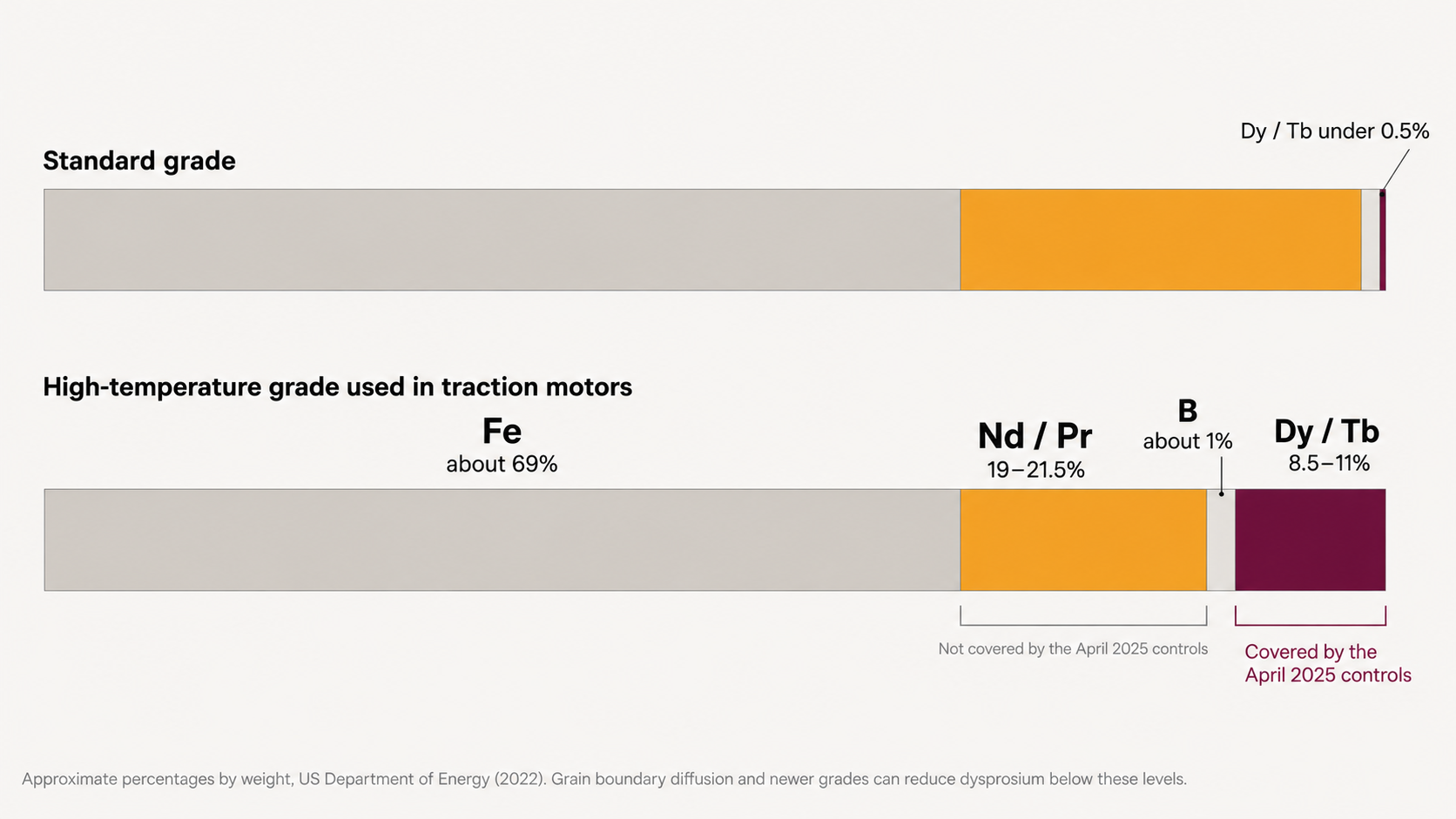
Permanent magnets account for roughly 85–90% of global dysprosium and terbium consumption, with electric motors and generators driving most of that demand. About 80% of modern EV drivetrains rely on high-performance permanent magnets.5 The strong magnetic fields of neodymium magnets deliver high torque density and efficiency, but those fields weaken as the magnet heats up. Adding HREEs gives the magnets their high-temperature resistance, ensuring they don’t degrade during heavy acceleration or continuous high-speed driving. These elements can make up about one-tenth of the magnet’s weight.
Three Pathways to Substitution
The world’s transition away from HREEs in permanent magnet synchronous motors (PMSM) is likely to be three-fold.
Use none or less of them
Since dysprosium and terbium only protect the magnet from heat, a motor designed not to reach high temperatures can use a magnet without them. Such magnets are not theoretical; they are already in production: Proterial, a materials and industrial technology company headquartered in Tokyo, Japan, produces HREE-free NdFeB grades.6
Where applications allow, this is likely to be the fastest lever available, because the rest of the motor and the vehicle largely stay the same. Indian electric two-wheeler makers began switching to light-rare-earth magnets within months of the April 2025 controls. Sona Comstar, a global automotive systems and component manufacturer based in India, has said motors under about 10-15 kW can do without HREEs, and Ather Energy is currently testing early prototypes of light-rare-earth motors that would displace HREEs.7
However, car motors run hotter, so going completely HREE-free means accepting less power, adding cooling or redesigning the magnet and rotor, as Honda Motor did in its Freed hybrid in 2016.8
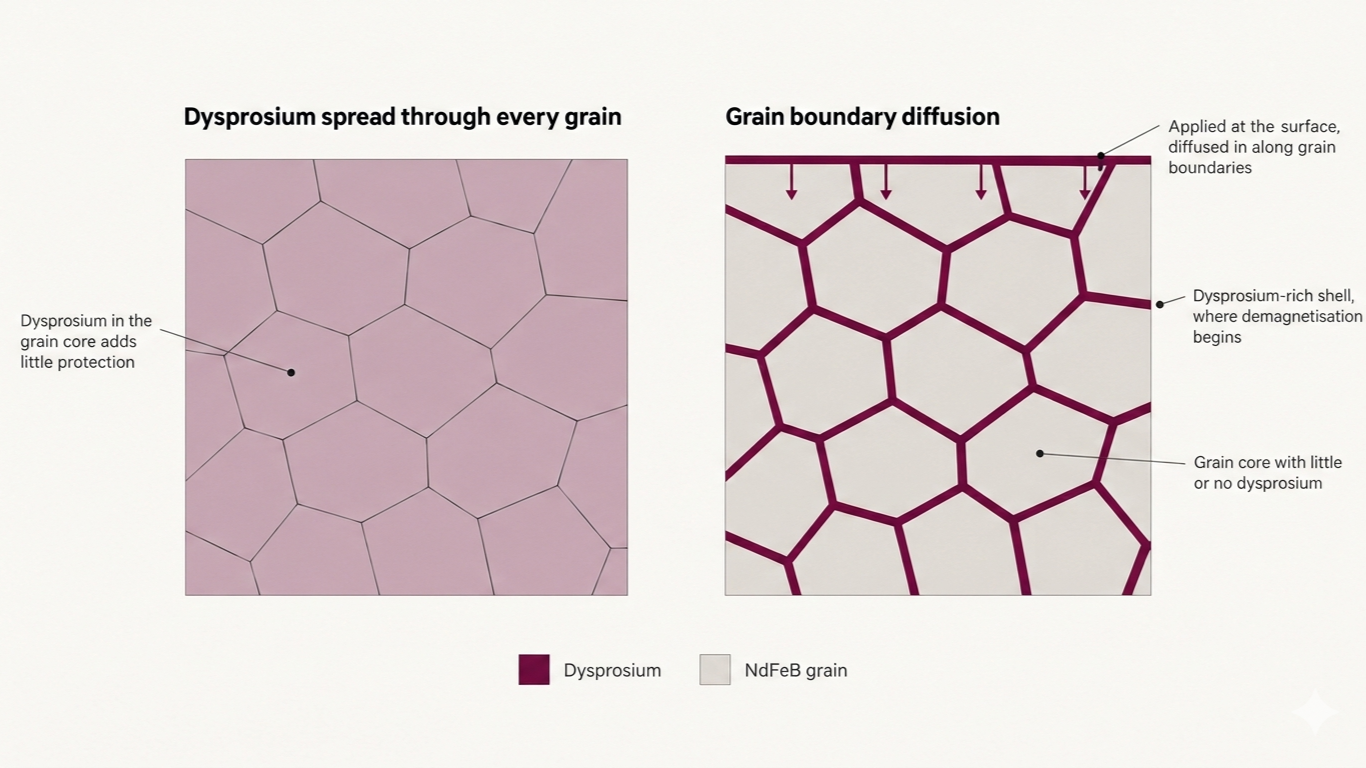
Even then, where a motor still needs heat resistance, it can use less HREEs. In a conventionally built magnet, most dysprosium is wasted. Coercivity is determined at the surfaces of the magnet’s grains, where demagnetisation begins, not in their interiors, so alloying dysprosium uniformly through the material is not its most efficient deployment.
Grain boundary diffusion (GBD) introduces it from the outside instead, concentrating it in a thin shell around each grain. The same heat tolerance can be achieved for a fraction of the HREE content, with less loss of magnetic strength. GBD is a fairly mature and standard technology for most major magnet makers. TDK, a leading manufacturer of industrial and high-performance magnets, says the process has the potential to cut dysprosium by 20-50%, and Nissan deployed an electric motor that needed 40% less dysprosium than earlier versions in its 2012 Nissan LEAF released in Japan.9
Change the magnet with minimal motor redesign
Ferrite magnets are weaker, but they are far cheaper, abundant and free of rare earths altogether. Since the magnetic field is weaker, the motor design needs an update. It has to recover its output through more magnet material, a larger rotor, higher speed or a different geometry altogether. Proterial Ltd.’s ferrite prototype, for example, produces less power than its NdFeB baseline, 102 kW against 110 kW, and is designed to spin faster, up to 15,000 rpm against 10,000 rpm, to make up for its weaker magnets.10
In India, Ola Electric announced government certification of its in-house ferrite motor in October 2025.11 Other magnet chemistries are at an earlier stage. Niron Magnetics, a US-based developer of rare earth-free magnets, and the Indian motorcycle maker Matter showed a prototype motor with iron nitride magnets.12 Still, the material has yet to show it can resist demagnetisation in a traction motor. The motor developer, Conifer, pairs ferrite magnets with an axial-flux layout.13 In such a layout, the field runs along the shaft, and torque comes from a wider disc to compensate for the weaker magnet.
Change the motor
The third is to change the motor. This would be the most expensive of the three options, forcing redesign of other systems, since each motor family has its own inverter, cooling and control requirements. There are four primary alternatives: induction motors, wound-field motors, synchronous reluctance motors (SynRM) and switched reluctance motors (SRM). More details about each of the alternatives are available on the dashboard.
They are still in early stages of commercial deployment. Further, the new motor also has to go through tests and be proven for range, sustained power, noise and durability in that specific vehicle. Therefore, despite being relatively mature technologies, this class of substitution is likely to take the longest to deploy.
Takeaways
- Technology substitution will be a key way to diversify away from China’s dominance in rare earths, and the choice of motor alternative will be application-specific. Several routes compete in the same vehicles and are likely to unfold in parallel across market segments.
- Ferrite magnets are weaker, but they are cheap, abundant and free of rare earths altogether. They are not suited for passenger cars, but India’s massive two- and three-wheeler market allows them to be widely adopted.
- For passenger vehicles globally, where the EV market is concentrated, wound-field motors are likely to dominate the PMSM alternative market. They provide the strong, controllable magnetic field a car’s main drive needs, and Renault and BMW already build them at volume.
- Induction motors are likely to gain where ruggedness or occasional extra power matters and are a proven option for commercial vehicles.
- Synchronous reluctance is farther from use in cars than wound field or induction. Without magnets, it needs a larger inverter and loses much of its power at high speed. Versions assisted by ferrite magnets are under development as they narrow this gap. Astemo, a Hitachi-Honda joint venture, aims to use one as a car’s main drive around 2030.14
- Switched reluctance is the least likely to spread widely in passenger vehicles. Achieving smooth acceleration with low noise and vibration requires substantial control and design work, and its best applications appear to be industrial.
- As the world’s leading EV manufacturer, China’s motor choices will still shape global demand for these magnets in the near term, especially given China’s record of preferential treatment to local components. The prices of many HREEs in the West are several times higher than domestic Chinese prices. This gives Chinese companies less reason to move away from them to heavier, bulkier and less efficient alternatives. The rest of the world will need to lead with technologically superior alternatives to the PMSM to reduce exposure to China’s motors and related incumbent technology.
- Technology substitution will take time to reach scale. Stockpiles for low-volume minerals and their associated magnets can be assembled quickly in the short term, while processing and recycling facilities typically take three to five years to be operational.15
AI tools were used to generate the images and visualizations.
Footnotes
Baid, Tannmay Kumarr, and Shobhankita Reddy. “India Critical Minerals Dashboard.” Takshashila Institution, October 2026. Link↩︎
Ministry of Commerce and General Administration of Customs of the People’s Republic of China. “Announcement No. 18 of 2025 of the Ministry of Commerce and the General Administration of Customs.” Ministry of Commerce, April 4, 2025. Link↩︎
CLEPA. “Urgent Action Needed as China’s Export Restrictions on Rare Earths Disrupt European Automotive Supply Chains.” European Association of Automotive Suppliers, June 4, 2025. Link; Automotive Component Manufacturers Association of India. “Indian Auto Component Industry Clocks Turnover of Rs. 6.73 Lakh Crore (USD 80.2 Billion) in FY 24-25.” ACMA, July 8, 2025. Link↩︎
Baid, Tannmay Kumarr, and Shobhankita Reddy. “The EV Motor’s Rare-Earth Problem.” Takshashila Institution, 2026. Link↩︎
Rom, Christopher L., Rebecca W. Smaha, Shaun O’Donnell, Sita Dugu, and Sage R. Bauers. “Emerging Magnetic Materials for Electric Vehicle Drive Motors.” MRS Bulletin, July 2, 2024. Link↩︎
Proterial. “Proterial Develops High-Performance Heavy-Rare-Earth-Free Neodymium Sintered Magnet for Electric Vehicle Driving Motors.” Proterial, Ltd., July 22, 2025. Link↩︎
Abidi, Shahkar. “Engineering Beats Geopolitics: Sona Comstar Restores Volumes Without Heavy Rare Earths.” Autocar Professional, September 16, 2025. Link; Ather Energy Limited. “Intimation of Deferring Claims under the PM E-DRIVE Scheme for Limited Vehicles.” Filing to the National Stock Exchange of India and BSE, September 25, 2025. Link↩︎
Honda Motor Co., Ltd. “Daido Steel and Honda Adopt World’s First Hybrid Vehicle Motor Magnet Free of Heavy Rare Earth Elements.” Honda Global Newsroom, July 12, 2016. Link↩︎
Magnet Applications. “Grain Boundary Diffusion of Heavy Rare Earth Elements (HREE) in Sintered NdFeB Magnets.” Magnet Applications, a Bunting Company, July 16, 2024. Link; Nissan Motor Corporation. “Activities in the Development Stage: Reducing Scarce Resource Usage.” Nissan Sustainability, accessed November 19, 2026. Link↩︎
Proterial. “Output Exceeding 100 kW Applicable for Traction Motors for BEVs and PHEVs Verified on Actual Ferrite Magnet Motor.” Proterial, Ltd., July 24, 2023. Link↩︎
Ola Electric Mobility Limited. “Ola Electric Becomes India’s First Automotive OEM to Get Government Certification for Its In-House Developed Ferrite Motor.” Ola Electric, October 6, 2025. Link↩︎
Niron Magnetics. “MATTER and Niron Magnetics Unveil Next Generation Rare-Earth-Free Variable Flux Motor.” Niron Magnetics, January 7, 2026. Link↩︎
Conifer. “Conifer | Onshored Electric Powertrains.” Conifer, accessed November 19, 2026. Link↩︎
Astemo. “Astemo Develops New Rare-Earth-Free Motor That Reduces Resource Risks.” Astemo, Ltd., October 27, 2025. Link↩︎
Baid, Tannmay Kumarr, and Shobhankita Reddy. “Critical Minerals Need Priorities, Not Longer Lists.” Moneycontrol, August 6, 2026. Link↩︎