What does the Mecca Pact actually change?
| AUTHOR | Aishwaria Sonavane |
| DATE | November 3, 2026 |
| DOCUMENT | Takshashila Discussion Document 2026-32 |
| VERSION | Version 1.0, November 2026 |
| CATEGORIES | Geostrategy Pakistan West Asia Strategic Studies |
Executive Summary
The Mecca Pact’s ability to translate a common defense commitment into collective military action remains constrained. This paper argues that the Pact operates better as a strategic hedge and a platform for political, diplomatic, financial, and military-industrial support than as an emerging NATO-style coalition.
The author would like to disclose the use of AI tools for formatting citations and preparing the dashboard.
The assessment observes that divergent threat perceptions, competing external dynamics, economic dependencies, and the absence of an integrated command structure will limit its operational reach. An activation model, tested against the first crises involving Pakistan-Afghan conflict, and Saudi Arabia-Houthi conflict, demonstrates how these contraints influence the response of each signatory. In both cases, support hovered largely at the level of diplomatic statements and mediation efforts, instead of any direct military engagement.
For India, the Pact does not present an immediate military threat or opens a new front. Its more consequential implications lie in the potential to strengthen Pakistan’s financial and military resupply, extend its capacity to sustain a prolonged conflict, and create additional diplomatic pressure for early de-escalation. The paper recognises specific indicators to track whether the Pact develops into a functioning security arrangement or remains primarily a political instrument.
The author would like to thank Anushka Saxena, Manoj Kewalramani, and Shambhavi Naik for their review and feedback.
Introduction
With great pageantry, on August 7, 2026, Saudi Arabian Crown Prince Mohammed bin Salman, Turkish President Recep Tayyip Erdogan, and Pakistani Prime Minister Shehbaz Sharif signed a trilateral defence Pact at Al-Safa Palace in Mecca. The Pact declared that an armed attack on one signatory shall be regarded as an attack on all three. The full text, released weeks after the signing, does not identify a specific region or country as a threat. However, it presses on member states to support one another in the event of an armed attack.1 The initial reading suggests a focus on military capacity-building rather than a NATO-style Article 5 collective defence clause. The Pact describes itself as defensive in nature and open to accession.
Sharif and Pakistan Army Chief Field Marshal Asim Munir signed the agreement after performing Umrah in Mecca, and meeting the Saudi and Turkish leaderships. The choice of Mecca for the signing does not seem incidental, as the location lends the agreement a degree of religious legitimacy. A similar pattern was witnessed in Riyadh with the 2017 Islamic Military Counter Terrorism Coalition, when it announced dozens of members. 2
The signing followed a wave of Iranian drone strikes on Saudi territory amid the ongoing West Asia conflict, and the Pact saw its first test as Yemen-based Ansarullah Houthis launched attacks on Saudi Arabia.3 Since the early days, Pakistan’s foreign minister has described it as “purely defensive,” not directed against any country, and open to other nations in the region. No other country has joined the bloc as of writing. However, a meeting between the pact members and Iran was held in late October 2026., but The meeting likely reflected the Pact’s deliberate refusal to not name an adversary, as it keeps a channel to Tehran open. Despite being the target of Iranian fire, Riyadh has preserved its 2023 Beijing-mediated normalisation with Tehran. Ankara has trade and energy ties with Iran, and Islamabad shares a border with it. The pact, therefore, likely serves as both a deterrent against Iran and a conduit to it simultaneously.
Separately, the collective defence strength of this bloc includes approximately 1.4 million active military personnel, more than 3,400 aircraft, over 6,000 tanks, and more than 340 naval assets.4 These figures, however, signal little about the coalition’s ability to fight together. The three militaries are not organised around a common theatre or command structure.
Similar pacts have been signed in the past. In 1954, Pakistan and Turkey signed a Treaty of Friendly Cooperation with Iran, Iraq, and Britain, which later became the Baghdad Pact, and then CENTO. However, when Pakistan fought two wars with India in 1965 and 1971, its CENTO partners did not fight alongside it. Instead, Iran and Turkey sent materiel and diplomatic support. The Regional Cooperation for Development, formed by Turkey, Pakistan, and Iran in 1964, did not evolve into a security arrangement.
Each signatory is widely seen as bringing a unique utility to the table. Pakistan possesses the only nuclear arsenal in the Muslim world, besides operational experience. Saudi Arabia brings capital, energy leverage, and a regional diplomatic standing. Meanwhile, Turkey has NATO’s second-largest military and an increasingly self-sufficient defence industrial base. The agreement sits atop existing bilateral relationships – most notably, the Saudi-Pakistan Strategic Mutual Defence Agreement signed in 2025, and Turkey’s expanding military-industrial cooperation with Saudi Arabia and Pakistan.5 Historically, Riyadh and Islamabad have maintained close ties, which can mostly be characterised as a patron-client relationship. The two countries played a leading role in establishing the Organisation of Islamic Cooperation in 1969. Over the decades, this relationship has remained crucial to both countries’ foreign policies. Meanwhile, the relationship between Ankara and Riyadh has seen many peaks and valleys. The rivalry finds its roots in the Ottoman campaigns since 1818, more recently, in the Arab Spring and the 2018 killing of Saudi journalist Jamal Khashoggi. Nonetheless, Turkey’s rebalancing of its regional policy and rebuilding ties with Arab countries, including the lifting of the Qatar embargo in 2021, facilitated warmer ties.6 Cooperation on Palestine, Syria, and regional security has since strengthened Ankara-Riyadh ties, providing a stronger bilateral context for the signing of the Mecca Pact.
NATO: The shared threat posed by the Soviet Union provided the basis for collective defence during the Cold War.
Warsaw Pact: The perceived threat from NATO and the Western alliance provided a common basis for military alignment.
GCC: Regional insecurity following the Iranian Revolution and the outbreak of the Iran-Iraq War steered greater security cooperation among member states.
Institutionally, the Pact currently remains at a nascent stage, with a Secretariat to be established in Saudi Arabia and a Pakistani secretary-general appointed by consensus. In practice, collective defence operates more effectively when there is a shared threat. However, member states of this Pact currently face divergent threats. Riyadh’s principal concern is Iran and the ongoing bombardments from the Houthis in northern Yemen; Ankara’s primary rival is Israel, alongside threats from Syria and the Iraqi frontier; and Pakistan’s biggest challenge is India on its eastern border, compounded by rising insurgent threats from Afghanistan. Each signatory is, hence, buying insurance from two partners who each maintain working relationships with the very state that the signatory considers its adversary. This structural fault line remains a defining factor for understanding what this Pact can and cannot do.
The paper examines the scope of what the Mecca Pact can realistically deliver beyond the diplomatic weight it holds as an emerging regional bloc. The paper unpacks the individual security calculations that brought the three countries together and notes the structural divergences that may hinder the pact’s enforcement. The paper also develops an activation model to analyse how a collective defence commitment could translate into varying levels of political, financial, military, and diplomatic support. It further tests this framework against the pact’s first live crises involving Pakistan and Saudi Arabia amid their conflicts with the Afghan Taliban and Houthis, respectively. The paper considers the pact’s repercussions for India and the West Asian security architecture, while identifying indicators to determine if the pact develops into a robust defence arrangement or remains constrained to a political instrument. The central question in this dashboard is to understand how far its three signatories are realistically prepared and able to act when their independent interests pull in opposing directions.
Three signatories, three different calculations
In a conventional security coalition, shared threat perceptions provide a basis for collective defence, and create incentives for members to act. However, in the case of the Mecca Pact, the three signatories face divergent threats across different theatres. As a result, the pact has a greater potential to function as a deterrent of last resort and a strategic hedge. It further allows its signatories to signal to external adversaries that aggression could result in unpredictable escalation. That said, a mutual defence obligation also carries risks of entrapment, as signatoriescould risk being pulled into regional conflicts that are not their own.7
Nonetheless, in operational terms, the Pact is likely to remain limited to defensive and mediatory functions. This could involve intelligence sharing, military transfer, and diplomatic manoeuvering, as opposed to total war fighting unity. The October 26 meeting between Iran and Mecca Pact-member states exemplifies this character.8 The meeting further reveals that the Pact also functions as a platform wherein military cooperation and diplomatic hedging occur simultaneously.
This assessment also significantly raises the threshold of any direct cross-border ground operations in Yemen in support of the Kingdom. Overall, the logic behind joining this pact is rooted in the countries’ own threat environment, and those reasons overlap only partially.
The Pact faces its first serious test three months into its signing. Today, Houthi attacks continue to target Saudi’s aviation sector, energy infrastructure, and cities since late July.[^9] Pakistan is in a sporadic cross-border conflict with the Afghan Taliban. Meanwhile, Turkey’s rivalry with Israel took a dangerous military dimension in Syria.[^10] The section below examines each signatory’s strategic calculations individually.
Saudi Arabia
For Saudi, direct exposure to Iranian drone and missile strikes amid the ongoing conflict between Iran and the US & Israel since February 2026 has led to the eroding reliability of American extended deterrence.[^11] The scale and geographical reach of the attacks across the Gulf region demonstrate that even states with extensive American military support remain vulnerable to the spillover effects of the conflict. The pact, therefore, adds a layer of political and materiel support within the region without requiring Riyadh to entirely abandon its security relations with the US. Since late July 2026, the pressure has been consistently mounting on Riyadh from its southern regions, where the Houthis have pounded missiles and drones into Saudi territory, while the US has declined to intervene militarily in its support.[^12] As such, the nature of this threat further explains why Riyadh is keen to broaden its pool of security partners.
So far, Pakistan has reportedly stationed 8,000 military personnel in Saudi Arabia, across air defence and ground forces, and has stated that the combat forces are restricted to defence operations to protect cities and key infrastructure. Meanwhile, Turkey is reportedly providing high-tech defense hardware, electronic warfare capabilities, and technical advisory support.[^13] Both have refrained from offensive operations.
Riyadh has also reached out to Western partners, including the UK, the US, France, and regional nations like Egypt, for support. This outreach beyond signatories reflects the Pact’s inadequacies. The value of this Pact lies in what it adds to that wider portfolio amid lowered trust in Western security commitments. As such, it is an additional layer of support rather than a substitute for others, and its long-term value will lie in its ability to fill the gaps that remain in other relationships.
Turkey
In Ankara’s case, interests likely extend beyond backing the signatories. Erdogan has sought to portray Turkey as an alternative seat of leadership in the Arab world, distinct from Riyadh. The pactoffers an institutional platform for Ankara through which it can influence discourse on regional security, while also institutionalising its existing bilateral ties with Islamabad and Riyadh. This effort will likely allow Turkey to take an active position in steering the changing security arrangements in West Asia. More significantly, the pact will enable it to push its consistently expanding defence-industrial complex, extending it to the Gulf.[^14] This calculation is based on the commercial upside for Turkish defence exporters, strategic autonomy signalling relative to NATO, a stake in West Asian security arrangements, and possible leverage over trade and energy corridors linking the Indian subcontinent and Europe. The defence-industrial dimension remains particularly crucial in Turkey’s context, given that the three signatories have discussed joint technology development, production, military exercises, and greater cohesion between their armed forces. This could turn Turkey’s defence export market into an institutional security partnership rather than a series of bilateral defence transactions.
That said, Turkey continues to remain a NATO member and also maintains relationships with states that Riyadh considers a strategic liability – especially Iran. This distinction is key to predicting Ankara’s behaviour, as it can use the pact to expand its regional influence and defence-industrial footprint, while retaining diplomatic flexibility to sustain relationships outside the alliance.
Pakistan
Pakistan’s relationship with its Gulf patrons is rooted in its Islamic identity since its formation in 1947, and finds constitutional expression in Article 40, which directs the state to consolidate fraternal ties with Muslim nations. Its deepening involvement in West Asia – including mediation efforts between the US and Iran and the signing of two security pacts – coincides with ongoing domestic fiscal challenges. Riyadh’s deposits and financial support help stabilise Pakistan’s currency and balance of payments, which face structural frictions. Therefore, Islamabad’s decision to join the Pact likely rests on factors such as the continuity of Gulf financial support in exchange for military support, diversification of external security ties beyond China and the US, and expanding military-industrial cooperation with Ankara.
For Islamabad, the agreement essentially formalises a security relationship with both Riyadh and Ankara that has existed in practice for years. Pakistani security personnel have long served in Saudi Arabia, and the two countries also maintain defence collaboration, including training and security assistance. The economic dimension remains intricately tied to its security calculations.
Concurrently, Pakistan’s participation in the Pact is not without constraints. Islamabad faces a quandary of balancing security commitments with Riyadh against three internal pressures. First is Iran, with which Pakistan shares a 900-kilometre border. Pakistan presently faces a Baloch insurgency that has continued to overextend internal security, and also a sizeable Shia population whose sectarian sensitivities remain vulnerable should any Pakistani action be perceived as anti-Iranian. Second is Afghanistan, which has been an active western front for Pakistan as Taliban-sheltered militants continue to launch cross-border strikes; the Pakistan Air Force (PAF) has periodically launched aerial strikes deep inside Afghanistan since February 2026. Third is China, Pakistan’s primary arms supplier and the financier of the China-Pakistan Economic Corridor (CPEC), whose flagship port at Gwadar sits close to the Iranian border. These limitations are expected to keep Pakistan wary of getting involved in West Asian conflicts beyond defending the Saudi Royal Family and the Kingdom’s own territory, where its forces are already deployed.
The Pact will prove advantageous for Pakistan only when it elevates its strategic relevance without creating a new military obligation that it cannot afford to fulfill amid already-existing hostile borders. In that context, the Pact offers Islamabad strategic relevance in West Asia, but it does not erase existing pressures,
All three signatories share common interests in steering towards a more multipolar security framework in the Gulf that reduces heavy reliance on the US. They also benefit from the diplomatic weight and deterrence of a formal collective defence instrument.
What the Pact Cannot Do
Riyadh’s primary adversary, Iran, is a trading partner of Ankara. Turkey’s main regional rival, Israel, is keen to seek formal normalisation of ties with Riyadh, and Islamabad’s primary rival, India, is a major economic partner of Saudi Arabia. India and Turkey have strained ties, but Ankara has no comparable stake in confronting New Delhi. The Mecca Pact, in its current form, lacks a resolution to any of these divergences.
The section further elaborates on the limitations that come along with the Pact for all signatories. These issues are likely to complicate things should other nations choose to join the bloc.
- Automatic combat deployment: The agreement obligates signatories to respond to an attack on a member state. Yet, the nature of the response is left to the nation’s discretion. The defence clause does not mandate automatic combat deployments or rapid retaliatory action.
- Integrated command: Unlike NATO, the Mecca Pact does not consist of a permanent, operational joint command structure or unified headquarters. Without a centralised military command to direct forces in real time, coordinated responses and immediate deployment can be challenging.
- Identical threat perceptions: All three signatories have disjointed threat perceptions, as explained above.
- Common rules of engagement or automatic retaliation against identified aggressor: The agreement stipulates no shared rules of engagement, interoperable protocols, or pre-agreed threshold triggers for a coordinated military response. Retaliatory strikes will continue to remain complicated and unpredictable without a consensus framework.
- Operational disconnect and Interoperability gaps: The armed forces of the three signatory countries operate under dissimilar military doctrines, equipment & platforms, and operational frameworks. They lack tactical interoperability, unified communication networks, and joint war-management systems necessary for joint combat operations. The merger of disparate forces in combat zones could result in logistical bottlenecks and command-and-control friction. The three countries have not held trilateral military drills as yet. Ambiguity over the threshold for collective action: Reaching consensus about what constitutes a common threat is an unresolved political challenge. The Pact publicly does not offer standardised or institutional mechanisms to set the terms for invoking collective defence. This objective is further complicated by covert attacks or cross-border proxy warfare.
- Willingness to absorb serious economic costs: A formal security arrangement does not translate into an appetite for bearing economic costs on the partners’ behalf. The signatory governments will remain wary of absorbing severe economic shocks such as trade disruptions, energy supply shocks, or even foreign sanctions. In such cases, national economic priorities will take precedence over commitments under the Pact.
To examine precedent, Saudi Arabia has maintained a mutual-defence clause with the Gulf Cooperation Council since 2000, and a bilateral one with Pakistan since September 2025. Neither has ever produced NATO-style automatic mobilisation. The realistic expectation, therefore, is a Pact that generates political and materiel support calibrated to circumstance, not an on/off switch.
The first live test aligns with this analysis. After Saudi Arabia reported a Houthi drone heading for Mecca, officials from Turkiye and Pakistan reported no request from Saudi Arabia for support, and their responses were just condemnation and statements of solidarity.[^15]
Moreover, there are differences in ratification processes across signatories. The Turkish parliament has approved the Pact.[^16] Saudi Arabia has yet to ratify it by royal decree. Similarly, Pakistan has yet to submit the agreement to its parliament, or may not. The ratification of a treaty in Pakistan is an executive prerogative, and a parliamentary debate around the agreement is likely to invite comparison with the 2015 resolution that kept Pakistani troops out of Yemen. Until all three member states finish ratification, the Pact still remains a political commitment rather than a legally ratified, binding agreement.
At present, the absence of automatic mobilisation, integrated command structures and shared threat perceptions means that any response will ultimately be calculated by each member’s wider strategic interests and relationships with other regional actors.
Strategic Network: Reading the Wider Web of Relationships
The factors stated above make the Pact’s broader network of relationships crucial to assessing how it may operate in times of crisis. Every plausible aggressor in this system is a state that at least one signatory has its own reasons to keep on its side.
The node-and-edge map below shows that Saudi Arabia, Turkiye and Pakistan sit at the centre as the three treaty signatories, and the outside states most relevant to the Pact — the US, China, Iran, Israel, Russia, India, the UAE, and Qatar — sit around them as nodes of their own. An edge runs from each signatory to each outside actor it has a live relationship with, and the edge’s colour carries subjective and analytical judgement.
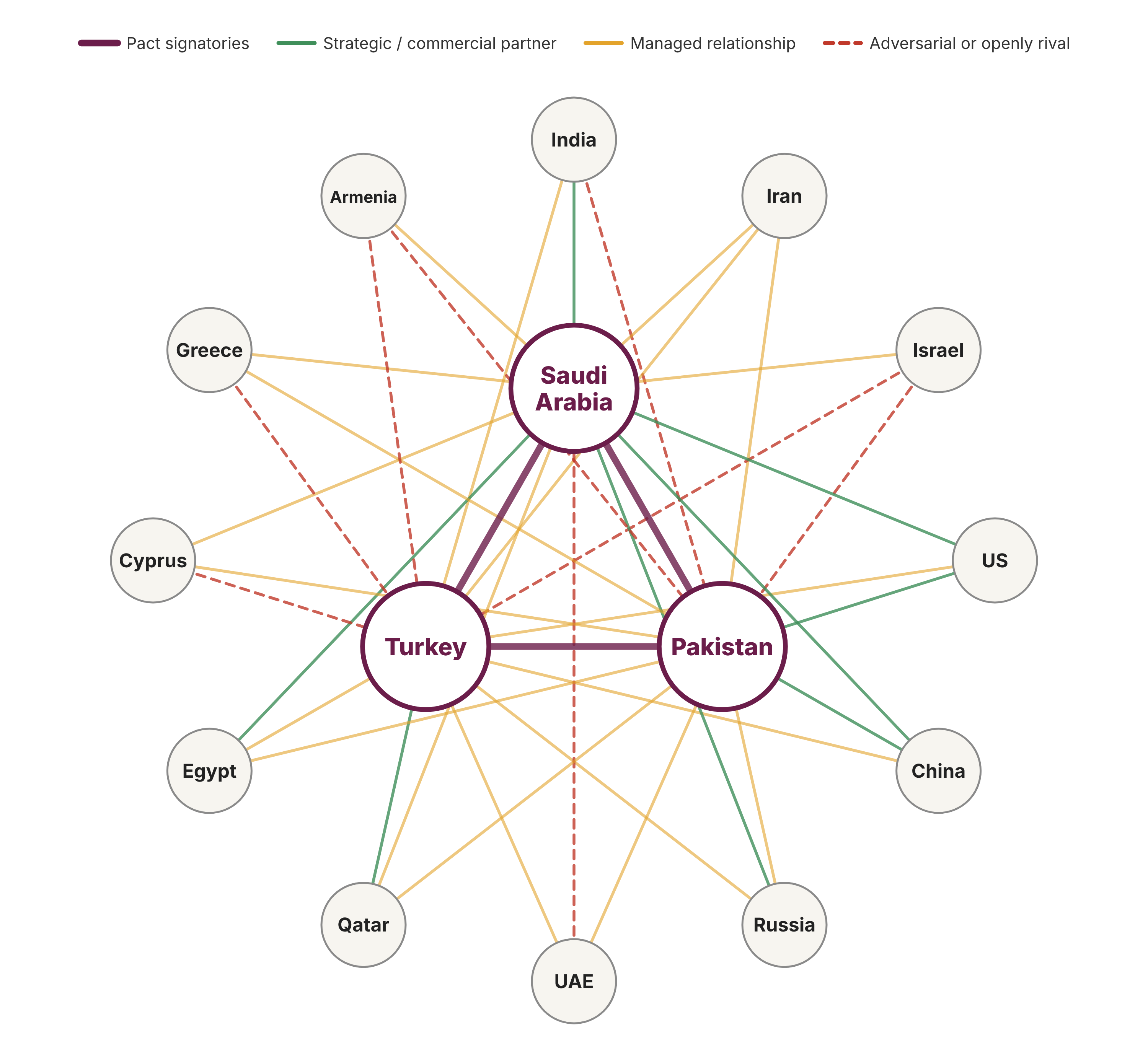 This image was made with the author’s input using Claude
Three colours are used, corresponding to three categories of relationships:
- Green for strategic or commercial partners: This is a relationship anchored in a security guarantee, a large and durable trade or investment flow, or both, such that the signatory has a strong material incentive to keep the outside actor onside regardless of what happens inside the Pact.
- Yellow for managed relationships: A relationship that is neither hostile nor unconditionally friendly. It is actively managed, hedged, or kept deliberately ambiguous, often because the signatory’s interests there conflict with its interests elsewhere in the network.
- Dotted Red for adversarial or openly rival: This is a relationship defined by declared or structural opposition – a named principal threat, an active territorial or ideological dispute, or a state the signatory’s own public rhetoric treats as an antagonist.
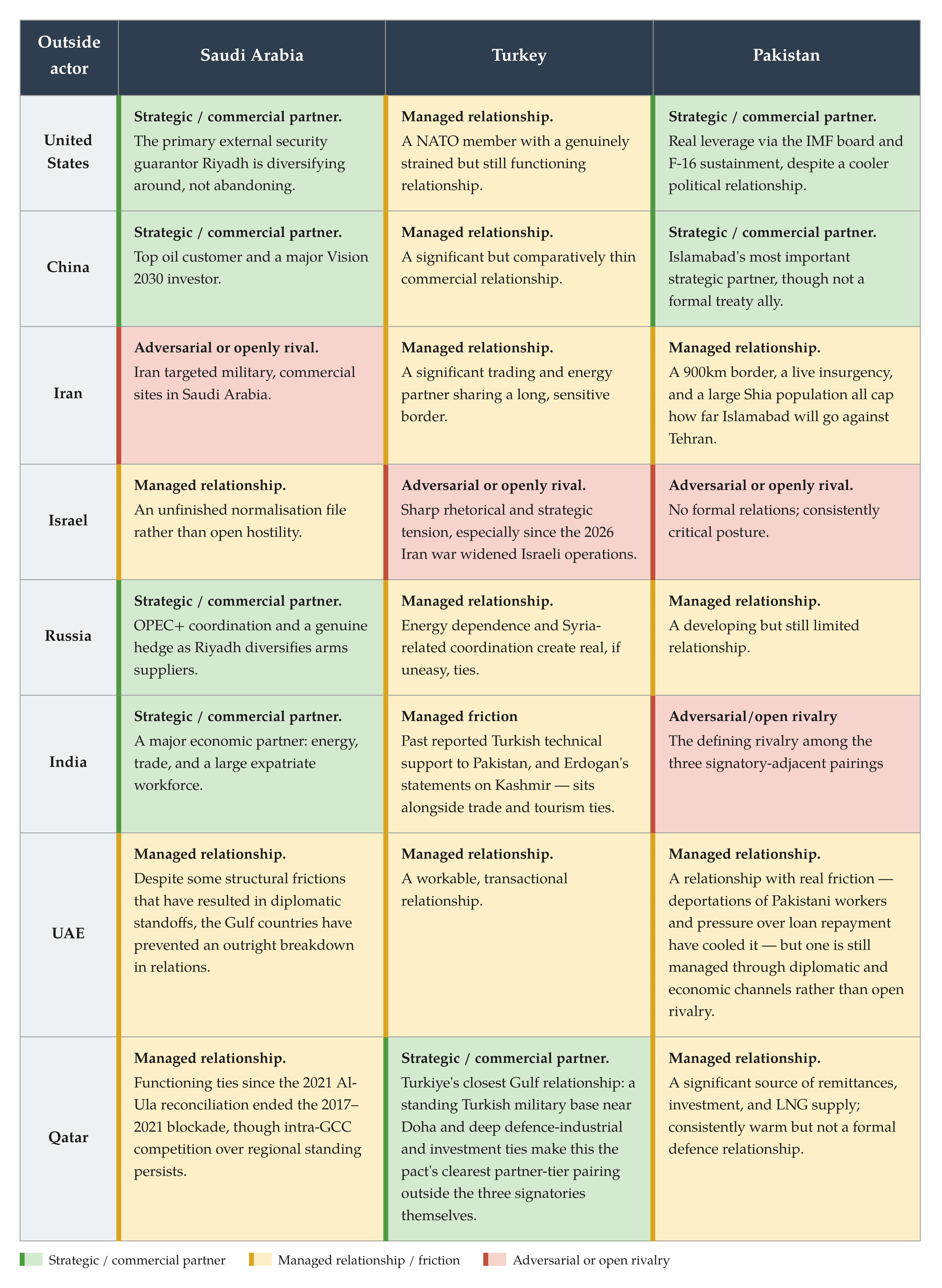
Further, the following matrix classifies each outside actor’s relationship with each signatory into three categories: strategic/commercial (green box), managed (yellow box), and adversarial (red box). The Crisis Calculator below, with its deeper mechanisms, including external security constraint, commercial exposure, home-front constraint, and token fulfilment, provides the fuller picture.
Activation Model
Per the Pact, an armed attack may trigger an obligation to respond, but the agreement does not itself determine the form, scale or speed of that response. Political willingness, geography, economic exposure, military capability, operational feasibility, and escalation tolerance intervene between the treaty clause and ground action. In assessing this reality, the document introduces a dashboard model based on scenarios and their potential outcomes. This dashboard treats collective defence as a pathway rather than an automatic switch. The treaty obligation is filtered through ‘x’ number of parameters, such as strategic interests, existing constraints, and available capabilities, before translating into a political choice about the appropriate level of response. This is assessed through a six-rung response ladder, ranging from political statements and diplomatic measures to materiel support, forward enablers, direct combat engagement and, at its highest level, belligerency. Each rung represents a different level of activation, with the eventual response also shaped by its potential second- and third-order effects.
The response ladder has six levels of activation:
- Level 1: Statement, involves condemnation, an emergency OIC session, or a joint communique
- Level 2: Diplomacy and finance, includes measures such as central-bank deposits, deferred oil payments, lobbying in Washington and Beijing, and shuttle mediation
- Level 3: Materiel involves the provision of munitions, drones, spares, strategic airlift, and satellite or signals support
- Level 4: Forward enablers, including air-defence detachments, advisers, tankers, basing, and overflight
- Level 5: Combat engagement involves direct participation inside the victim’s own theatre.
- Level 6: Belligerency represents the highest level of activation, involving strikes reaching the aggressor’s own homeland.
What Factors Impinge on Decision-Making?
Four mechanisms explain why a signatory’s willingness to act for a partner shrinks as its other relationships grow.
External security constraint
A state that relies on a major external power for its own security is reluctant to act against another state that power also backs. Saudi Arabia and Turkey’s restraint toward Israel traces partly to a shared reluctance to jeopardise their own relationship with Washington. Although each has distinct reasons to maintain positive ties with India, their assessments of Washington’s ties with Delhi also likely influence them.
Commercial exposure (“Customer Brake”)
States often remain hesitant to jeopardise stable commercial relationships. Saudi Arabia’s commercial relationship with India runs across three separate channels, including energy exports, a large and growing investment pipeline, and a multi-million-strong Indian expatriate workforce whose remittances matter to both economies. Any one of those channels would argue for caution on its own; together, they make Riyadh a structurally poor candidate for military entanglement in an India–Pakistan crisis, regardless of what the treaty text says. This is the single most asymmetric challenge in the entire model, since no comparable brake restrains Turkey’s behaviour toward India.
Home-front constraint
A state will not open a new battlefront on its own soil for a partner’s sake. Pakistan’s 900-kilometre border with Iran, its own Baloch insurgency, and a significant domestic Shia population it cannot afford to alienate will together cap what Islamabad will do against Iran specifically.
Token fulfilment
Without an automatic trigger or shared command, partners reach for symbolic or indirect support, such as cash, weapons, airspace, a UN vote, or honouring a Pact on paper while staying out of direct combat. This is why comparable clauses like the GCC’s 2000 provision and the 2025 Saudi–Pakistan Pact have historically produced deposits and arms sales, but not deployed divisions.
Crisis Calculator
An outside actor attacks a signatory. The other two must price their treaty obligation against their own strategic interests. The dashboard’s calculator does not predict behaviour. It evaluates how each responding signatory could respond, based on named, transparent variables, and returns the highest rung on the ladder those variables support. In the dashboard, the user set the variables, and the calculator returned an activation band for each of the two responding signatories, with a written reasoning trail. This document lays out the same logic as a static decision pathway.
The calculator considers a few elements – the attack (state or non-state proxy), the victim signatory, what was hit, whether the signatory is defending or attacking, and the nature of the conflict (from sub-conventional to existential scale). The calculator also considers constraints including diplomatic relationships, trade/economic ties, whether a signatory is already tied down at home, and whether the obligation can be met short of combat (money, intel, logistics) rather than troops. The result is a band: Green for statements and diplomacy, Yellow for weapons and supplies, Orange for forward support such as air defence, and Red for combat.
The calculator’s reading aligned with what the partners actually did after the two crises recorded following the Pact’s signing. In each case, the partners had strong reasons to hold back and little ability to act, so the calculator pointed to the lowest rungs of the ladder, and that is where they stayed.
Explore the Mecca Pact dashboard (here)[https://aishwariasonavane.github.io/Mecca-Pact-Dashboard/].
Case study one: Afghanistan and Pakistan
On September 18, 2026, a suicide attack on a police mosque in Kohat, Khyber Pakhtunkhwa, killed at least 31 people and wounded 100 others.9 Ittehad-ul-Mujahideen Pakistan (IMP), an Afghanistan-based militant group, claimed the attack. Pakistan responded with airstrikes in parts of Afghanistan between September 21 and 24. The calculator predicts this as a low-intensity attack on Pakistan by outfits based in Afghanistan. Neither Saudi Arabia nor Turkey has strong reasons to confront the Taliban administration in Kabul, and neither can easily reach Pakistan’s western borders. Therefore, as per the calculator’s predictions, Riyadh and Ankara condemned the attack. Neither did Pakistan seek help under the Pact.
Under a Sub-conventional attack by a non-state, Afghanistan-based sanctuary on Pakistan (defensive case), the calculator places Saudi Arabia at the higher of the two levels, approximately Level 2 — Diplomacy & Finance; Turkey is independently assessed at Level 2 — Diplomacy & Finance. Neither is derived from the other; each signatory’s obligation is priced against its own relationships, not against what its partner does. Because IMP is a non-state or proxy actor, this is not automatically treated as an Article 5 case. Attribution confidence is doing most of the work in this result. At “medium” confidence, the model caps activation at Level 3 regardless of how severe the underlying constraint scores would otherwise allow.
Case study two: the Houthis and Saudi Arabia
The Yemen-based Houthi attacks on Saudi Arabia began in July and escalated sharply in early September, wounding 73 people reportedly. The Houthis have targeted Saudi cities and energy infrastructure, including the targeting of Riyadh.10 The Houthis have seized Yemen’s Red Sea coast, effectively controlling the Bab el-Mandeb strait, a crucial maritime corridor. Pakistan’s leaders promised to defend the kingdom “to any extent,” while its Foreign Office said no military action was under discussion.
Similarly, in the case of a sub-conventional attack by the Houthi movement against Saudi Arabia, Turkey reaches the higher level of the two, approximately Level 2 — Diplomacy & Finance; Pakistan is independently assessed at Level 2 — Diplomacy & Finance. Even here, the model caps activation at Level 3 regardless of how severe the underlying constraint scores would otherwise allow. The calculator has correctly recorded Pakistan’s constraint from making any move against Iran. As predicted, Turkey, as well, has so far limited itself to statements and diplomacy. Both partners condemned the attacks and used their contacts with Iran. However, nobody has demonstrated willingness to enter combat to support Saudi Arabia. This case further shows existing gaps in the Pact.
In both cases, the calculator was accurately able to separate what the treaty states from what the partners would actually do. The clause promises that an attack on one is an attack on all. The calculator read past that to each partner’s strategic interests, geography, and ties to the attacker, and those decided the outcome. In both crises, the response was calibrated, not automatic, and it settled on statements and diplomacy, so far.
What does the Pact mean for India’s strategic environment?
The live cases are unlikely to drastically affect India’s strategic calculations. In the case of a future India-Pakistan crisis, any potential financial and material gains for Islamabad, more than active combat participation, would remain crucial to monitor.
Pakistan
Turkish materiel and Saudi financing reach Pakistan in peacetime and help sustain it through a short conflict. This is the most likely effect across every India-related scenario in this model. Neither flow adds troops to India’s own borders. However, both extend how long Pakistan can absorb economic and military pressure before its position becomes untenable. The Pact does not soften the India-Pakistan dynamic, the one relationship in this network thatremains the defining rivalry among the signatory-adjacent pairings, and nothing in the treaty text is likely to change the underlying dispute. The September cases add one consideration. Pakistan’s Gulf deployment and its western-front operations now draw on the same force pool. In an India-Pakistan crisis, recalling Gulf-based squadrons or air-defence elements would send a visible, meaningful signal, and the western front would compete for them.
Saudi Arabia
India’s commercial relationship with Riyadh rests on trade, energy, a large expatriate workforce, and a growing investment pipeline. It also reflects Saudi Arabia’s reluctance to be drawn into a nuclear-armed regional rivalry it has no stake in escalating. The ‘Customer Brake’ is the strongest single restraint in this model, and it points specifically to Riyadh.
Saudi Arabia has historically maintained a neutral stance in India-Pakistan conflicts. In the 1965, 1971, and 1999 wars, Riyadh extended financial and diplomatic support to Islamabad but never deployed forces against India.11 That said, past actions remain relevant data points; however, they offer no guarantees. The Houthi case adds a second reason for restraint. Riyadh’s preference when attacked was to fight with its own forces, seek American support, and to use its Muslim partners as channels to the aggressor’s patron – in this case, Iran.
Turkey
Ankara has a limited commercial relationship with India, unlike Riyadh. Pakistan has already received Turkish materiel and technical support during past India–Pakistan conflicts.12 Turkey is the signatory whose actions merit the closest independent tracking. However, both case studies demonstrate Ankara’s preference for mediation and bridge-building with the other side – Kabul and Tehran, in this case, combined with defensive equipment for the partner. Applied to an India–Pakistan crisis, the former is unlikely because Ankara has no mediating standing in New Delhi comparable to its standing in Kabul. The latter is the resupply channel that the model already identifies.
The Gulf
The Pact intersects with Saudi–Iran tension, the durability of the US security umbrella, and the interests of the UAE and Qatar, both of which have their own reasons to avoid a Riyadh-Ankara-Islamabad bloc consolidating without them. That intra-Gulf competition is itself a variable India can watch rather than try to manufacture.
Strategic constraint and diplomatic complication
Two additional capitals now carry a treaty-based argument for early de-escalation in Washington and Beijing during any India–Pakistan crisis. That can compress India’s window for punitive decisions. The Houthi case shows the channel in use – Riyadh appealed to Beijing, and Beijing pressed Tehran.13 In addition, a trilateral Islamic defence bloc adds a forum, alongside the OIC and its member states, through which Pakistan and Turkey could contest India’s domestic political narrative internationally, particularly on Kashmir and the Indian government’s Muslim-minority policies and rhetoric.14 This channel already existed bilaterally. The Pact gives Islamabad and Ankara a standing reason to consult before using it, not a new capability.
Pakistan’s official statements on the Kohat attack and its aftermath describe anti-Pakistan Islamist groups as an “Indian proxy.” India has consistently rejected such claims. The framing matters for the model because it offers a pathway to recast a western-front crisis as India-related in Pact consultations. There is no evidence that Riyadh or Ankara has accepted it, given that both capitals condemned the Kohat attack without naming any state.
In the immediate term, no change is likely to force a posture on India’s border, but a modest reinforcement of Pakistan’s external financing and resupply can be expected. As Turkish–Pakistani defence-industrial cooperation and Saudi investment institutionalise, Pakistan’s capacity to sustain a prolonged conflict shifts, but not its capacity to start one, which remains crucial in the medium term. Ratification and the new secretariat will determine whether consultation becomes routine. Meanwhile, the open analytical question is whether the Pact becomes a durable pattern of Gulf-subcontinent security cooperation that reshapes the wider regional architecture in the long term. The alternative is that it remains, like its GCC and 2025 precedents, a standing instrument that rarely activates beyond Levels 1–3.
The paper lays out three factors that will remain critical indicators relevant to India’s planning. The first indicator is a formal invocation of the Mecca Pact consultations during an India–Pakistan crisis, as distinct from routine bilateral outreach. The Houthi case sets the baseline that no formal invocation followed a sustained attack on a signatory. The second is the movement of Pakistani squadrons or air-defence assets between the Gulf and Pakistan’s western or eastern fronts, the clearest tripwire linking the theatres. The third is any joint Gulf–Ankara statement naming India directly rather than addressing the region generally, or any joint statement adopting Pakistan’s “Indian proxy” framing.
What the Pact means for the wider ecosystem
United States
Riyadh and Ankara both remain deeply tied to US security architecture. The Pact reads as diversification rather than a rejection of that relationship, as demonstrated in Saudi Crown Prince Mohammed bin Salman’s call to US President Donald Trump seeking help against the Houthis.15 Washington holds significant leverage over Pakistan, particularly through International Monetary Fund (IMF) influence and the F-16 sustainment package, which will remain a constant constraint on Islamabad’s behaviour even inside the Pact.
China
Beijing’s strategic partnership with Pakistan and its strong commercial ties to both Saudi Arabia and Turkey give it every reason to welcome a more autonomous regional security order. It can do so without formally committing Chinese capabilities to it.
Iran
Tehran’s own calculus is one of the more consequential open questions in this model. It could treat the Pact as containment requiring a response, or as a structure it can work around via its own ties to Ankara and Islamabad. While senior Iranian figures publicly celebrated Houthi gains against Riyadh, its foreign minister kept communication lines open with Pakistan’s army chief and with Riyadh. Pakistan, a signatory, served as the conduit for Saudi warnings to Tehran. In the Houthi case, the Pact did not isolate Iran; it gave Iran a signatory to talk through. Whether Tehran’s influence over the Houthis is enough to deliver restraint remains to be seen.
Israel
Israeli concern centres less on the treaty clause itself than on Turkish drone proliferation and Ankara’s expanding regional posture. This is an area where India and Israel have a shared interest. Ankara’s reported plans to deploy air-defence systems and personnel to Saudi Arabia would extend that posture into the Gulf.
Second- and third-order effects
If the Pact is activated at any tier above token support, the first-order effects would be an immediate diplomatic and possibly material, response from the other two signatories, with public statements framing it as treaty-driven. Second-order effects would include regional pressure for de-escalation channelled through Washington and Beijing, shifts in defence-industrial orders as partners recapitalise, economic disruption if commercial exposure is tested, and retaliation against a responder’s exposed assets.
The Houthi case offers a partial view of the first two orders even without activation above token support. Statements framed as treaty-driven appeared immediately. De-escalation pressure ran from Beijing to Tehran. The Houthis warned both responders they would retaliate before either acted. That suggests the second-order effects of the Pact will probably arrive before the first-order response does.
Should the Pact prove durable, the third-order effects could serve as a blueprint for middle-power blocs. This could signal that regional middle powers don’t rely on the US security umbrella. Instead, they build modular alliances to handle regional threats. This could set a precedent for other regional coalitions.
Indicators to Monitor
On the legal side, key indicators are ratification by the Turkish and Pakistani parliaments and a Saudi royal decree. All are still pending, with Turkish submission expected around October. Another legal indicator is the publication of the treaty text, which remains classified. Subsequently, there are four domains in which progress can be tracked:
- Diplomatic: It is important to monitor whether the signatories formally invoke treaty consultations, as distinct from routine bilateral contact. An emergency session of the Organisation of Islamic Cooperation (OIC) convened at a signatory’s request would be a further signal of collective intent. So would joint statements that name a specific external actor rather than addressing the region in general terms. Any talks on the accession of a fourth state would indicate that the Pact is expanding beyond its founding members. Dhaka had briefly expressed an interest in joining the Mecca Pact; however, there has been no further communication regarding the arrangement.16
- Military: Deployments and rotations of forces between the Gulf and the signatories’ home fronts show whether commitments are turning into physical presence. Trilateral joint exercises and training cycles indicate whether the three militaries are building the interoperability that collective action would require. Movements of air defence detachments are among the most likely forms of practical support. Changes to basing and overflight arrangements would show whether the signatories are preparing the infrastructure to act together.
- Economic: Emergency financing or the renewal of central-bank deposits would indicate whether the Pact is being used to support a partner under pressure. Extensions of deferred-oil facilities serve a similar purpose and would signal continued support for a partner’s balance of payments. Trade or investment decisions that coincide with a crisis may indicate that economic tools are being used to reward, reassure, or signal.
- Military-industrial complex: Weapons transfers and delivery milestones may exemplify whether commitments of materiel are actually being met. Orders for ammunition and drones may indicate how the signatories expect to fight and whether they are preparing to resupply one another. Sales of air-defence systems may point to the kind of support partners are most willing to provide. Maintenance and technology-sharing agreements may reveal whether the defence-industrial relationship is deepening into long-term dependence.
Conclusion
The Mecca Pact includes an Article-5-like clause. However, its relevance lies in the gap between the Pact’s stated text and what each signatory can and will offer. The treaty text has not been published in full, so key operational details remain unverified. Its clause states that an attack on one is an attack on all. However, it does not specify how far or how quickly any partner must respond, and each government still answers those questions based on its strategic and domestic calculations. These considerations depend on each country’s threats, economic ties, geography, and relationships with the attacker. For India, the Pact does not open a new front, but it can extend Pakistan’s ability to sustain a conflict and add diplomatic pressure for early de-escalation. Whether it becomes a durable regional security framework or remains a grouping that rarely moves beyond statements will depend on future crises.
```
Footnotes
Web Desk, “Pakistan Carries Out ‘Calibrated’ Air Strikes against Terrorist Hideouts near Afghan Border after K-P Attacks,” The Express Tribune, September 21, 2026. Link↩︎
Reuters, “Turkey, Saudi Arabia, Pakistan, Egypt Affirm Riyadh’s Right to Defend Itself,” Reuters, September 22, 2026. Link↩︎
Lauren Dagan Amoss, “Saudi Arabia–Pakistan Defense Pact Will Cause Strategic Ripples for India and Israel,” The Jerusalem Post. Link↩︎
“Turkey Helped Plan Drone Strikes on India, Sent Military Operatives to Pakistan: Sources,” Business Today, May 14, 2025. Link↩︎
Reuters, “China Presses Iran to Help Rein in Houthis after Saudi Appeal, Sources Say,” Reuters, September 17, 2026. Link↩︎
“The Kashmir Issue and Recep Tayyip Erdoğan’s Remarks at the UN General Assembly,” The Indian Express. Link↩︎
Barak Ravid, “Scoop: MBS Urged Trump to Strike Houthis amid Red Sea Threat,” Axios, September 11, 2026. Link.↩︎
“Bangladesh Expresses Interest in Makkah Pact,” Dhaka Tribune. Link↩︎