Roundtable | Building Capability in Deep-Space
| DATE | July 20, 2026 |
A Conversation on “Building Capability in Deep-Space: The Science of Autonomous Space Exploration”
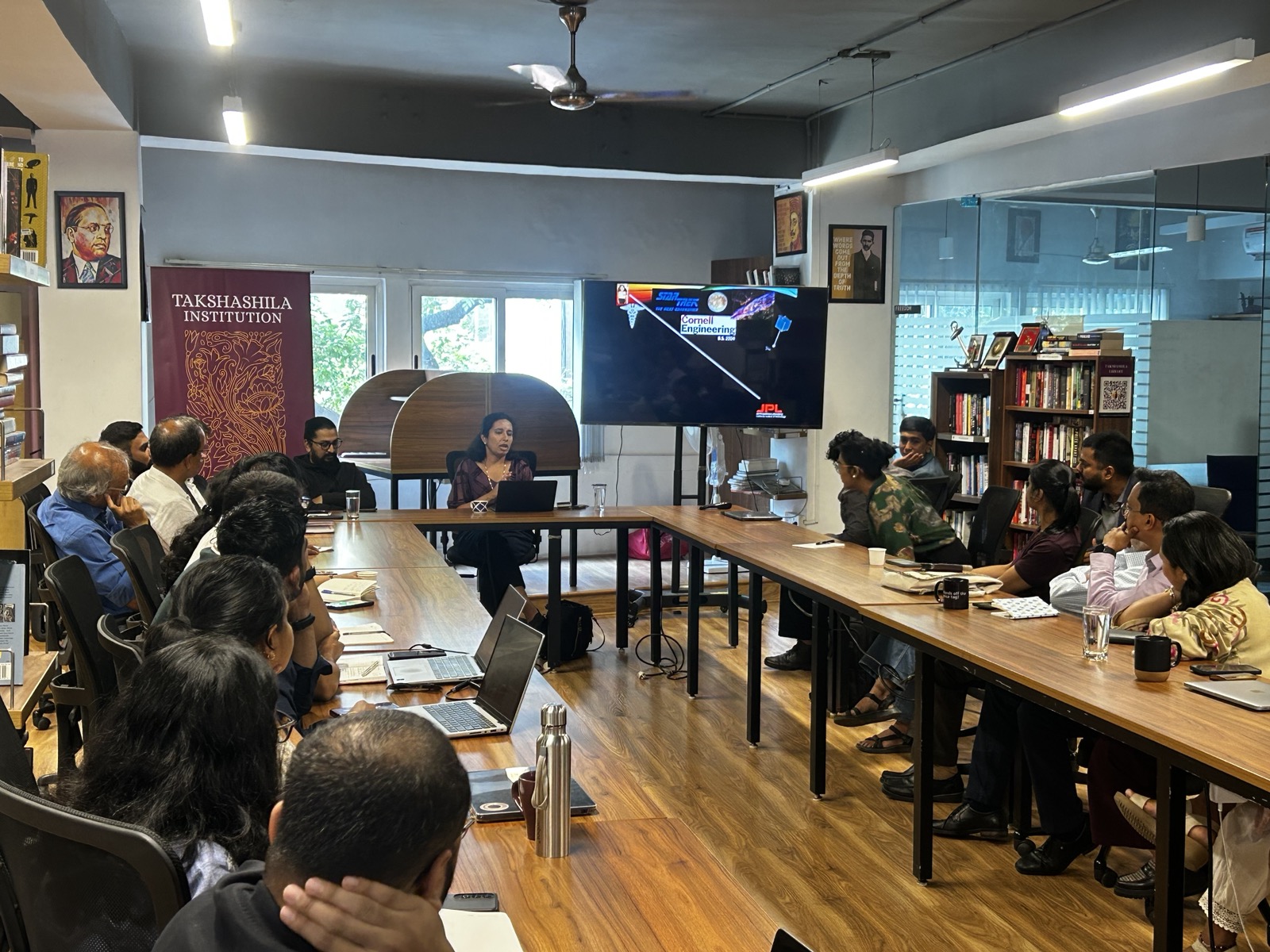
On Monday, July 20th, the Takshashila Institution hosted a roundtable with Dr. Swati Mohan, Aerospace Engineer and AstroNav Project Manager at NASA’s Jet Propulsion Laboratory, co-hosted with the U.S. Consulate General Chennai. Dr. Mohan, who led the guidance, navigation, and controls operations for the Mars 2020 mission, drew a room that brought together astronomers, astrophysicists, industry representatives, and other space enthusiasts, alongside Takshashila staff. The conversation ranged across two threads: the engineering of autonomous deep-space exploration, and the rapidly shifting commercial landscape that is reshaping humanity’s space activities.
On the first, Dr. Mohan spoke about deep-space guidance, navigation, and control and how autonomy is a neccessity. She walked through Terrain-Relative Navigation, the technology behind Perseverance’s precise landing, which let the spacecraft match its cameras against an onboard map of Jezero Crater in real time to fix its position and steer clear of hazards. She reflected briefly on her own path into the field, from a physics classroom in Virginia through Cornell and MIT to JPL, and on the centrality of systems engineering to missions of this kind.
On the second, Dr. Mohan traced the transition from “Old Space,” the government-driven model born with Sputnik in 1957 and dominated by a few large vendors, to “New Space,” built on the simultaneous collapse of three cost barriers: the cost to launch, to build, and to operate. She mapped the resulting ecosystem across six pillars, spanning launch and transportation, satellite manufacturing, the ground segment, satellite connectivity, Earth observation and analytics, and the emerging frontier of in-space operations, and set out the strategic choice every startup faces between vertical integration and the asset-light niche model. She closed on where India fits, describing it as among the fastest-growing and most disruptive New Space sectors in the world, on the strength of cost-efficient engineering talent, a regulatory gateway in IN-SPACe that opens ISRO’s facilities to private firms, and liberalised capital flows, with the opportunity lying in drawing international customers to Indian launches and positioning India as an integrator in the emerging orbital economy.