What’s the PLA Doing at Freezing Heights? Writing a Book About Itself.
| AUTHOR | Anushka Saxena |
| DATE | November 16, 2026 |
| CATEGORIES | China Defence Geostrategy |
On November 14, 2026, the People’s Liberation Army (PLA) Daily published a long, full-page report on the Gamba/ Ganbala county in Tibet, titled “New chapters in stories above the snowline” (雪线上的故事写新篇). The key focus of the report is a Border Defence Battalion (BDB; unit 77656) that has, for over a decade, compiled the lives of its soldiers and best practices of the battalion, into a Collection called ‘Gamba Officers and Soldiers Story Collection’. It is now supposed to be inculcated into classroom curriculum in Tibet by veterans taking up teaching roles as well, and is to become a mandatory reading for new recruits.
There are three other very important tactical signals that emerge from this report, and are particularly relevant for India.
To begin with, if one looks at the altitude rungs at which the PLA Western Theatre Command operates, those often mentioned are 5309 metres, 5318 metres, 5371 metres, and the highest, 5592 metres. More or less, these are altitudes of established or temporary but active posts, with a lot of drill activity reported across heights above 4500 metres.1 The November 14 report, interestingly, gives readers two new heights of note – one, it places a Tibetan officer, Pingcuo Daji, at a small post at 5501 metres. Second, it talks about a squadron from the BDB’s artillery company, recently completing a task on a hilltop at 5700 metres.
For context, Siachen is the highest battleground in the world, located in India at a height of between 5700 and 6000 metres above sea level. So the PLA’s upward movement is concerning, especially considering one often believes one of their disadvantages to be altitude. Of course, this is not to say that the PLA has a confirmed post/ company established at 5700 metres, and we know from reports published after the Doklam standoff that the BDB often patrols at heights up to 6900 metres too. But drilling there usually comes with retrofitting of, if nothing else, temporary settlements for troops – inclusive of oxygen bars, clean water tankers/ tap fittings, and fresh fruit delivered from the mainland once a week, and the extent of movement at new outposts is vital to monitor.
Next, there is a fascinating point made about post 5592, wherein a Tibetan veteran, Xire Nima, is named as the man who led troops up to the outpost. When they arrived, they lit fires to soften the frozen soil before digging foundations. More crucially, the report adds that the post’s “birthday” falls in a month. That places it around mid-December, which probably settles a noteworthy debate visible in Chinese sources themselves about when a company set up house at that height. If the birthday of the post is in a month, it likely began construction in December 2019, even if it got completed at the time CCTV pegged it – “early 2020.” With 20/20 hindsight, what this essentially tells a curious watcher is the post-Doklam buildup at the Tibetan plateau in Ganbala is not only rapid (considering also the fact that another post – Renla, at a height of 5309 metres – is likely to have come up after 2017 as well), it is also hurried.
What I mean by that is, nobody chooses to break frozen ground at 5592 metres in December unless an order has come with a deadline attached, i.e., it is not routine construction. The troops had reached there by December 2019, which was 5 months before the first skirmish at Naku La – 6 months before Galwan. So even though one can say 5592 was not a reaction to the skirmishes of 2020, it is also noteworthy that the outpost was a part of a broader plan to set up eyes and ears as high and far as possible before any trouble broke out. Not to mention, the BDB has already held the 5300-metre line since Chagula was set up at 5318 metres in 1961-62. Climbing a further 280-odd metres in the dead of winter buys little else except a much better view of the other side.
Finally, and perhaps most interesting as a story indicator, is the choice of photograph published with this report of November 14.
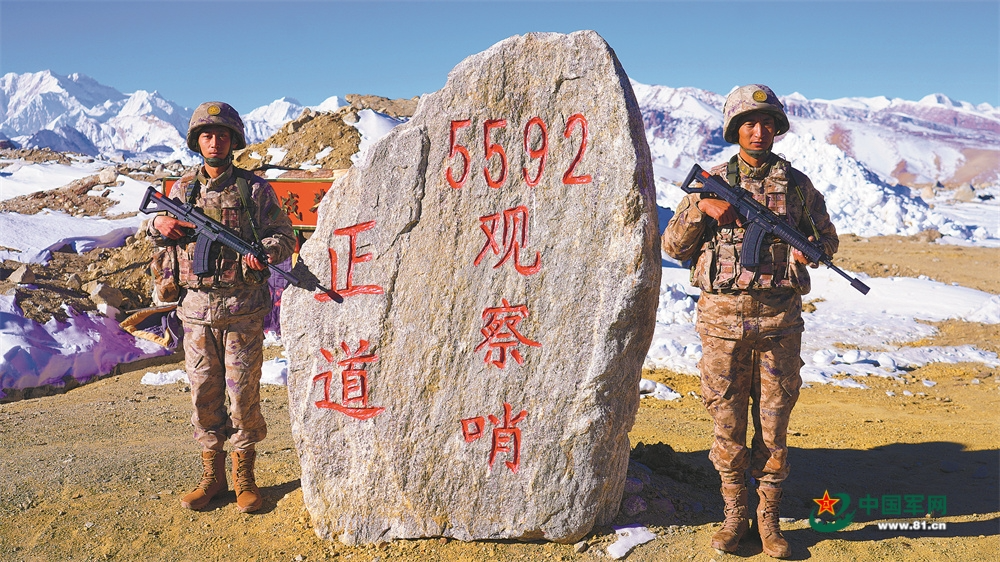
It is, as Xire Nima himself says, a now-popular, rather “old” (老照片) picture showing the wall erected in 5592’s first days. A newer generation of insulated barracks has since come up, and one of the stories in the Collection being promoted in the report, is about a corporal who fixes frozen water pipes in the dead of night. So clearly, the picture serves the theme of nostalgia and the progress made since, but it also hides what 5592 really looks like after seven years.
This is not to say that the PLA Western Theatre Command has tamed the plateau. But with the king of coverage and photos on provisions, recruitment and scaling of heights that have emerged in less than a decade on the Chinese side, it is evident that the worry can no longer be about picket fences and shabby stone houses. One need only look at how the BDB has been awarded the “Model Battalion on the Plateau” (高原戍边模范营) award twice (2016 and 2024), or how the Chagola of the 60s continues to be cherished and glorified, and one will know – no one writes an anthology if the goal was not to stay long-term.
Footnotes
I’ve broken these heights and drill activities down in detail from official Chinese sources in an edition of Takshashila’s newsletter, ‘Eye on China’.↩︎