National Sports Governance Act, 2025: Slow off the blocks
| AUTHOR | Malathi Renati |
| DATE | November 26, 2026 |
| CATEGORIES | Governance Regulation Discussion |
The 18th of August 2025 was a landmark day in Indian sports administration: the first-ever National Sports Governance Act (NSGA 2025), received presidential assent. This was a true milestone; a culmination of many years of effort since the National Sports Development Code of India (NSDCI or Sports Code) was issued in 2011. Many successive drafts were circulated but never crossed the finishing line until this Act was passed.
The goals
The four main objectives of the statute are to
- Develop and promote sport
- Improve athlete welfare
- Follow universal principles of good governance, ethics, and fair play derived from the Olympic and Paralympic Charters
- Resolve sports grievances in a fair and equitable manner
At its core, the Act makes recognition by a new National Sports Board (NSB) the gateway for every sports body: only recognised bodies are eligible for government funding and can use ‘India’ and the insignia in their name. To improve accountability & transparency, those sports bodies that receive public funding can be brought under the purview of the Right to Information (RTI) Act, 2005, to disclose how the money was utilised.
The national sports bodies
Each sport in India is run by its respective National Sports Federation (NSF) and is affiliated with its international counterpart. Example: AIFF (All India Football Federation) is the recognised sports body for football in India. Its international affiliate is FIFA, and AIFF is bound by FIFA’s mandate and the Olympic Charter. While the 2011 sports code served as guidelines for all NSFs, it was not legally binding, and we saw many fallouts over the last decade around lapses in integrity, governance and corruption. Nepotism, principal-agent issues (conflict of priorities) and regulatory capture plagued NSFs like the Wrestling Federation of India (WFI), while AIFF was suspended by FIFA in 2022 for third-party interference after a court-appointed committee took charge. Both even temporarily lost their recognition from their international bodies. The athletes (and the sport) unfortunately had to bear the brunt of this mismanagement.
A statute does four things the Sports Code 2011 could not do.
- It’s legally binding
- It gives sport its own grievance redressal/dispute forum, which the National Sports Tribunal panel oversees
- It creates permanent institutions instead of court-appointed administrators (which we saw with AIFF and WFI recently)
- It gives Parliament’s legitimacy to limits on age (25 to 70 years and max 75 years in exceptional cases) and tenure (3 terms followed by a cooling-off period)
With India’s stated ambition to not just host the Olympics but enter the enviable league of the top 10 sporting nations in the world by 2036 and the top 5 by 2047 (aligned to the vision of Viksit Bharat), fast-tracking sports policies and administrative efforts have consistently figured on the government agenda in the recent past. We saw how, close on the heels of the updated National Sports Policy (Khelo Bharat Niti) 2025, the NSGA 2025 too arrived.
Walking that fine line between good governance and autonomy is never easy, and the Act makes a cautious attempt to do both, though some aspects have been conspicuously left out. The last decade has shown that self-regulation alone has failed; the question is who regulates. With the markets stepping in and society in the metros and tier 1 cities responding to the benefits of sport, the government should slowly step back to minimal guardrails and leave oversight to a regulator independent of the ministry. Separating steering (setting policy and regulation) from rowing (running sport or service delivery) would have set a precedent for real autonomy.
The NSGA structure
Government overreach in the Act is unmistakable. The Board’s search-cum-selection committee is chaired by the Cabinet Secretary, and the Tribunal selection committee has two government secretaries alongside one judicial nominee. The government can also restrict participation in international events. The three apex bodies (National Sports Board, National Sports Election Panel, and National Sports Tribunal) have a firm grip on the recognition, elections, and disputes of all sports bodies. The RTI Act applies only to bodies dependent on government funding, leaving the wealthiest, like the BCCI, outside it, though the Supreme Court has questioned the BCCI about this. Interestingly, with cricket being an Olympic sport in Los Angeles 2028, it would be forced to come under its ambit. It’s a wait-and-watch until then.
Some welcome features, however, have been the requirement for each sports body to form four committees (executive, athletes, ethics, and dispute resolution) along with a general body and elect three office bearers (President, Secretary General, and Treasurer). It also caps age and tenure for office-bearers and requires at least two Sportspersons of Outstanding Merit (SOM) on the executive committee. Another encouraging inclusion is the directive to have a safe sports policy and code of ethics to safeguard ‘vulnerable persons against abuse by persons in a position of trust, responsibility, or authority’, though it does not go further to include a whistleblower policy.
Only a half-hearted effort has been made to advance gender equity, secure meaningful athlete representation, and promote expert-led governance over politically driven leadership. A minimum of four women in a maximum 15-member executive committee falls short of the critical mass that associates with a notable shift in the status quo. With no women explicitly mandated in decision-making roles (President, Secretary General or Treasurer), the system risks crucial perspectives on areas that impact girls and women taking up sport, including scientific coaching, menstruation and sports, safety and social stereotyping, as these may not be approached holistically. As Goodhart’s law states, ‘if a measure becomes a target, it ceases to be a good measure’, and the risk here is tokenism and performative governance. However, this is an opportunity for each NSF to take the lead and explicitly plug these gaps in their bye-laws.
The multi-tier tribunal grievance redressal mechanism is the most consequential reform in this statute. Most disputes can now be resolved within the sports ecosystem, reducing the load on the high courts, though appeals still lie with the Supreme Court and international matters with the Court of Arbitration for Sport (CAS). Athlete careers are short, and fast-tracking dispute resolution is a necessity.
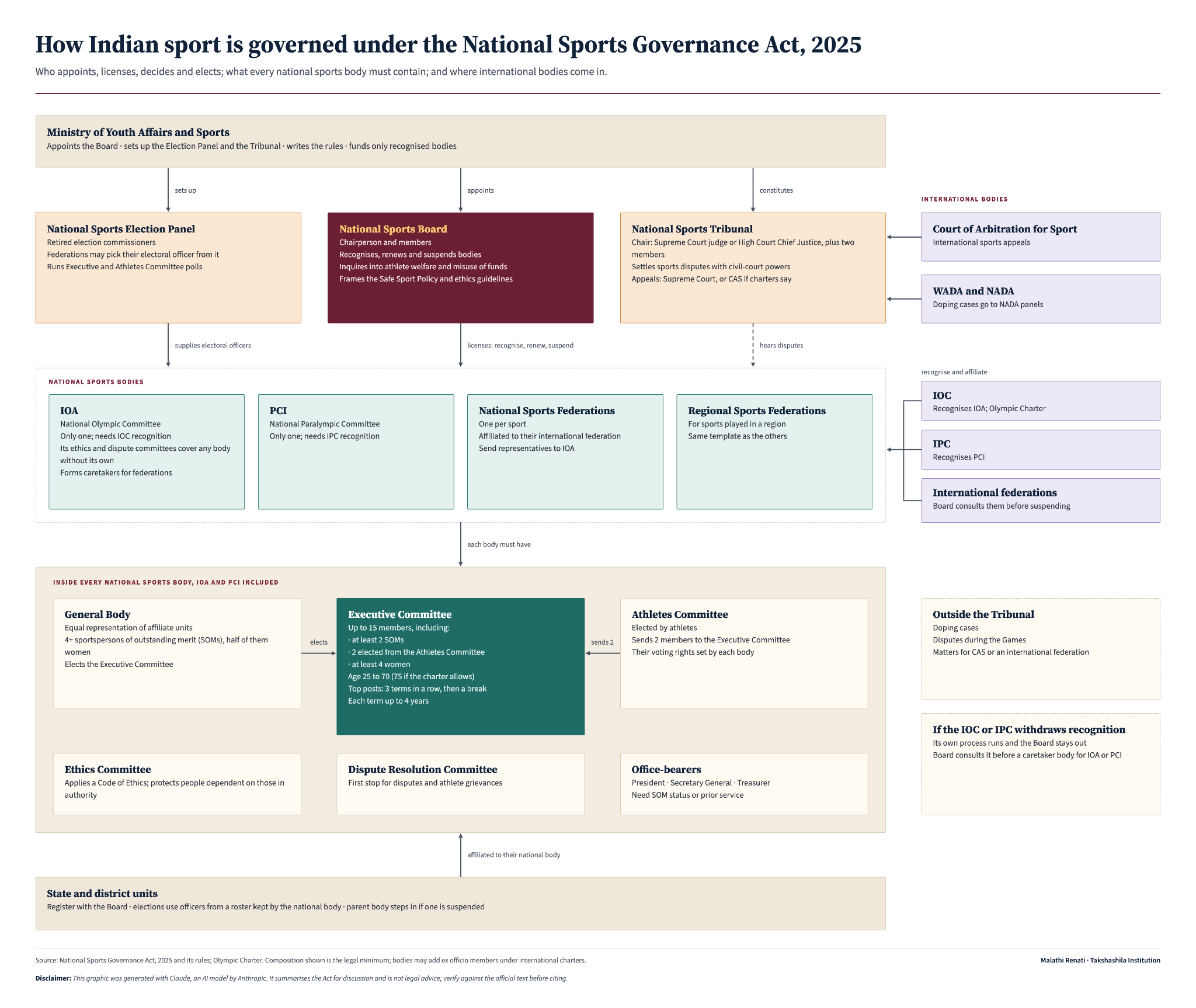
The most inexplicable aspect, though, has been the sequencing of creating the three apex bodies. The Board should have been created first, since it is meant to maintain the roster of the Election Panel. Instead, the Election Panel came into existence only in September 2026, thirteen months after the Act. The Board leadership took office later on 16th November 2026 and at the time of writing, had only 2 of the 3 board members identified, and the Tribunal is yet to be formed. All this while, the announcement to all NSFs was that they could defer elections until 31st December 2026 so they had adequate time to align with the new structure. That deadline is surely unrealistic. NSFs cannot align to a structure whose regulator is half-staffed and whose tribunal does not yet exist. The Act’s credibility now depends on how independently and how quickly it is implemented.
Conclusion
International sports bodies are watching closely to see how India can put its house in order both internally and institutionally as it bids for international multi-sport events and leverages sport to strengthen its global soft power. This window of opportunity to drive systemic change must be seized with both hands. What may seem like a small step in Indian sports administration could prove to be a giant leap for India’s sporting ecosystem.