Washington Assumes the Burden of a Sliding Yen
| AUTHOR | Anupam Manur |
| DATE | August 28, 2026 |
| CATEGORIES | Geoeconomics |
On 31 July, a Reuters photographer at Camp David captured a notepad in front of the US Treasury Secretary. It read: “To Do — Buy Japanese Yen (JPY) $5–10 bil.”
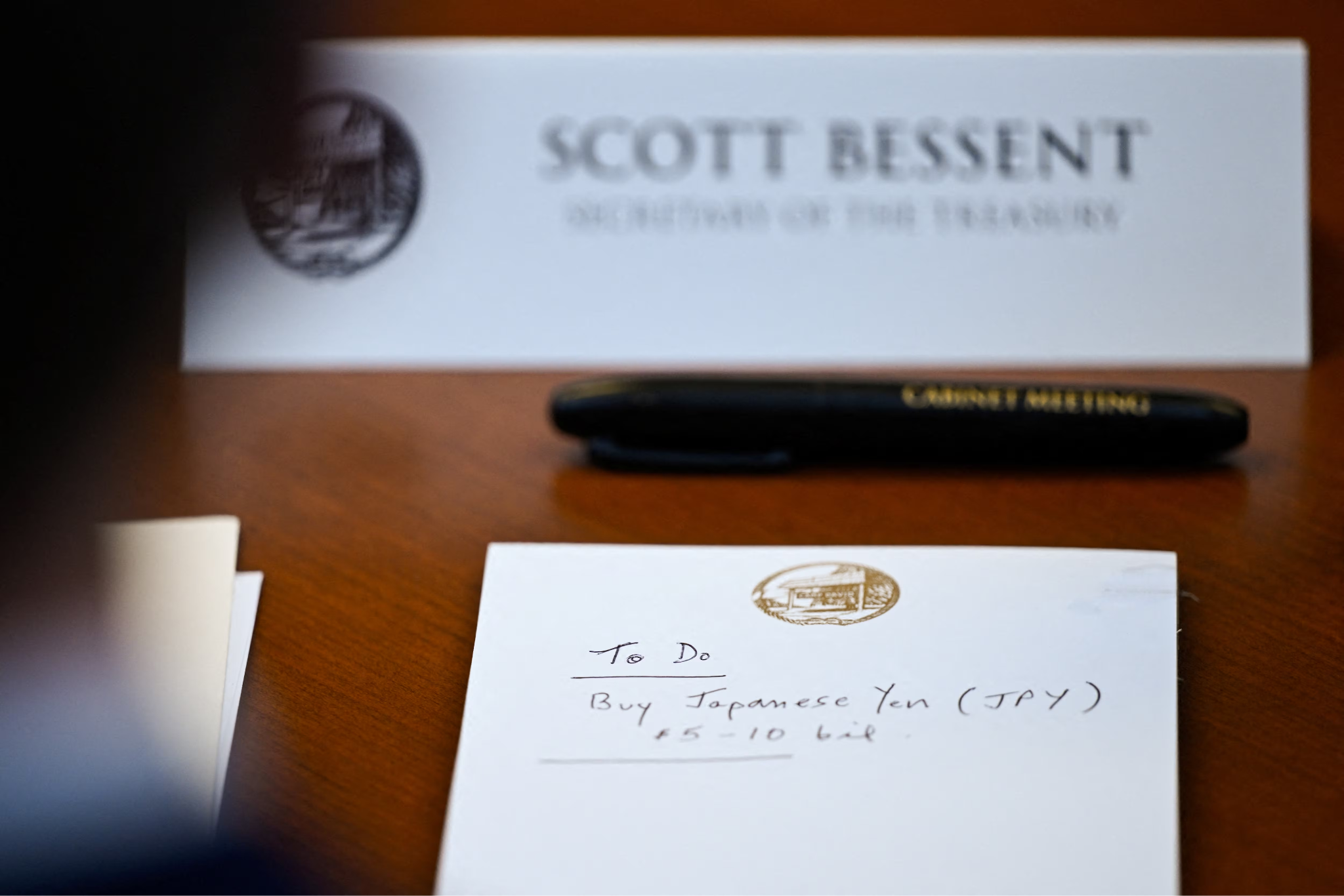
Image source: Reuters. Story brought to my attention by my colleague Vanshika Saraf
Later that day, the New York Fed, acting on the Treasury’s behalf, followed through by selling euros from American reserves to buy yen, alongside Japan’s own intervention. Both governments confirmed it on 3 August. It was the first time in nearly three decades that Washington had intervened to support the yen. The last comparable episode was 1998, during the Asian financial crisis; the 2011 joint action ran the other way, to stop the yen rising after Fukushima.
WHY?
The yen had fallen to roughly 164 to the dollar in late July, its weakest since 1986, on the back of imported inflation (thanks to the war) and a Bank of Japan that was slow to normalise. Tokyo’s problem was straightforward and domestic: a currency that makes food and fuel more expensive, in a country that imports both.
Washington’s problem was different, however. When Japan intervenes to support the yen, it needs dollars. Its conventional source of dollars is its foreign exchange reserves, which are overwhelmingly US Treasury securities. Japan is the largest foreign holder of American government debt, at somewhere around $1.1–1.2 trillion. A yen-buying operation financed the old way means selling Treasuries into a market where the 30-year yield had just touched its highest level since 2007, and where total federal debt has crossed $40 trillion, over 120 per cent of GDP.
So the United States was not really defending the yen. That is not its policy priority, but it was interested in defending its own long end. The mechanics confirm it. Washington sold euros rather than dollars, which could be seen as an odd choice, since coordinated intervention has always been funded with dollar assets, and one that several analysts thought muddied the signal. But it is coherent if the point was to avoid touching Treasury holdings at all. And within days, Japan’s finance minister announced that future interventions would be financed through the Fed’s FIMA repo facility, which lets foreign monetary authorities borrow dollars against their Treasuries instead of selling them. The US Treasury Secretary publicly called for that facility to be expanded.
The geoeconomics
The deeper shift is what this says about the dollar system.
The Exchange Stabilisation Fund, created under the Gold Reserve Act of 1934, gives the Treasury Secretary extraordinarily wide discretion over a large pool of money without going near Congress. It was used to prop up the Argentine peso less than a year ago. It has now been used to manage the currency of America’s largest sovereign creditor. When this is read together, these are not stabilisation operations in the old, narrow, technical sense. They are geoeconomic instruments, deployed at executive discretion.
The reserve currency issuer has historically enjoyed the privilege of not having to care about the exchange rate. What we are watching is that privilege inverting. A debtor, who is at 120 per cent of GDP cannot be indifferent to the financing decisions of its creditors and so it starts managing them, first by buying their currency, then by building facilities that let them raise dollars without selling its bonds.
These actions taken together signals that the dollar system is more discretionary, more political, and more dependent on the judgement of whoever holds the office. The market’s response to the eventual conclusion of that logic is the thing to watch. If an asset’s price partly reflects official intent, then the market will eventually price the asset for official intent.
For India, that cuts two ways. A more interventionist, more discretionary US Treasury makes the reserve currency more of a policy instrument in someone else’s hands and perhaps less of a neutral utility. This strengthens an argument for diversification on top of the already strong arguments to do with sanctions or de-dollarisation.
In other currency news, Russia is trying to devalue its currency to help with its domestic budgets. Here’s the news from the Economist:
But lately a strong rouble has been a curse—notably for the federal budget. In the first half of the year it averaged 77 to the dollar; the budget had assumed a rate of 92. Because Russian oil exporters (which are mostly state-owned or otherwise linked to the government) earn their revenue in dollars, their income translated into fewer roubles than expected. Oil and gas provide 20% of budget revenue. A persistently strong rouble would make the shortfall bigger.