Why AI Governance Keeps Prioritising Speed Over Safety
| AUTHOR | Bharath Reddy |
| DATE | July 31, 2026 |
| CATEGORIES | Artificial Intelligence High Tech Geopolitics |
Takshashila’s State of AI Governance 2025 reaches a blunt verdict: every major power chose innovation over safety. AI governance has been less about putting on the brakes to build carefully and more about industrial policy. Chips, data centres and indigenous models now drive policy more than safety does.
AI use disclosure: Claude was used for copy-editing and to brainstorm the causal loop diagram described in this blog.
The harder question is why this pivot is proving difficult to reverse despite public demand for restraint from civil society, regulators and even some governments. A causal loop diagram helps to untangle the different forces at play in the system.
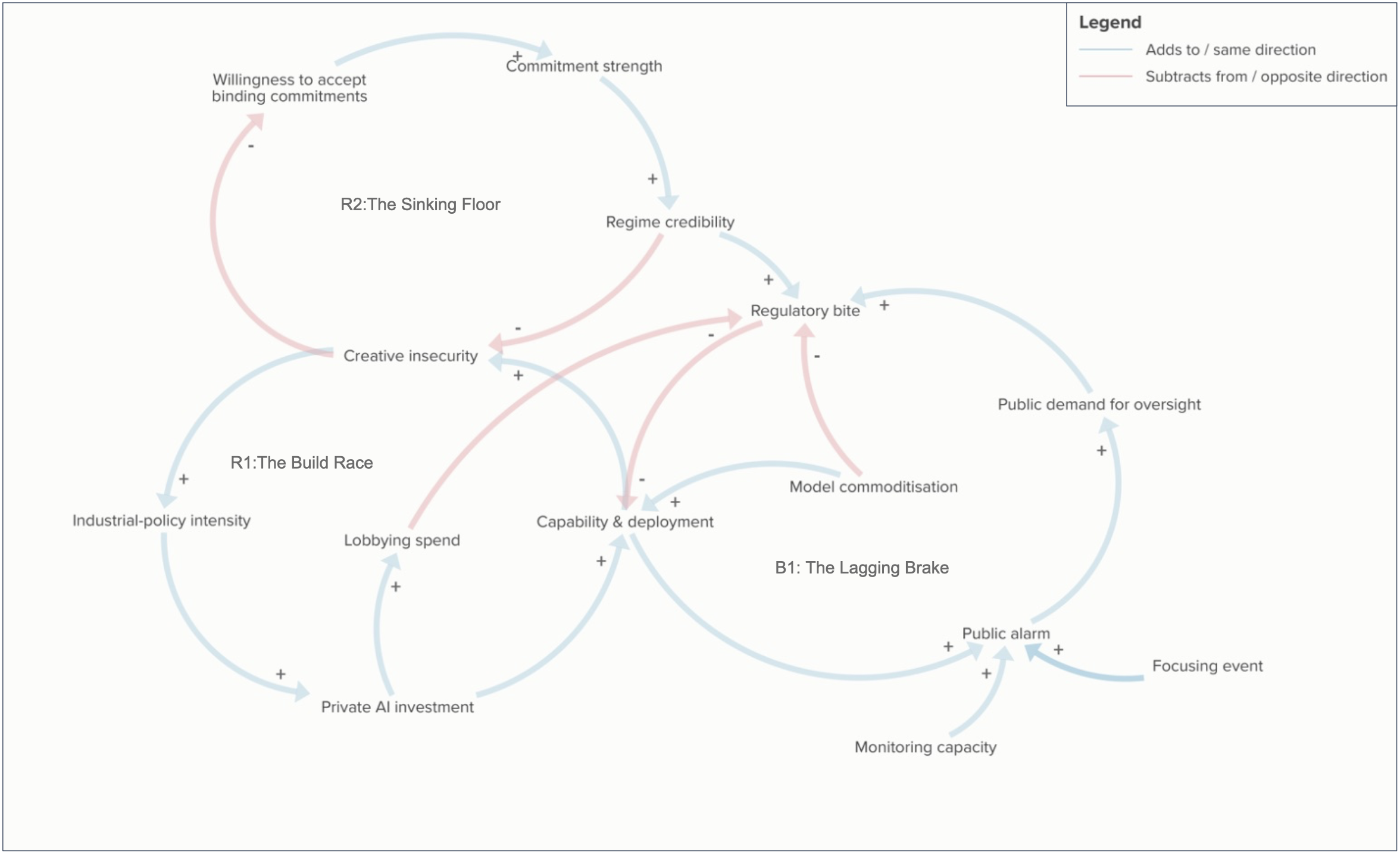
Creative insecurity, a term coined by Mark Taylor in his book The Politics of Innovation, sits at the core of the situation we find ourselves in. It describes a scenario (like the current world order) when external military or economic threats force domestic political groups to overcome rivalries and heavily fund national science and technology innovation.
Creative insecurity powers two self-reinforcing loops. The first is a domestic Build Race: insecurity drives industrial policy, which pulls in investment, which raises capability, which raises everyone’s insecurity again since the other side is doing the same thing. The second is the Sinking Floor of international governance rules: the same insecurity makes states unwilling to accept binding commitments, which weakens the strength of any agreement they do reach, which erodes the credibility of the regime as a whole. A regime no one trusts offers no assurance, so insecurity stays high. The AI Summits from Bletchley to Seoul to Paris to Delhi traces exactly this descent — broader declarations, thinner commitments, and the two most capable states walking away in Paris. Creative insecurity is the single engine driving two loops: it is simultaneously accelerating the domestic build-out and dissolving global coordination
Against both reinforcing loops stands one balancing loop – the Lagging Brake. Harm becomes visible, the public demands oversight, leading to regulation that bites. In principle, it self-corrects. However, it arrives late in practice because harms surface slowly, and it is actively weakened: lobbying grows with investment and blunts regulation, while commoditisation of models scatters capable models across thousands of deployers, making it harder to target regulatory interventions.
This outcome is not set in stone. Reinforcing loops can be flipped, and the diagram identifies the levers: a focusing event that jumps the delay (as when Anthropic’s Mythos model exhibited capabilities to autonomously exploit software vulnerabilities, prompting governments to weigh pre-deployment oversight) and strengthening monitoring capacity that enables faster response.