Weapons ‘Made in China’
| AUTHOR | Anushka Saxena |
| DATE | June 20, 2026 |
| DOCUMENT | Takshashila Discussion Document 2026-16 |
| VERSION | Version 1.0, June 2026 |
| CATEGORIES | China Defence Geostrategy |
Executive Summary
Two weapons systems China has exported widely, consistently emerge as deficient across multiple buyers — the NORINCO VT-4 Main Battle Tank and the CASC CH-4B combat drone. The VT-4, which Thailand and Nigeria both deploy, has repeatedly faced thermal and metallurgical defects. The CH-4B fleets of Jordan, Iraq, and Algeria have experienced crashes, offloading incidents, and groundings.
Importer trends speak to a clientele of partially dependent, geographically concentrated, developing-world consumers. Yet, even as some buyers like Saudi Arabia and Pakistan continue to engage in new contracts, consumers continue to diversify or indigenise. Examples include Jordan selling off its CH-4Bs, Nigeria and Kenya turning to South African, Russian, and American platforms, and Myanmar grounding its aircraft.
Three factors are likely to complicate Beijing’s arms export trajectory. These are the likely post-Ukraine resurgence of Russian and American exporters; the widening net of the US BIS and Department of War designations of Chinese military-industrial entities; and notable operational failures and serviceability lacunae, that may discourage the kind of deeply intertwined defence ties that bind China to Pakistan, or India to Russia.
1. Introduction
China’s has well established its economic power, and cemented its status as the factory of the world. In President Xi Jinping’s conception, building expansive military power goes hand in hand with economic prowess. That belief has manifested on two fronts — modernising the People’s Liberation Army (PLA) to become a world-class force by 2049, which requires a military-industrial complex (MIC) that is innovative, self-reliant, and can provide for both the PLA, and the emerging global market for a diversified supply of arms and ammunition.
This paper aims to assess the paradox posed by Beijing’s rise as a major arms exporter and the internal and external deficiencies in its arms trade engagements. Assessing this dynamic is vital for three reasons. Firstly, from a global perspective, China’s endeavour to advance the military-industrial complex and statecraft is not a standalone commercial enterprise but rather a broad project intertwined with flagship diplomatic and monetary initiatives, such as the Global Security Initiative and the Belt and Road Initiative. It is further empowered by a robust domestic legislative framework and financial support from the party-state, which protect Chinese business interests abroad and subsidise costs for a clientele of developing economies.
Secondly, countries attempting to navigate US-China competition cannot do so without factoring in the fact that Chinese arms exports are a central pillar of the broader contest over technology, economic advancement and military modernisation. This is especially important given contemporary US government efforts to impose heavy sanctions and restrictions on Chinese firms that back or are backed by Military-Civil Fusion (MCF). This brings many privately owned or dual-use component suppliers onto their radar, warranting compliance scrutiny for all economies globally.
Thirdly, for India, China’s weapons exports and defence partnerships directly impact its regional standing and security policy. Events from the four-day hostilities of May 2025 saw Pakistan combat India using weapons systems and platforms heavily imported from China.1 Keeping track of similar Chinese footprints in not just Pakistan’s but also other regions’ security and defence apparatuses enables Indian thinkers and decision-makers to respond in a prompt and informed manner.
The paper proceeds in three parts. The first lays out the contemporary architecture around China’s MIC — the scale, policy and geopolitical scaffolding, the major State-Owned Enterprises (SOEs) and non-traditional actors, the main weapons exported, and key consumers/ importers. It also discusses what Beijing gains from arms exports, not just in terms of revenue and market share, but also in creating operational validation environments in live theatres and cultivating leverage against adversaries engaged in regional conflicts. The second section covers case studies across Southeast Asia, West Asia, Africa, and Venezuela and Pakistan. The conclusion then synthesises the analysis into structural insights, while cautioning against the more reductive assumption that Chinese weaponry is uniformly poor in quality — a claim that, as case studies discussed below shall show, requires a far more disaggregated and theatre-specific assessment than the headlines typically afford.
2. China’s MIC: Patterns, Policy, Geopolitics and Leverage
2.1 The Manifestation of Military Industrial Power: Numbers and Patterns
Beijing’s investments in an ‘MIC with Chinese characteristics’ began to yield results in the past decade or so, even as the seeds for a formalised defence economy go as far back as Mao Zedong’s ‘Two Bombs, One Satellite’ programme. For example, SIPRI data suggests2 that China climbed a couple of spots from the five-year period between 2006 and 2010 to the one between 2011 and 2015, and became the world’s fourth-largest arms exporter after the US, France and Russia. Its percentage share in the global arms export pie remained between 5 and 7 per cent. It held that position until 2024, when it was superseded by Germany by a small margin of 0.1 per cent in 2025 (see Figure 1).
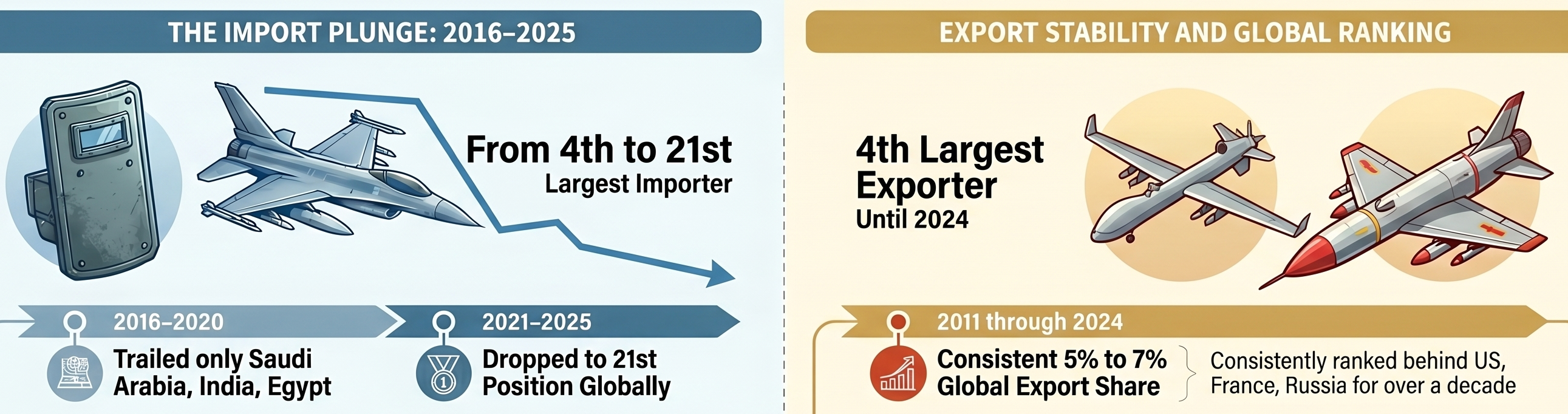
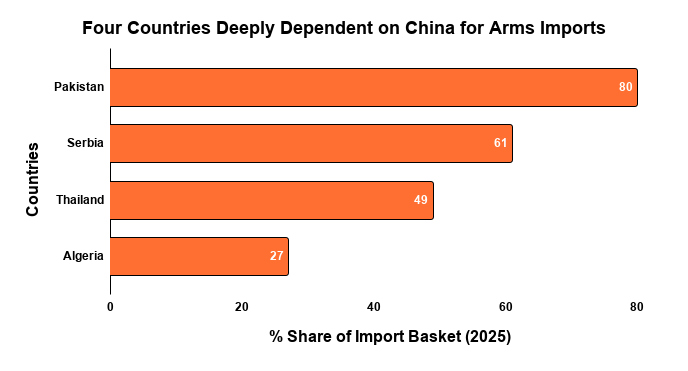
More notable, however, has been China’s downward climb on the global list of top arms importers. It went from the fourth-largest importer of arms after Saudi Arabia, India, and Egypt in the 2016-2020 period to the 21st-largest importer by 2021-2025. Today, it has its own deeply dependent clientele, with Pakistan, Serbia, Thailand and Algeria at the top. As of 2025, China contributed 80 per cent, 61 per cent, 49 per cent, and 27 per cent of their total arms imports baskets, respectively (see Figure 2).
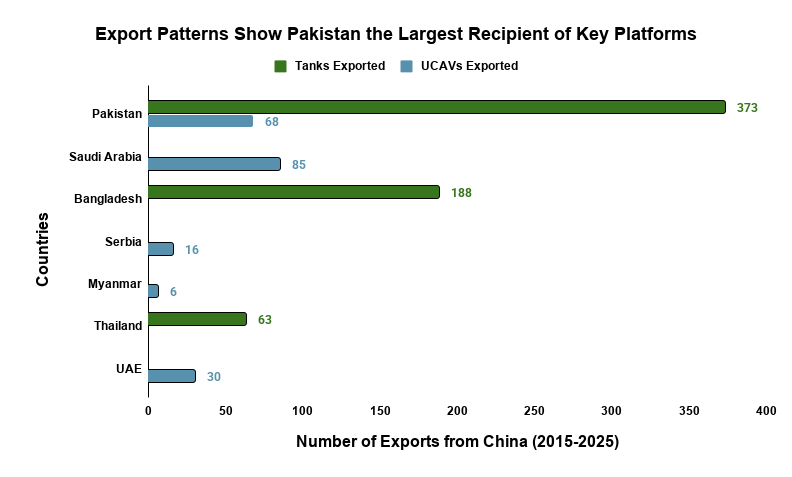
In terms of scale and patterns, a comprehensive dataset3 analysis based on SIPRI’s ‘Trend Indicator Values’ database4 further reveals the meta-trends in the profile of weapons exported. Between 2015 and 2025, China has sold ~600 tanks to eight countries (see Figure 3). Pakistan was the largest buyer, with ~373 tanks (Type-90-2M and VT-4 combined), followed by Bangladesh with 188 (Type-59G and VT-5), and Thailand with 63 (3 ZTD-05 light tanks and 60 VT-4s). In terms of Uncrewed Combat Aerial Vehicles (UCAVs), China sold roughly 300+ to at least 16 countries. Saudi Arabia was the biggest buyer with ~85, Pakistan with ~68, and the UAE with ~30. Iraq, Serbia, Algeria, and Nigeria also purchased large numbers of UCAVs from Beijing.
In terms of ships, Bangladesh was the top naval buyer with ~15 vessels, including four frigates, two corvettes, two submarines, and five patrol boats (see Figure 3). Pakistan was second with ~13, including four Type-054A frigates — one of China’s most advanced exported warships. More recently, however, under the Hangor-class co-production deal between Beijing and Islamabad, four submarines are to be transferred from the former to the latter, while four more are to be built in Pakistan. Finally, in the aerial domain, Pakistan has received ~95 JF-17 Thunder jets across varied block iterations (I/II/III) and 20 J-10CE fighters, making it China’s only export customer for modern fighter jets. Subsequently, the Pakistan Aeronautical Complex (PAC) in Kamra has begun co-producing JF-17s.
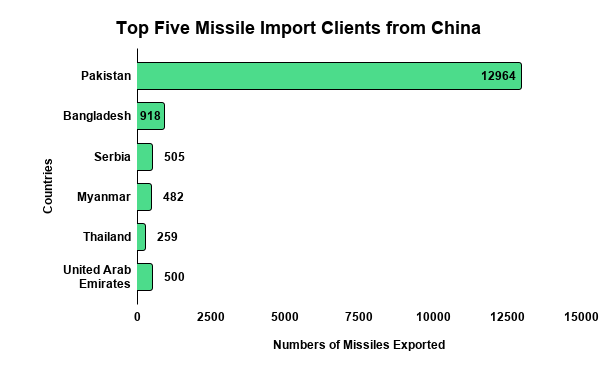
Further, between 2015 and 2025, Pakistan alone purchased over 12 thousand missiles, ranging from the Red Arrow-8 anti-tank missiles (500/ year for 11 years), the PL-12 air-to-air (40/ year for nine years), and the PL-5E (60/ year for 11 years), to LT-2 guided bombs and anti-ship missiles across a wide array of systems. The basket also includes the LY-80 surface-to-air missile systems, which SIPRI classifies as ‘Air Defence Systems’. China also exported large-scale SAM systems to at least 12 other countries in the same period. After Pakistan, Myanmar bought the most by unit count, with 350 KS-1 SAMs (which have also been exported to Cambodia, Thailand, Turkmenistan and Uzbekistan), while Serbia has purchased the advanced HQ-22 SAM systems.
Despite the existence of this broad and diverse clientele, certain systemic and structural factors are likely to complicate Beijing’s arms export trajectory. These are the likely post-Ukraine resurgence of Russian and American exporters; the widening net of the US BIS and Department of War designations of Chinese military-industrial entities; and notable operational failures and serviceability lacunae, that may discourage the kind of deeply intertwined defence ties that bind China to Pakistan, or India to Russia. Internal tussles emerging from the purges in China’s military-industrial complex, and concerns over the inefficiency of Beijing’s weapons procurement and sales processes, further undermine legitimacy and credibility.
2.2 Policy and Geopolitics
The predominant pillar of China’s defence manufacturing and technological innovation strategy is Military-Civil Fusion (MCF). Xi elevated MCF, which has the overarching objective of ensuring rapid advancements in civilian research,5 to the status of ‘National Development Strategy’ by 2015. Since then, under the ambit of MCF, and more recently, the ‘National Strategic Systems and Capabilities’ (NSSC)6 model, critical dual-use modernisation efforts have become the cornerstone of China’s MIC. Per Premier Li Qiang’s 2024 Government Work Report,7 NSSC is geared towards taking the MIC to a DTIB — a Defence Science, Technology and Industrial Base — while also pursuing a whole-of-nation mobilisation strategy to build it.
In terms of establishing sustained policy pushes around the MIC, the last three Five-Year Plans, the 13th (2016-20), 14th (2021-25) and 15th (2026-2031) have codified the need to balance development and security. The 14th FYP, in particular, called for “simultaneous increase of national defence strength and economic strength,”8 with a focus on disruptive and asymmetric high-technologies. The 15th FYP,9 unveiled at the National People’s Congress in March 2026, calls for the development of an “advanced national defence science and technology industry system.”
Concerns arising from US restrictions on Chinese firms for supporting the PLA have also, over the past five years, led Beijing to create a layered legislative moat around its MIC. Such a moat is specifically designed to exact compliance from domestic firms, deter long-arm jurisdiction by foreign states, and insulate domestic supply chains from external shocks. In this regard, two important legislative frameworks are the 202010 Export Control Law and the 202111 Data Security Law. While the former defines security using broad and vague parameters and lays down guidelines to govern and restrict exports of and trade in dual-use items, the latter mandates rigorous national security checks for the processing of dual-use data, restricting the flow of information and R&D outcomes outside of the Chinese border.
More recently, in April 2026, the PRC State Council promulgated two major Regulations — On Industrial and Supply Chain Security (Decree No. 834)12 and On Countering Unjustifiable Extraterritorial Jurisdiction Measures (Decree No. 835).13 These are meant to identify and chart suitable responses to the threats facing China’s supply chains. For example, Decree 834 includes a provision to build a “Key Sector List,” likely encompassing critical technologies such as batteries, renewable energy, graphite, lithium, and rare earths, over which the party-state can exercise emergency measures when their supply is threatened. On the other hand, Decree No. 835 acts outward, in conjunction with China’s 202114 Anti-Foreign Sanctions Law and ‘Unreliable Entities List’. It details punitive measures the party-state can take against companies complying with any foreign state’s sanctions on China. Likely targets would include companies complying with, say, the US Treasury Department’s Office of Foreign Assets Control (OFAC) sanctions, the Uyghur Forced Labour Prevention Act (UFLPA), the Bureau of Industry and Security (BIS) Entity List, or the EU Corporate Sustainability Due Diligence Directive.
This, however, has not prevented the US from imposing restrictive measures on Chinese military-industrial actors. The US Department of War’s 1260H List15 of ‘Chinese Military Companies’ operating directly or indirectly in the US, between 2021 and 2025, has designated ~188 Chinese firms16 and their subsidiaries for supporting China’s MIC. BIS, acting under the US Department of Commerce, too, has designated hundreds of Chinese entities for “acting contrary to the national security or foreign policy interests of the United States.” This strategy of restricting trade with, and disallowing operations of, Chinese defence enterprises, is what BIS has termed “small yard, high fences.”17 There also exist specific sanctions, such as OFAC’s crackdown on Iran’s “Transnational Missile and UAV Procurement Networks,”18 which has led to the targeting of various China- and Hong Kong-based suppliers. In this regard, China’s MIC has become both a source of enhanced military power and a bone of contention in its competition with the US.
2.3 The Why
The Chinese defence export ecosystem presents both the benefits of capturing a value-arms market, and the risks of creating a parallel arms trading order. This is because Beijing provides developing nations with relatively qualitative but affordable arms when compared with Western or Russian alternatives. Also, these arms sales do not enforce strict human rights and end-user stipulations, nor do they require governments to provide financial solvency checks, which are especially prominent requirements in European sales. When packaged with Chinese President Xi Jinping’s flagship programmes, such as the Belt and Road Initiative (BRI) and the Global Security Initiative (GSI), these arms trades capitalise on deep political interconnections and economic dependencies to create new markets.
But beyond the revenue and market share propositions, Beijing derives some leverage and strategic value from these sales, and the layered legislative moat at the underbelly of the MIC is, in part, what allows such value extraction to occur with relative impunity. Firstly, arms exports function as operational validation environments for systems that the PLA itself has not had the opportunity to battle-test at scale. The Iranian Shahed-136 drone, for example, even though it is not a wholly Chinese product, has had major components like engines, cameras and some processors supplied by Chinese firms such as Mile Haoxiang and Honphu, and its successes in kamikaze strikes against American bases in Bahrain and Saudi Arabia, and the British base in Cyprus, generate a direct feedback loop between Chinese producer/ supplier and Iranian operator/ deployer. For a PLA that may, in any future contingency in its periphery, face the same Patriot and THAAD architectures fielded against the Shahed, the lessons on combining conventional interceptors with drone swarms in a contested air battle are significant.19 Such exports also speak to the predominance of state-guided firms in even foreign sales of weapons, and allow Beijing to build its own operational template for sanctions evasion.
Secondly, every adversary that Washington is locked in conflict with — whether it be Iran in West Asia, Russia in Ukraine, or Pakistan in the Indian Subcontinent — represents an opportunity for Beijing to tip the scales by ensuring that the US has to compete against another major power backing its rival. In the Iranian case, Tehran’s leverage over the Strait of Hormuz provides Beijing with a greater incentive to grease the wheels, given its own energy security imperatives. Hence, China becomes a preferred arms seller for those competing with the US or the broader West in their own ways, while, in exchange, gaining at best a deal or, at worst, some goodwill.
2.4 Actors
China continues to witness the growth of large state-owned enterprises (SOEs) in the military-industrial sector. Some of the biggest firms to this end include the Aviation Industry Corporation of China (AVIC), the China State Shipbuilding Corporation (CSSC), the China Aerospace Science and Technology Corporation (CASC), the China Electronics Technology Group Corporation (CETC), and the China North Industries Group Corporation (NORINCO). These SOEs come under the dual oversight of the Central Military Commission (CMC) and the State Council’s State-owned Assets Supervision and Administration Commission (SASAC). Some of these SOEs hold exclusive and permanent authorisation to undertake international arms transfers — something that, unlike in the West, private-sector firms cannot do. For the past many decades, Beijing has authorised four SOEs — namely, NORINCO, Poly Technologies, China Jing’an Import and Export Corporation, and China Xinxing Import and Export Corporation — to exclusively export small arms and light weapons (SALW).20
The individual expertise of the big SOEs also reflects patterns of monopolisation. NORINCO, for instance, dominates the land systems domain, producing Main Battle Tanks (MBTs), Armoured Personnel Carriers (APCs), howitzers, and SALW. These constitute the majority of China’s ground-force exports to Africa, Southeast Asia, and West Asia. Then there is AVIC, whose many subsidiaries, like the Chengdu Aircraft Industrial Co. (CAIC) and Shenyang Aircraft Corporation, manufacture drones and fighter aircraft. AVIC’s Wing Loong drone series is especially popular in the global market. The China National Aero-Technology Import and Export Corporation (CATIC), as AVIC’s dedicated aerospace trading arm, handles the international marketing and sale of fighter jets, trainer aircraft, and UAVs, and has been implicated in transfers to Liberia when it was under a UN arms embargo. Similarly, CASC leads China’s missile and space programmes, and its CH/‘Rainbow’ series of reconnaissance and strike drones is widely exported. CASIC is responsible for the SAM sales, while CETC produces military radars, electronic warfare systems, and C4ISR infrastructure. And CSSC, the world’s largest shipbuilder by tonnage, constructs the PLA Navy (PLAN)’s surface combatant and submarine fleet domestically, while simultaneously producing export frigates, corvettes, and submarines for Pakistan, Bangladesh and Thailand.
China’s private defence contractors are being gradually roped into the MIC through the “All-PLA Arms and Equipment Purchase Information Network.” Procurement data analysed21 by CSET Georgetown indicates that of all the AI- and intelligentisation-related contracts awarded by the PLA in the two-year period between January 2023 and December 2024, 338 entities received at least two such contracts. Of these, a whopping 75 per cent can be classified as “Nontraditional Vendors” (NTVs) with no self-reported state ownership ties. These come together with the traditional private giants like Baidu, Alibaba, Tencent and Huawei to form a readily available commercial cluster for dual-use defence industrial innovation and production.
3. Case Studies: Operational Realities and Battlefield Post-Mortems
It is notable that China is emerging as one of the top five arms exporters in the world, despite having invested in a fully developed MIC much later than the West. And yet, recent operational experiences from training, combat deployment, and battle-damage assessment reveal genuine issues with the arms and weaponry it has to offer. Case studies of four recipient regions, discussed below, address both technical and incidental issues, as well as broader challenges related to life cycle and serviceability.
3.1 Debacles in Southeast Asia
Southeast Asia in general, and countries like Thailand, Cambodia and Myanmar in particular, are major consumers of Chinese defence goods. They also maintain friendly relations with the party-state, and ASEAN members like Vietnam and Indonesia also host regular inter-ministerial dialogues on defence with their counterparts in Beijing. And yet, the operational experiences in certain Southeast Asian countries with regard to the use of Chinese weapons in both combat and training speak to the qualitative issues with the product and its outcomes.
Thailand has a history of arms trade relations with Beijing, having purchased multiple Type 69 MBTs from China in the late 1970s. After decades of sitting unused22 in Thailand’s Khorat city, because they were unserviceable and irreparable, the country’s government dumped them into the ocean to create “artificial reefs” for fishermen. Clearly, the China-Thailand defence partnership did not get off on the right foot, and yet, Thailand is today the third-largest buyer of Chinese weaponry. By 2023, Thailand had acquired as many as 60 VT-4 MBTs from NORINCO.
In December 2025, during a live-fire and assault exercise along its active combat border with Cambodia, a Royal Thai Army (RTA) VT-4 reportedly witnessed its 125 mm gun barrel explode while firing high-explosive ammunition. The explosion severely wounded23 all three of the tank’s crew members. The platform was, of course, unusable after that. Although the RTA has released no official diagnosis on the exact cause of the explosion, potential reasons identified by commentators include a combination of issues, such as overpressure24 in the turret and metallurgical defects25 in production. The Thai Ordnance Department has yet to conclude its investigation, but its officers seem to26 attribute the issue to thermal stress caused by soldiers’ overuse or misuse.
But even beyond this potentially isolated incident, an OSINT review27 of the VT-4’s battlefield performance sends mixed signals to interested markets. For example, even though VT-4s have been deployed in vast numbers by the RTA against Cambodia, anecdotal testimonials28 from Thai tank crews complain about melting barrels as soon as a “safe limit” is crossed, while the V12 diesel engine seems to underperform on the field, and the traverse speed of the mounted turret is slow. So far, till early 2026, Cambodia seems to have damaged29 three Thai VT-4 tanks. The RTA’s sustained use of these systems in any future border conflicts will likely depend on crew training to avoid overuse, and on assurances that thermal issues are kept in check.
A more damaging episode in China-Thailand defence-industrial relations is the saga surrounding the S26T submarines. In 2017, the Royal Thai Navy (RTN) and the China Shipbuilding & Offshore International Co (CSOC; now under CSSC) signed30 a G-to-G agreement for the production and sale to Thailand of three Yuan-class S26T submarines, each costing ~13.5 billion baht (~US$ 402 million). The initial contract guaranteed the inclusion of the German MTU396 diesel engine in the submarines. However, the European Union’s arms embargo31 on any domestically originating contributions to Chinese military products or capabilities prevented Berlin from exporting the engine.
It directly impacted Thailand’s interests; yet Beijing continued to pressure Bangkok to accept a domestically produced Chinese-built substitute — the CHD620 engine — which powers32 the Yuan-class submarines China has sold to Pakistan. Yet, the engine is not a scaled-up and battle-tested model, but RTN had to capitulate after years of deliberation, in August 2025. The Thai cabinet signed a revised contract that extended the delivery timeline by 1,217 days, stretching to late 2028. Reportedly, Beijing even pressured Bangkok33 by offering the half-built submarines to Indonesia, apparently with the German engine included.
In Myanmar, both the military junta, and rebel groups like the Three Brotherhood Alliance, are consumers of Chinese weaponry. In the case of the formal transfers with the former, the junta has faced its own operational difficulties with such consumption.
Perhaps the biggest such failure is the Myanmar Air Force (MAF)’s grounding of its JF-17 fighter jet fleet in November 2022 due to a variety of issues. Myanmar inked a deal34 in 2016 to procure 16 China-Pakistan co-produced jets, of which six were confirmed delivered, at a cost of ~US$ 25 million per unit. After commissioning, the MAF discovered issues with the jet’s ability to precisely target and perform in Beyond-Visual-Range (BVR) operations, and its CETC-developed KLJ-7A Active Electronically Scanned Array (AESA) radar faced sustained failures. The issues with radar are not unique to the Burmese — avionics specialists have previously highlighted35 radar resolution-cell issues with the KLJ-7/7A, in which the radar overperforms and exaggerates when distinguishing closely spaced flying targets, affecting situational awareness in dense combat environments.
Further, there were critical supply and life-cycle issues with the jet, primarily due to sanctions imposed on the junta, which left them unable to import spares and parts from the West. As the jet’s airframe began showing cracks and engines encountered stresses, and because the Myanmar military lacks the technical expertise to repair these complex systems, Pakistani technicians from the Pakistan Air Force had to reportedly36 be secretly flown into the Pathein air base in the Ayeyarwady Region of Myanmar, so that they could help resolve the glitches and set up simulators.
Myanmar’s fleet of AVIC-developed FTC-2000G fixed-wing multirole combat attack jets, inducted37 into the MAF in 2022, has suffered operational setbacks. For example, two FTCs have been confirmed to be shot down in separate instances, by Burmese rebel groups. The first instance in January 2024 saw the Kachin Independence Army in Shan State down a jet using, ironically, a Chinese-made FN-6 MANPAD. The second instance, in June 2025, saw38 a rebel group claim to have shot an FTC down in Myanmar’s Sagaing region — an area where armed resistance against the junta thrives. While there are competing accounts of why the jet actually went down, with officials claiming it was the result of a mechanical failure, neither scenario bodes well for the jet’s operational success.
3.2 Paradoxes in West Asia
The February 2026 hostilities between Iran and the US and Israel have brought out conversations on China’s role in supplying Tehran with critical defence components and systems. There is no official confirmation of sales of widely discussed equipment, such as the CASC HQ-9B SAMs, CM-302 anti-ship missiles, and JY radar systems, over the past decade. Hence, there is no proven operational record to assess with clarity. It is notable, however, that Chinese suppliers, re-exporters, and OEM manufacturers have been deeply integrated into Iran’s drone ecosystem, with firms such as Mile Haoxiang and Honphu supplying everything from engines to visible-light cameras for its Shahed UAVs. The Shaheds have also had vital successes in kamikaze operations targeting American bases in Bahrain and Saudi Arabia, and a British base in Cyprus.39
China has, in general, been an active participant in the West Asian drone ecosystem. Its CH-4B and Wing Loong drones have found a major consumption market in Jordan, Iraq, and, more recently, Saudi Arabia.
Yet, some of these importers have faced hindrances to the deployment of these drones, stemming from both American pressure and operational challenges. Jordan, for example, purchased six CH-4Bs in 2016, and put them up for sale40 within three years of acquisition, in 2019. Though there was no official reason provided by Amman for this decision, some speculated41 that it had to do with the US refusing to service any C2 demands for Chinese-made drones, and pressuring it to purchase MQ-9 ‘Reapers’ from Washington. Yet, reports42 from 2018 also suggest that Jordan may not have been “happy” with the drone’s performance, and “was looking to retire them.”
Iraq has had similar trysts with its fleet of 20 CH-4Bs. By 2019, eight43 of these drones had crashed during testing and in conflict, while the others were grounded44 in hangars by 2021, due to an absolute lack of spare parts servicing from their producer, the CASC. Nonetheless, since then, Iraq has purchased more Chinese drones, including the next iteration — the CH-5. Baghdad unveiled it45 during a live missile launch drill around the time US forces completely exited the Ain Al-Asad airbase in February 2026.
This speaks to the broader trend in West Asia, with countries seeking to continue military-industrial cooperation with China despite evident operational failures. For example, in March 2026, Riyadh, seeking to diversify its defence partnerships away from the US, reportedly46 facilitated a landmark US$ 5 billion agreement between China’s AVIC and the General Military-Industrial Authority of Saudi Arabia (GAMI). The deal provides for the establishment of a massive manufacturing assembly line in Jeddah capable of producing 48 Wing Loong-3 UCAVs annually, and builds to a certain degree, indigenous UCAV manufacturing capability in Saudi.
3.3 Casualties in Africa
Chinese defence exports to Africa are primarily targeted at state militaries engaged in counter-insurgency and domestic security operations. Here, Chinese weapons systems have failed to meet certain vital baseline operational standards critical to such a tense environment. In Nigeria, for instance, the military procured the VT-4 MBTs to combat Boko Haram as part of Operation Tura Takai Bango,47 and the first batch was delivered by NORINCO in 2020 for a price48 of US$ 152 million. In a scenario similar to that faced by the RTA, Nigerian armour crews reported49 that the tanks suffered severe thermal stress issues. For instance, the turrets required a 30-minute cooldown period between engagements in sustained fire, due to overheating. In a civil war scenario requiring repeated firepower engagement, this can prove lethal.
Then, in 2016, Kenya procured 30 NORINCO VN-4 armoured personnel carriers from China. Apparently, in the initial delivery and training days, Chinese sales personnel from the main producer of the APCs, Chongqing Tiema Industries, refused50 to sit inside the vehicles during test firings. Subsequently, it was reported51 in the Kenyan platform Standard Digital in 2019 that the National Police Service, which inducted the VN-4s, found that the platform “cannot withstand a rocket-propelled grenade (RPG) attack.” These APCs were hit by improvised explosive devices (IEDs) planted, presumably, by Al Shabaab terrorists, and the impact led to injuries and deaths of over 10 Kenyan forces.52
Both Nigeria and Kenya have adopted diversification postures to ensure backups and operational stability, increasingly acquiring MBTs and APCs from non-Chinese vendors. Nairobi has, for example, in late 2025, signed53 a deal with South Africa to purchase its Springbuck 4x4 mine-resistant APCs, and to buy second-hand M1117 Armoured Security Carriers from the US. In 2023, Nigeria reportedly54 resumed negotiations with Russia to purchase T-90 MBTs for US$ 99.5 million, though the Nigerian defence ministry later refuted the endeavour. At this time, the armed forces have continued55 to use their T-72 MBTs from Czechia and Ukraine, as well as the old Vickers Mk-3 tanks from the UK.
A different example is that of Algeria. Between 201456 and 2021,57 the Algerian armed forces, as in Iraq and Jordan, experienced multiple crashes and technical failures involving their CH-4 B fleet. Two of them crashed one month apart during58 regular training drills at Algeria’s Tindouf and Ain Oussera airbases. But, so far, Algeria does not seem to have officially lost interest in operating the drones or procuring more of them.
3.4 Debated Instances From Venezuela and Pakistan
In January 2026, the US conducted specialised operations targeting Venezuelan President Maduro to “face justice”59 on American soil. Operation Absolute Resolve succeeded without triggering any radar or missile systems in Venezuela, and US SOF completed its mission objectives with relative ease. Whether Venezuelan systems were ineffective, overwhelmed, internally sabotaged, or never activated in the first place is a matter of debate. After all, the US openly imposed60 a barrage of electromagnetic warfare (EW) measures before aircraft flew in, which involved space, cyber, ISR and spectrum dominance efforts. Yet, the fact remains that Venezuela is reported to have invested61 over US$ 2 billion to create a layered air defence network with Russian S-300 air defence missiles and Chinese JY-27A radars, and enough redundancy does not seem to have been integrated into this architecture.
Its suite of Chinese radar systems, specifically the CETC-produced JY-27A and JYL-1, was an important component of Caracas’s layered defence networks. These systems were marketed62 globally as highly mobile, jamming-resistant, long-range air surveillance platforms capable of detecting advanced stealth aircraft at ranges approaching 400 kilometers. It was US Joint Chiefs of Staff Chairman Dan Caine’s assessment63 that the radars actually failed to detect US fighter jets or other aircraft, while Russian S-300s and Pantsir S-1 guns did not fire a single shot. There would, of course, be a cascading effect to note here — if the radar failed to detect, the gun would fail to fire.
Similar debates surround Pakistan’s performance with Chinese-origin weapons during its retaliatory operation against India’s Operation Sindoor, Operation Bunyan Ul-Marsoos. Pakistan is the predominant client for Chinese defence exports, absorbing hundreds of air, land, and sea platforms.
Yet, it too, has faced certain operational challenges. In the naval sector, for example, the Pakistan Navy procured four F-22P Zulfiqar-class frigates from China in 2009 to emphasise its surface warfare and air defence capabilities against India. However, these vessels have been found64 to operate poor FM-90(N) missile systems, which exhibit faulty image-processing units. It inhibits their ability to acquire and lock in on targets with clarity. Similar defects have been found in their IR17 infrared sensor systems and SR60 search radars, which together render visible light, infrared and multispectral imaging and target search ineffective. Nonetheless, Pakistan has acquired65 new Type 054A/P frigates from China in 2023, has inducted66 the first of eight Hangor-class submarines from China in early 2026, and relies on Chinese CM-401 hypersonic anti-ship missiles for surface-based land warfare.
In the hostilities of May 2025, in particular, even as both India and Pakistan inflicted damage, India successfully attacked Pakistan’s armed forces bases, which, to some degree, indicates the failure67 of Chinese radar and anti-air missile systems to detect and counter incoming aerial threats. And while it is officially unclear if PAF’s JF-17s were downed, in the past few years, many of these jets have experienced68 technical failures during drills and crashed69 at Pakistani sites.
4. Concerns and The Future
Despite their benefits to developing countries and militaries, several challenges persist in China’s defence consumer market. As the preceding sections prognosticating training and battlefield performance show, Chinese weapons systems face challenges ranging from mechanical and detection failures, to service life and post-delivery issues. Not to mention, two important internal dynamics plague the progress of China’s MIC. Firstly, because China remains reliant on foreign core and critical technologies, particularly advanced semiconductor lithography tools and aircraft engines, major public and private enterprises face the brunt of restrictions. The Chinese have indeed built some domestic alternatives, such as their WS-series jet engines and joint70 Huawei and SMIC Kirin chips, but they have not been sufficiently tested or scaled to the levels required for mass deployment.
Secondly, as is discussed below, the equipment procurement process continue to face qualitative hurdles due to corruption and rigging of bidding processes, which, in the past three years, has led to the removal of the entire leadership of the Central Military Commission Equipment Development Department, the PLA Rocket Force, as well as many defence SOEs71 like AVIC, NORINCO, China National Nuclear Corporation (CNNC), and the Chinese Academy of Engineering Physics (CAEP).
Further, most buyers of Chinese weaponry cite a major concern as the unavailability of spares and parts, as well as technical support, in the event of malfunctions or failures of the imported systems. Such support is likely built into co-production deals, such as those signed between Beijing and Islamabad on the Hangor Submarines and the JF-17 jets, or between China’s AVIC and Riyadh’s GAMI for the Wing Loong drones. However, as examples from Myanmar, Nigeria, and even Venezuela suggest, once a Chinese SOE secures the initial sale, it does not address the requirements of the system’s remaining life cycle. Because most of China’s defence-industrial consumers are also developing nations, it becomes difficult for them to address technical challenges or obtain support from Western economies due to the risk of sanctions or embargoes. Not to mention, training in the safe use of the weapon is also not a service China packages with the sale, which may lead to incidents like those that emerged in Thailand.
Further, because defence production was, for the longest time, only tangentially important to China’s manufacturing and exports ecosystem, there exists a structural deficit in military-grade innovation and scale. These challenges manifest in metallurgical deficiencies, as evidenced by thermal stresses in VT-4 tanks, airframe deformities in the JF-17s, and quality concerns with Chinese diesel engines for Thai S26T submarines and Pakistani F-22P frigates. There also exist challenges with Chinese-built software deployed on board its exported systems. Potential radar failures in Venezuela, as well as radar reporting discrepancies with the JF-17, point to this constraint. Also, the fact that most semiconductors, machine vision or data processing-related equipment on board an Iranian Shahed drone, despite many of its components coming from China, are American, Swiss, Taiwanese, or Japanese, may indicate both a lack of preference or a sales vacuum.
Internal tussles and the unravelling of China’s military-industrial networks between 2023 and early 2026 have added a visible layer of complication to the equation. In July 2023, the CMC Equipment Development Department (EDD) had made clear its plans72 to investigate and rectify violations of regulations and discipline by experts involved in equipment procurement bidding and review activities. In China’s procurement ecosystem, the “experts” tasked with technical evaluations of defence equipment may have exploited loopholes in selecting the right SOEs or private-sector firms for the job, or may have leaked trade secrets to make bidding easier for select contractors. Inspections of the equipment in field testing have been known to reveal misreporting and mediocrity.73 Internal investigations may have shed light on officials accepting kickbacks or pocketing budgets intended to enhance real combat capability, ultimately leading to the disappearance of some who wavered.
The revealed networks of such graft have eventually led to the purges of leaders like former Defence Minister and EDD Director Li Shangfu, former CMC Vice-Chairman and EDD Director preceding Li, Zhang Youxia, AVIC Chairman Zhou Xinmin, CNNC Chief Engineer Luo Qi, NORINCO Chairman Liu Shiquan, CASC Chairman and Party Chief Wu Yansheng, and CAEP Director Liu Cangli.74 The vacuums and mistrust such purges create are likely to drastically affect, if nothing else, the well-preserved image of credibility and control pervading China’s party-state system, and the potential reliability of those in its SOE or military leadership who run the defence business with the rest of the world.
Going forward, three factors are likely to complicate preferences for, and the supply chains of, China’s defence exports globally.
The first, is the likely resurgence of Russian and American exporters to fill in the gaps left by them due to their engagements in the war in Ukraine since 2022. It is notable that China’s rise to the fourth-largest global arms exporter in the 2020-2024 period was due to Russia’s shrinking share of the pie, thereby inflating the contribution numbers of actors ranking below it.
Second, there is the repeated casting of a wider net by the US BIS under the 2021 National Defence Authorisation Act’s 1260H list, against ‘Chinese Military Companies’ directly or indirectly operating in the US. The June 2026 list now includes major privately owned giants like Alibaba, Baidu, and BYD that enable China’s MIC, and prohibits the Department of War, and by extension other US businesses, from entering into contracts with any of the 188 designated entities.75
Thirdly, as the Chinese after-sales and spares and parts delivery vacuums become bones of contention, even as a diverse set of countries continue to sign new deals and co-production arrangements with China, Beijing is unlikely to emerge as the predominant partner for a large group of stakeholders anytime soon. Its structural inefficiencies and operational failures are likely to further discourage both new and existing importers from building deeply intertwined defence-industrial connections, as those that exist between China and Pakistan, or India and Russia.
Acknowledgement: The author is grateful to Manoj Kewalramani for his valuable research feedback.
Footnotes
Jagatbir Singh, “Pakistan – China Collusivity as Witnessed in Operation Sindoor,” USI of India, July 14, 2025, Link↩︎
Mathew George et al., “Trends in International Arms Transfers, 2025,” Stockholm International Peace Research Institute, March 9, 2026, Link↩︎
Database microsite prepared by Anushka Saxena, June 2026, Link↩︎
“SIPRI Arms Transfer Database,” Stockholm International Peace Research Institute, n.d., Link↩︎
“习近平的两会时间(十): 系统阐述军民融合发展的三个看点,” Xinhua, March 12, 2015, Link↩︎
“In Their Own Words: 2025 China’s National Security in the New Era,” China Aerospace Studies Institute, August 9, 2025, Link↩︎
“Highlights of 2024 government work report,” Embassy of the People’s Republic of China in the United States of America, March 7, 2024, Link↩︎
“中华人民共和国国民经济和社会发展第十四个五年规划和2035年远景目标纲要,” Centre for Security and Emerging Technology (trans.), May 13, 2021, Link↩︎
“’十五五’规划纲要, 全文来了!,” People’s Daily App, March 13, 2023, Link↩︎
“Export Control Law of the People’s Republic of China (2020 edition),” China Law Translate, October 19, 2020, Link↩︎
“Data Security Law of the PRC,” China Law Translate, June 10, 2021, Link↩︎
“State Council Provisions on Industrial and Supply Chain Security,” China Law Translate, April 8, 2026, Link↩︎
“PRC Regulations on Countering Improper Extraterritorial Jurisdiction by Foreign States,” China Law Translate, April 13, 2026, Link↩︎
“China Adopts Anti-Foreign Sanctions Law,” UNCTAD Investment Policy Hub, June 10, 2021, Link↩︎
“DOD Releases List of Chinese Military Companies in Accordance with Section 1260H of the National Defense Authorization Act for Fiscal Year 2021,” US Department of War, January 7, 2025, Link↩︎
“Entities Identified as Chinese Military Companies Operating in the United States in Accordance with Section 1260H of the William M. (Mac) Thornberry National Defense Authorization Act for Fiscal Year 2021 (Public Law 116-283, Section 1260H, as amended (codified at 10 U.S.C. § 113, note),” US Department of War Media, June 8, 2026, Link↩︎
“Remarks as Prepared for Delivery by Under Secretary Estevez: Mount Fuji Dialogue,” US Bureau of Industry and Security, Department of Commerce, October 21, 2023, Link↩︎
“Treasury Disrupts Iran’s Transnational Missile and UAV Procurement Networks,” US Department of the Treasury, November 12, 2025, Link↩︎
Anushka Saxena, “China’s role in enabling Iran’s Shahed drone supply lines,” Nikkei Asia, May 7, 2026, Link↩︎
Mark Bromley et al., CHINA’S EXPORTS OF SMALL ARMS AND LIGHT WEAPONS, SIPRI Policy Paper No. 28, Stockholm International Peace Research Institute, October 2013, Link↩︎
Cole McFaul, Sam Bresnick and Daniel Chou, “Pulling Back the Curtain on China’s Military-Civil Fusion: How the PLA Mobilizes Civilian AI for Strategic Advantage,” Centre for Security and Emerging Technology, September 2025, Link↩︎
Asaree Thaitrakulpanich, “RADIANT AND RADICAL: TADA HENGSAPKUL’S ART UNCOVERS THAILAND’S DARK HISTORY,” Hard Stories, January 7, 2022, Link↩︎
Sam Cranny-Evans, “China’s defence exports, a troubled tale,” Calibre Defence, February 2, 2026, Link↩︎
Fabrice Wolf, “The explosion of a Thai VT4 tank raises questions about the quality of exported Chinese military equipment,” MetaDefense, September 14, 2025, Link↩︎
Vladislav V., “Thai Tank Crews Complain About Chinese-Made VT-4,” Militarnyi, January 6, 2026, Link↩︎
“VT4 Tank Barrel Cracks After Continuous Firing in Clash with Cambodia,” Thairath Online, December 12, 2025, Link↩︎
“รถถัง VT-4 ไทยเสียหายเพิ่มจากเหตุปะทะ สะเก็ด ค.120 มม. กำลังพลบาดเจ็บ 4 ราย,” Siamrath, January 7, 2026, Link↩︎
“Thai cabinet approves changes to submarine contract and first phase of Gripen fighter jet purchase,” The Nation, August 5, 2025, Link↩︎
“Thailand’s Submarine Deal: Billions in, No Engine Out!!!,” Asian Military Review, May 23, 2025, Link↩︎
Ridzwan Rahmat, “China again offers Thailand-ordered S26T submarine to Indonesia,” Janes, July 3, 2024, Link↩︎
“Myanmar’s JF-17 Fighters Grounded Due to Technical Glitch: Opposition Newspaper,” DefenseMirror, November 26, 2022, Link↩︎
Karon, “JF-17 Issues III – KLJ-7 Radar Resolution,” Fly And Wire, January 19, 2025, Link↩︎
“Technical Problems Ground Myanmar’s JF-17 Fighter Jets Bought From China,” The Irrawady, November 25, 2022, Link↩︎
“Myanmar Regime Buys FTC-2000G Fighter Jets From China,” The Irrawady, October 18, 2022, Link↩︎
Gavin Blackburn, “Myanmar military junta fighter jet shot down near Mandalay, rebel group claims,” EuroNews, June 10, 2025, Link↩︎
Anushka Saxena, “Tracking Iran War Weapons & Attacks Daily,” n.d., Link↩︎
Royal Jordanian Armed Forces, “Announcement No. 36,” n.d., Link↩︎
David Axe, ’One Nation Is Selling Off Its Chinese Combat Drones,” The National Interest, June 5, 2019, Link↩︎
Kyle Mizokami, “Turns Out Buying a Chinese Knock-Off Predator Drone Is a Bad Idea,” Popular Mechanics, June 12, 2019, Link↩︎
Vasily Ivanov, “Chinese drones have flown far away,” VPK News Russia, December 1, 2023, Link↩︎
Jeremy Binnie, “Iraqi Su-25s, UAVs grounded because of lack of spares,” Janues, May 6, 2021, Link↩︎
“Iraq tests Chinese strike drone at Ain Al-Asad after Coalition exit,” Shafaq News Baghdad, February 14, 2026, Link↩︎
“China is Helping Saudi Arabia in Localizing UAV Production Under the Belt and Road,” Seetao, March 10, 2026, Link↩︎
Jayanta Kalita, “Chinese VT-4 Tanks Used In Major Anti-Terror Ops Against Boko Haram In Nigeria,” EurAsian Times, January 14, 2021, Link↩︎
Precious Igbonwelund and Okodili Ndidi, “Army takes delivery of $152m armoured tanks,” The Nation, April 9, 2020, Link↩︎
“Temu Tank: Nigerian Army’s Chinese-made VT-4 tank takes 30 minutes to cool down the turret and are incapable of rapid fire,” Global Defense Corp, December 23, 2025, Link↩︎
Kanak Agarwal, “In-Depth Analysis Of The Chinese Navy Reality,” DefenceXP, April 18, 2022, Link↩︎
Cyrus Ombati, “Armoured Personnel Carriers acquired from China cannot withstand RPGs,” The Standard Kenya, September 18, 2019, Link↩︎
Vincent Kejitan, “2 Kenyan Military Officers Die After Armoured Vehicle Runs Over Explosive in Mandera,” Kenyans.co.ke, August 21, 2018, Link↩︎
Guy Martin, “Kenya boosts armoured vehicle fleet with Springbuck and M1117 APCs,” Defense Web South Africa, August 6, 2025, Link↩︎
“Nigeria has resumed negotiations with Russia on the purchase of T-90S tanks,” VPK News Russia, August 29, 2023, Link↩︎
Leander Jobse, “Nigerian Armoured Vehicles,” Tank Encyclopedia, November 17, 2024, Link↩︎
“Algeria evaluating Chinese CH-4 UAV,” Defense Web South Africa, March 11, 2014, Link↩︎
“Chinese CH-4B Drones Keep Crashing In Algeria For Technical Fault,” Global Defense Corp, March 11, 2021, Link↩︎
“Algeria evaluating Chinese CH-4 UAV,” Defense Web South Africa, March 11, 2014, Link↩︎
Charles Lyons-Burt, “How Defense Tech Enabled the US Operation to Capture Nicolás Maduro,” Executive, US Government, March 2, 2026, Link↩︎
“Chinese, Russian air defenses in Venezuela no match for U.S. capabilities, analysts say,” Indo-Pacific Defense Forum, January 2, 2026, Link↩︎
Bill Gertz, “China, Russia air defenses faulted in Venezuela,” The Washington Times, January 7, 2026, Link↩︎
“Chinese, Russian air defenses in Venezuela no match for U.S. capabilities, analysts say,” Indo-Pacific Defense Forum, January 22, 2026, Link↩︎
“Defective critical components, poor service from Chinese manufacturers give nightmares to Pakistani Navy,” ANI, June 15, 2022, Link↩︎
Liu Xuanzun, “Exclusive: Pakistan Navy to receive two more Type 054A/P frigates from China in 2023: Pakistani naval chief,” Global Times, January 9, 2023, Link↩︎
Anushka Saxena, “PNS Hangor: Inside The $5 Billion Submarine Fleet Pakistan Is Buying From China,” NDTV, May 18, 2026, Link↩︎
“China’s military exports perform poorly in India-Pakistan skirmish,” Indo-Pacific Defense Forum, June 9, 2025, Link↩︎
“JF-17 Thunder crashes near its factory again Pakistan air power narrative takes hard hit,” India Today on Facebook, May 21, 2026, Link↩︎
“Video: Chinese-Made JF-17 Fighter Jet Crashes In Pakistan, Pilots Eject Safely,” NDTV World, May 20, 2026, Link↩︎
Ian King, “China’s Huawei, SMIC Make Progress With Chips, Report Finds,” Bloomberg, December 11, 2025, Link↩︎
Anushka Saxena, “Cage The Tigers, Cast A Net For Their Cubs,” ‘Eye on China’ on Substack, February 16, 2026, Link↩︎
Jiemian News, “军委装备发展部征集全军装备采购招标评审专家违规违纪线索,” Tencent-QQ, July 26, 2023, Link↩︎
Anushka Saxena, “Clean, Intelligent and Information-Based: A New Drill and The Pillars of The PLA,” The Takshashila Institution, April 20, 2026, Link↩︎
Anushka Saxena, “An Updated 1260H List: What It Means For US-China Competition,” The Takshashila Institution, June 15, 2026, Link↩︎