Geopolitics of LPG Supply in India
| AUTHOR | Narayan Ramachandran, Dr Y Nithiyanandam |
| DATE | March 18, 2026 |
| DOCUMENT | Takshashila Issue Brief 2026-04 |
| VERSION | Version 1.0, March 2026. |
| CATEGORIES | Geopolitics Geoeconomics Iran West Asia Geospatial Research |
1 Introduction
It appears that, like in the nineteenth century, geographical choke points and sea routes have become salient once again. Even as warfare has moved from trench and tank warfare of the last century to ballistic missiles, missile shield systems and armed drones, the geography of shipping has come back to focus.
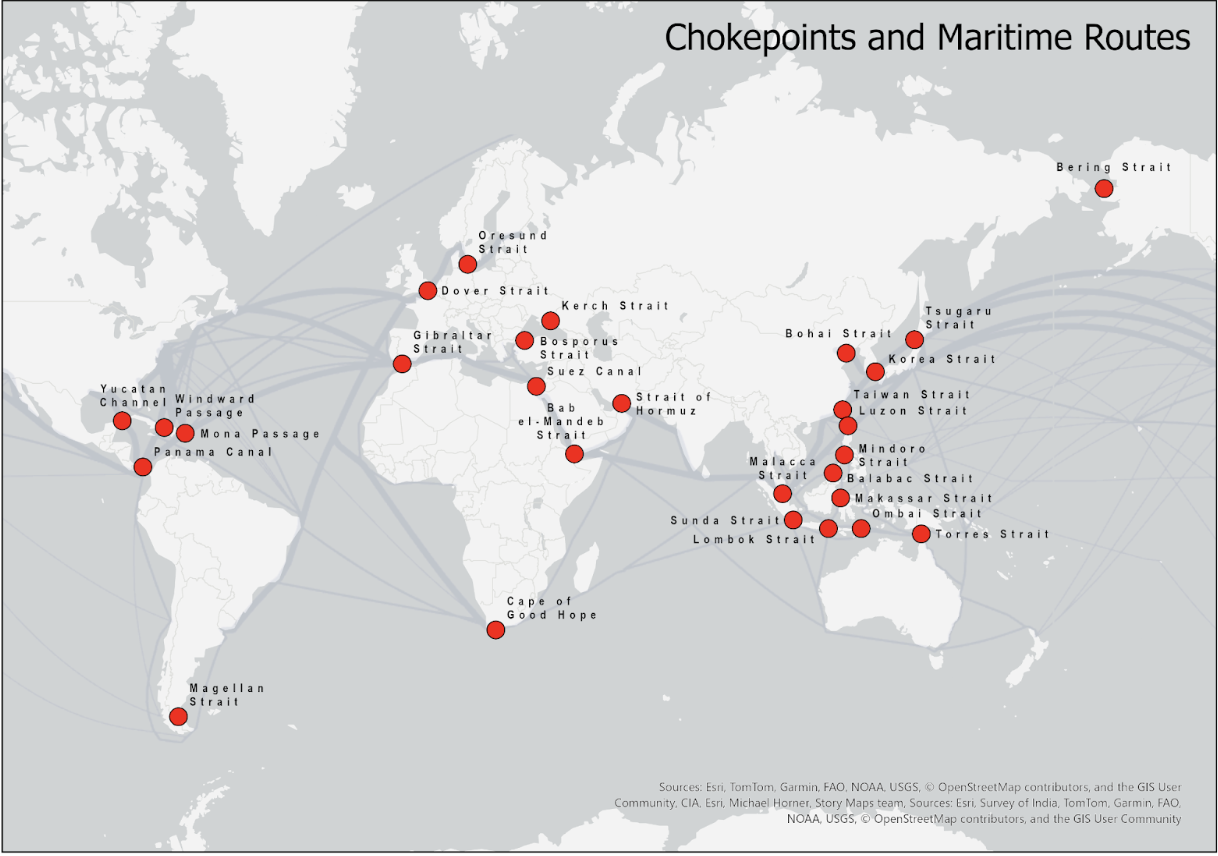
There are 28 choke points/hubs plotted on Figure 1, out of which 13 are major, and 15 are minor choke points/hubs.1 From west to East, the major choke points are the Panama Canal, Gibraltar Strait, Dover Strait, Oresund Straits, Bosporus Strait, Suez Canal, Bab el-Mandeb Strait, the Strait of Hormuz, the Malacca Strait, the Lombok-Makassar Strait, the Ombai Strait, the Taiwan Strait, and the Korea Strait. The other 15 are the Strait of Magellan, Florida Strait, Windward Passage, Yucatan Channel, Mozambique Channel, Cape of Good Hope, Palk Strait, Sunda Strait, Torres Strait, Luzon Strait, Bohai Strait, Tsushima Strait, Tsugaru Strait, Soya (La Pérouse) Strait, and Osumi Strait. In maritime trade routes, the thickness of grey lines in Figure 1 indicates vessel density.
2 Supply, Demand and Sea Routes for LPG in India
Liquefied Petroleum Gas (LPG) is a fuel gas commonly used in Indian households and commercial establishments for cooking purposes. It is most often a combination of propane (C₃H₈) and butane (C₄H₁₀). It is a nearly fully burning, clean fuel and has substantially replaced firewood and kerosene for most cooking purposes in India.
LPG is produced as a byproduct of natural gas liquids (NGL) extraction or as a distillate product in the refinery process. The cost of extraction as a byproduct is much lower than as a distillate, which is to some degree an explanation as to why India still relies on imports rather than on distillation for its full annual requirement.
The global demand/supply of LPG per year is over 340 million tonnes (MT).2 India’s consumption of LPG, almost entirely for cooking purposes, is approximately one-tenth of the world’s consumption per year at 31.3 MT.3 The domestic sector, utilising 14.2 kg cylinders, accounts for the overwhelming majority, approximately 87%, of total consumption.4 The growth in this segment has been driven by government policies like the Pradhan Mantri Ujjwala Yojana (PMUY), leading to over 33 crore active domestic connections.5 The commercial sector (restaurants) uses 19 kg, 47.5 kg or 425 kg cylinders and accounts for roughly 13% of total usage.6
Approximately 60% of India’s total LPG requirement is met through imports.7 This means that annual imports are roughly 20 million MT.8 One very large gas carrier (VLGC) carries roughly 50,000 MT of compressed LPG. India, therefore, needs about 400 shiploads of LPG a year. A significant majority of this comes from the Persian Gulf on tankers. Major sources of LPG for India are from Qatar, the UAE, Kuwait, and Saudi Arabia.9
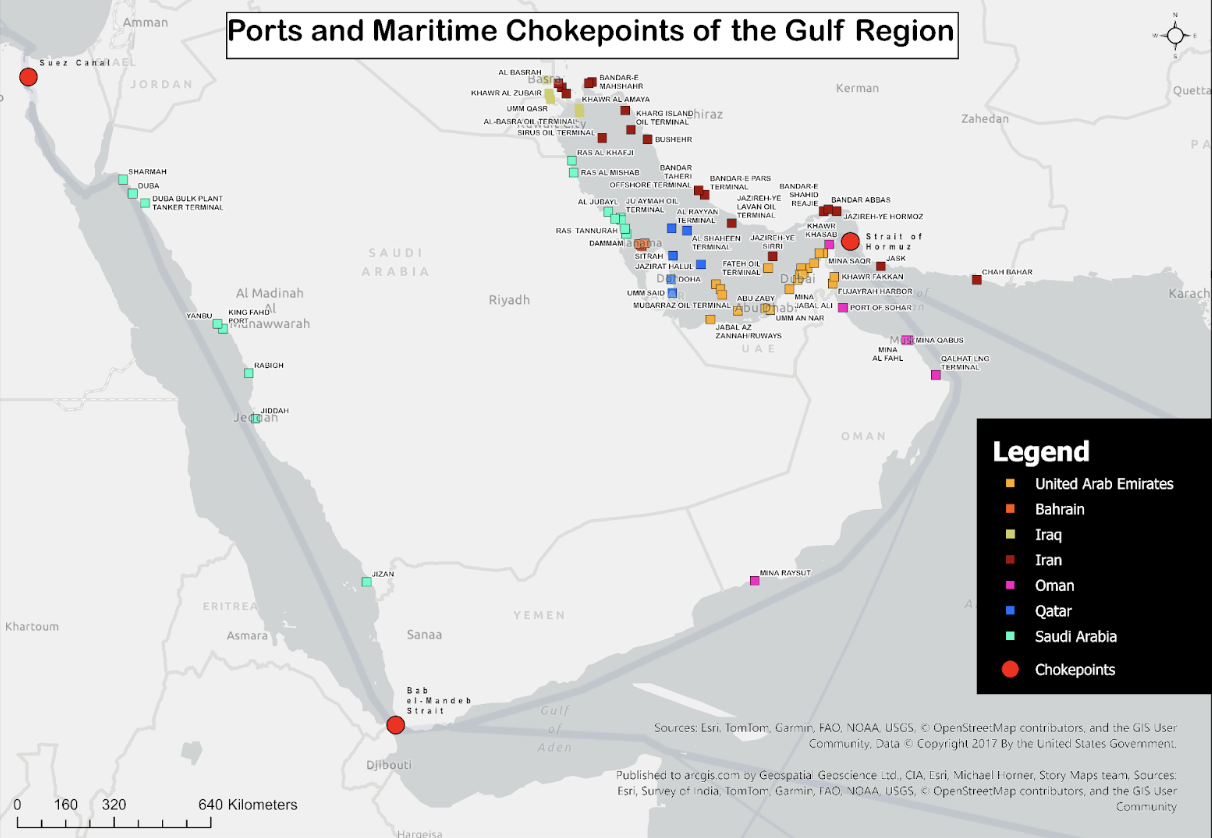
Additionally, the Strait of Hormuz transits approximately 45% of India’s crude oil and 52% of its Liquified Natural Gas (LNG) imports.10 LNG is different from LPG since it is substantially made of methane and its end use is for compressed natural gas vehicles (CNG) or piped natural gas in cities (PNG). Because of the ongoing conflict, Iran is targeting ships passing through the Strait of Hormuz. The map above depicts the major and minor ports in the Gulf region; ports in Oman and Saudi Arabia are outside Iran’s immediate influence. India faces a challenge because it imports 20-23% of its crude oil from Iraq, 16-18% from Saudi Arabia, and 8-10% from the UAE.11 It also imports 50% of its LNG from Qatar, 12% from the UAE, and 4% from Oman, all of which have to transit through the Strait of Hormuz.12 Alternative routes are possible via remote ports in Saudi Arabia, which must pass through the Bab el-Mandeb Strait. Not all ports in the region are suitable for tanker/cargo loading, so there are few options.
The Persian Gulf route necessarily passes through the Strait of Hormuz. One alternative would be to source more from the Red Sea ports of Saudi Arabia, such as Yanbu, Jeddah or Jizan. While Saudi Arabian LPG is among the cheapest in the world, the practical difficulty is that Natural Gas Liquids (NGL) fields like the Shaybah field in Saudi Arabia, which produce LPG as a byproduct, are over 1000 km from the Red Sea ports. The East-West pipeline in Saudi Arabia is not currently geared to moving LPG or NGL, only crude oil.13 Additionally, sourcing from Red Sea ports of Saudi Arabia necessitates passage through the Bab el-Mandeb Strait, another critical maritime chokepoint, which at its narrowest is about 27 km wide and sits between Yemen and Djibouti. Yemeni Houthis are considered an ally of Iran and may join the current hostilities at any time.
If the ships enter the Gulf of Oman via the Strait of Hormuz or the Gulf of Aden via the Bab el-Mandeb Strait, it is a direct route to India’s west coast. The maritime route from Jeddah to Mumbai is about 2300 nautical miles via Bab el-Mandeb and about 1300 nautical miles from Qatar to Mumbai via the Strait of Hormuz. As of this writing, newspapers are reporting that Indian ships will be allowed safe passage through the Strait of Hormuz. However, given the risks involved and the insurance implications, very few ships, if any, have passed through.
3 Representation of Transit Time for Indian Imports Through Key choke points
Table 1: Sea routes & choke points through which India imports crude oil and LNG
| Supplier Country | Primary Route | Transit Time | Key choke points |
|---|---|---|---|
| CRUDE OIL ROUTES | |||
| Iraq | Strait of Hormuz → Arabian Sea | 5-7 days14 | Strait of Hormuz |
| Saudi Arabia (East) | Strait of Hormuz → Arabian Sea | 4-7 days15 | Strait of Hormuz |
| Saudi Arabia (West) | Red Sea → Bab el-Mandeb → Arabian Sea (alternative) | 8-10 days | Bab el-Mandeb, Suez Canal |
| UAE | Strait of Hormuz → Arabian Sea | 4-8 days | Strait of Hormuz |
| Russia (West) | Baltic/Black Sea → Suez Canal → Red Sea → Arabian Sea | 40+ days16 | Suez Canal, Bab el-Mandeb |
| Russia (East) | Vladivostok → South China Sea→ Strait of Malacca → Bay of Bengal | 12-24 days17 | Strait of Malacca |
| USA | Atlantic Ocean → Cape of Good Hope → Indian Ocean | 35-55 days18 | Cape of Good Hope (No Chokepoint) |
| Nigeria/Angola | Atlantic Ocean → Cape of Good Hope → Indian Ocean | 20-35 days | Cape of Good Hope (No Choke Point) |
| LNG/LPG ROUTES | |||
| Qatar | Strait of Hormuz → Arabian Sea | 6-8 days | Strait of Hormuz |
| UAE | Strait of Hormuz → Arabian Sea | 5-7 days | Strait of Hormuz |
| Oman | Gulf of Oman → Arabian Sea (partially bypasses Hormuz) | 4-6 days | Partial Hormuz exposure |
| USA | Atlantic Ocean → Cape of Good Hope → Indian Ocean | 40-50 days | Cape of Good Hope (no chokepoint) |
| Australia | Indian Ocean (direct route) | 10-15 days | None |
Table compiled using Claude.ai
It is clear from Table 1 that India’s crude oil and LNG/LPG imports must pass through choke points such as the Strait of Hormuz (from Gulf countries) and the Suez Canal (from Russia/Western side of the Arabian Peninsula). Importing from Gulf countries is the shortest route, with most shipments reaching Indian ports in less than 10 days, whereas imports from Russia, Africa, Nordic regions and the United States take 12 to 50 days.
When it comes to the vulnerability of choke points, conflicts around the world have increased India’s risk in imports.
Table 2: India’s exposure to various choke points
| Chokepoint | Width | India’s Exposure | Control/Risk Factor |
|---|---|---|---|
| Strait of Hormuz | 33 km | 30% crude (2026), 60% LNG, 90% LPG | Iran controls the northern shore; US-Iran tensions |
| Strait of Malacca | 2.8 km | 15-20% crude (Russia East route) | Piracy, congestion, and China’s proximity |
| Bab el-Mandeb | 29 km | 5-10% crude (Suez-Red Sea route) | Yemen conflict; Houthi attacks |
| Suez Canal | 300 m | 5-10% crude (Russia West route) | Egypt control: Potential blockages |
| Cape of Good Hope | N/A | 30-40% crude; 10-15% LNG | No chokepoint; weather delays only |
Table compiled using Claude.ai
Importing oil and gas through narrow straits is currently inevitable; however, India needs to remain vigilant. While the Strait of Hormuz is directly in the conflict zone, the Bab el-Mandeb is also under threat due to the Yemen conflict and Houthi attacks. The Suez Canal and the Strait of Malacca are not in immediate danger, but they are certainly a source of concern given global geopolitical developments.
When it comes to threats, the width of the passage is also an important consideration; drones. Unmanned underwater vehicles and land-based missiles are common options for targeting vessels passing through narrow choke points. The Strait of Hormuz is the widest, measuring 33 kilometres between the two coasts, while the Strait of Malacca is only 2.8 kilometres wide. The narrow passages are prone to mines, and quick targeting makes the vessels passing through extremely vulnerable. Although the route is the longest, ships travelling along the Cape of Good Hope are less vulnerable. The Cape of Good Hope route offers lower vulnerability for vessels, but significantly lengthens the travel time and distance.
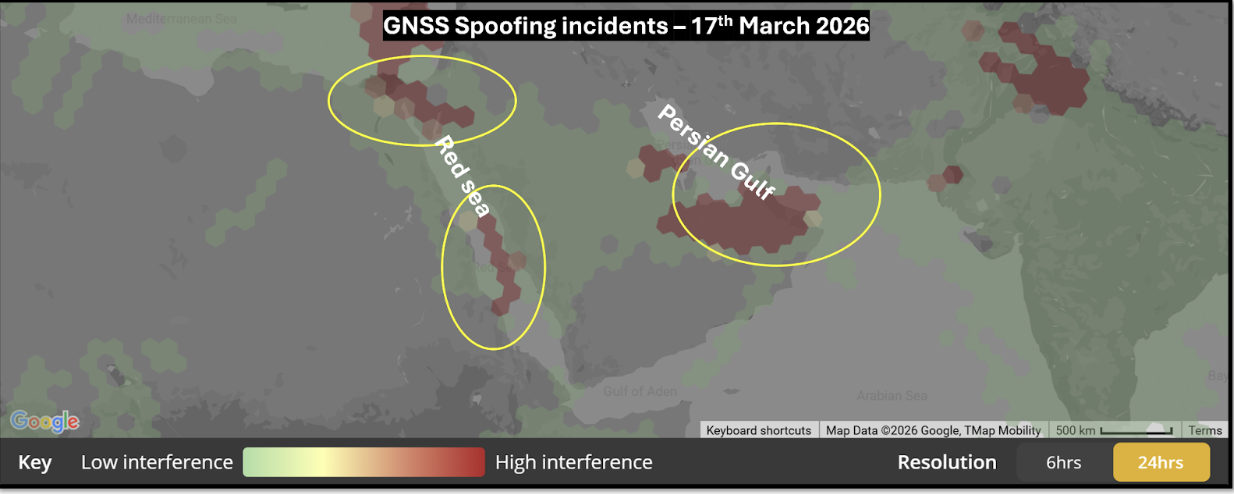
In addition to conventional threats, GNSS spoofing incidents have frequently been observed near straits of interest to India (see Figure 3), particularly in the Persian Gulf and the Red Sea, due to regional conflicts disrupting navigation. GNSS spoofing is the intentional manipulation of a GNSS receiver by broadcasting false signals to mislead it about its actual location, speed, or time. Indeed, the fake signals are usually much stronger than the original ones. Spoofing incidents are increasing in regions where anti-drone operations are conducted in conflict zones, and they are affecting civil aviation more significantly.19 These events can affect the location and navigation of the Automatic Identification System (AIS), which transmits its position via satellite. Furthermore, the number of spoofing incidents is a proxy for the number of drones in operation, and threats to vessels from drone strikes are evident in the ongoing conflict.
4 India’s Options
4.1 Short-term strategy
The near-term strategy for Indian households is to practice prudent use of LPG in homes. Using pressure cookers reduces cooking time significantly, saving 30-50%. Batch and communal cooking can also be used to reduce cooking time and, therefore, LPG use. Peripheral cooking tasks like water boiling and making tea can be undertaken using electric utensils and induction stoves. Cooking with induction stoves saves about 30% of the heat for the same cooking task. Only when direct heat is used for charring, like that used to make rotis, is gas a superior alternative.
Beyond actions at the household level, India must continue its diplomacy with Iran to get more ships through the Strait of Hormuz. Every three ships that pass through the Strait of Hormuz add two days of ready capacity to India. India should also increase purchases from Saudi Arabia and the United States. The Saudi Arabian LPG should be contracted through the Red Sea ports. The Red Sea transit will require passage through the Bab el-Mandeb Strait. The most common sea route from the US Gulf is via the Atlantic Ocean, down and around the Cape of Good Hope and up to the west coast ports of India, such as Mundra, Vadinar and Jamnagar.
4.2 Long-term strategy
India currently produces about 12 million MT of LPG onshore as a byproduct of crude distillation.20 A significant part of this comes from the Indian Oil Corporation refineries in Panipat, Mathura and Vadodara. Even though LPG is not a “high value” byproduct, India must increase its output to improve its resilience to continuing shocks from West Asia.
India currently has two underground storage caverns in Vishakapatnam and Mangaluru. Total storage capacity in these is about 150,000 MT, equivalent to 3 VLGCs or about 2 days of demand.21 Given the importance of LPG for Indian households, it is imperative to establish a Strategic LPG Reserve with a capacity of about 3 million MT (30-40 days of demand).
India must diversify its cooking gas supply between LPG and Piped Natural Gas (PNG). While PNG is also dependent on imported sources, it is diversified and has a separate supply chain that comes from natural gas and can be stored in bulk in Liquefied Natural Gas (LNG) containers. This is not a long-term solution, but a useful diversifier.
As India proceeds towards its Net Zero targets, it is important to promote electricity-based cooking for all peripheral needs. This can and should be achieved concurrently with the grid becoming green. This target is a major destination, and India must begin to work towards it.
5 The Difference in LPG Use Between China and India
There is a major strategic use difference between China and India when it comes to LPG. India uses LPG primarily as a cooking gas. China uses LPG as a feedstock to make propylene, which is then polymerised to polypropylene.22 Interestingly, China’s cooking conversion to modern fuels is less complete than India’s, but China has moved to PNG and electricity-based cooking from wood fuels.23 It has, however, made dramatic progress in greening its electricity grid. This is why China is more resilient to an LPG shock from the Persian Gulf. While Chinese dependency on the Gulf remains for crude oil and LNG, it is much more protected because of its massive Strategic Petroleum Reserves (SPR). At about 120 days of capacity, China’s SPR is 3 times larger than India’s in terms of “days of demand”.24
6 Looking Ahead
India has made dramatic strides in converting a significant majority of households to LPG. Urban penetration exceeds 90%, and rural penetration is not far behind at about 70% (though reorder frequency is lower than urban). While it is difficult to imagine now, India must undertake another major transformation towards electricity becoming the primary cooking fuel over the next few decades. A parallel and even bigger transformation is required in greening the electric grid. If this were to happen, India would be significantly less vulnerable to maritime choke points.
Footnotes
U.S. Energy Information Administration (EIA). “World Oil Transit choke points.” Washington, DC: U.S. Department of Energy, 2024. Link.↩︎
World LPG Association (WLPGA). Statistical Review of Global LPG 2023. London: WLPGA/Argus Media Group, 2023. Link.↩︎
Petroleum Planning & Analysis Cell (PPAC), Ministry of Petroleum and Natural Gas, Government of India. Consumption of Petroleum Products (Products-Wise). Last updated March 3, 2026. Link.↩︎
Government of India, Press Information Bureau. “Press Release.” December 2025. Link.↩︎
Government of India, Press Information Bureau. “Year End Review 2024 – Ministry of Petroleum and Natural Gas.” January 7, 2025.Link.↩︎
Press Trust of India. “Oil Ministry Sets Up Panel as Commercial LPG Shortage Hits Hospitality Sector.” The Hindu, March 10, 2026. Link.↩︎
Government of India, Press Information Bureau. “Press Release.” 2026. Link.↩︎
Reuters. “India’s Non-Hormuz Crude Sourcing Has Increased to 70% of Imports, Oil Minister Says.” Reuters, March 12, 2026. Link↩︎
The Hindu. “How the U.S.-Israel Conflict with Iran Is Exposing India’s LPG Dependence.” The Hindu, March 2026. Link.↩︎
Government of India, Press Information Bureau. “Energy Supplies Remain Secure.” March 2026. Link; BBC News. “Gas on the Line: Will the Iran War Squeeze India’s Piped Gas Next?” BBC News, March 2026. Link.↩︎
Directorate General of Commercial Intelligence and Statistics (DGCI&S), Ministry of Commerce and Industry, Government of India. Insights into Import of Crude Oil and International Crude Oil Prices. September–October 2025. Link.↩︎
U.S. Energy Information Administration. Country Analysis Brief: India. 2025. Link.↩︎
U.S. Energy Information Administration (EIA). “The Strait of Hormuz Is the World’s Most Important Oil Transit Chokepoint.” Washington, DC: U.S. Department of Energy, October 2023. Link.↩︎
EIA. “Country Analysis Brief: Iraq.” U.S. Dept of Energy, 2024. Link ; EIA. “World Oil Transit choke points.” 2024. Link↩︎
EIA. “Country Analysis: Saudi Arabia.” U.S. Dept of Energy, 2023. Link ; Saudi Aramco. Annual Report 2023. Dhahran: Saudi Aramco, 2024. Link↩︎
Mathew, Liz, and Anil Sasi. “New Eastern Route Cuts Down Shipping Time and Costs, Promises to Boost India-Russia Trade.” The Indian Express, December 16, 2024. Link.↩︎
ibid.↩︎
U.S. Energy Information Administration. “Red Sea Attacks Increase Shipping Times and Freight Rates.” Today in Energy, January 2024. Link.↩︎
The Economic Times. “Why Fake Satellite Signals Are a Real Threat to Navigation Systems in Aviation, Defence Ops.” The Economic Times, September 17, 2024. Link.↩︎
Bureau of Energy Efficiency, Ministry of Power, Government of India. India Energy Scenario: For the Year 2023–24 (2nd ed.). 2024. Link↩︎
The Hindu. “Surging LPG Consumption and Inadequate Storage Put India in a Bind.” The Hindu, March 2026. Link.↩︎
World LPG Association (WLPGA). Statistical Review of Global LPG 2023. London: WLPGA/Argus Media Group, 2023. Link.↩︎
Tracking SDG7. “China.” Tracking SDG 7: The Energy Progress Report, 2023 Link↩︎
Oxford Institute for Energy Studies. “China’s SPR Release: A Test of Mechanisms Rather Than a Market.” Oxford: Oxford University, September 2021. Link; ETEnergyWorld (The Economic Times). “Lack of Space at India’s SPR an Opportunity Lost: Platts.” April 22, 2020. Link.↩︎