The Strait and Narrow
| AUTHOR | Adya Madhavan |
| DATE | May 21, 2026 |
| DOCUMENT | Takshashila Issue Brief 2026-16 |
| VERSION | Version 1.0 May 2026 |
| CATEGORIES | Defence Geopolitics Iran |
Introduction
The war in West Asia has made the Strait of Hormuz central to global politics. On 2nd March, Iran officially ‘closed’ the Strait in response to the US-Israeli air campaign. After peace talks in Islamabad fell through on 12 April, the United States announced a blockade of Iranian ports in the Strait, in an attempt to choke that country’s exports. The Strait serves as the only maritime exit for as much as 20% of the world’s oil and liquified natural gas, as well as agricultural fertilisers such as urea and petrochemicals such as methanol.1 The impact of the closure of the Strait on these important commodities has shaken global markets and created a supply crunch.
There are several pieces to the puzzle: the geography and hydrology of the Strait, international legal disputes surrounding it, Iran’s naval capabilities, and, finally, the other navies operating in the region.
The geography and hydrology of the Strait
The Strait of Hormuz stretches between Iran to the north and the Musandam Peninsula of Oman and the United Arab Emirates to the south. It is about 97 km or 84 nautical miles at its widest, and at its narrowest, it merely spans 21 nautical miles, or 39 kilometres.
The entire narrowest segment of the Strait falls within the territorial seas of Oman and Iran. To manage large tankers and vessels, a Traffic Separation Scheme (TSS) is utilised to streamline traffic.2 It consists of 3.2 km inbound and outbound lanes, padded by a buffer zone that also stretches for 3.2 km (and separates the inflow and outflow of vessels. The inbound lane falls within Oman’s waters, but as soon as ships pass through the Strait, the geography of the region redirects them close to Iran’s coast.
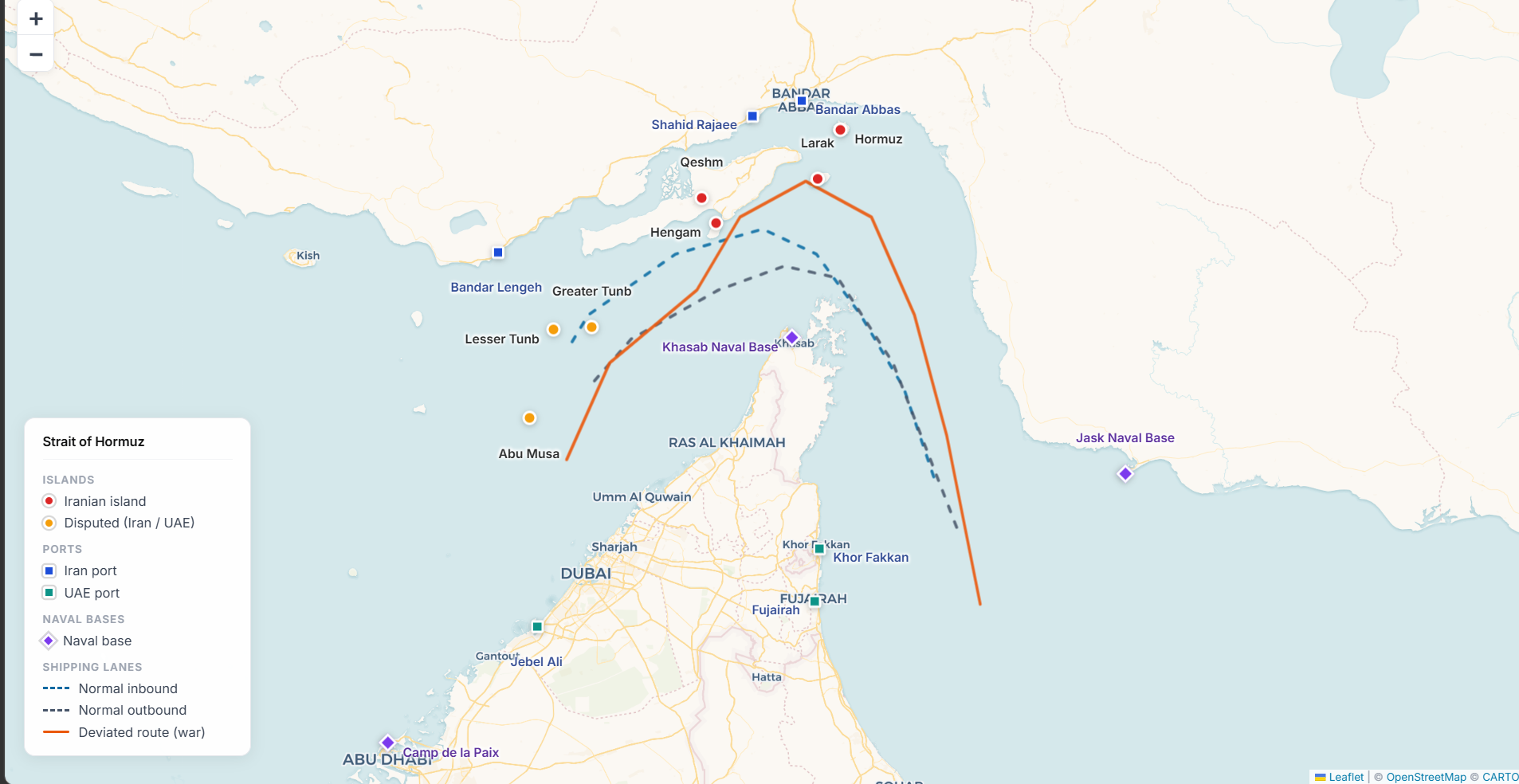
Fig. 1 Major ports and bases
Visualisation by author
Iran exercises control over the Strait by utilising its own coastline and an arc of seven islands: Abu Musa, Greater and Lesser Tunb, Hengam, Qeshm, Larak and Hormuz.3 Iranian facilities on these islands are equipped to monitor and control the shipping lanes that run close to them. Iran’s coastline near the Strait rises from flat beaches to the Zagros Mountains, whose ridges run along much of its shore. It uses the elevation to deploy anti-ship cruise missile batteries.4
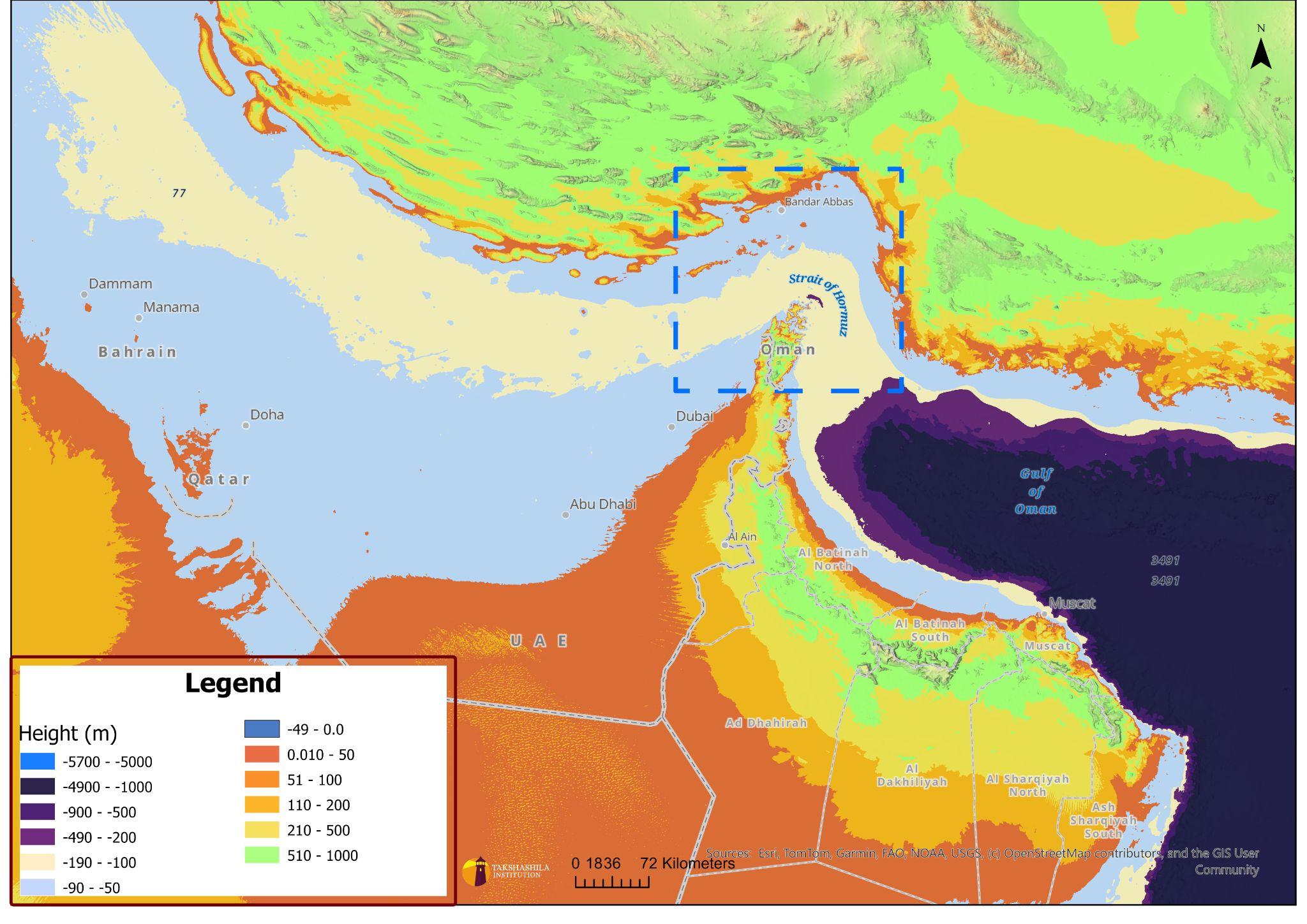
Fig. 2. Hydrology of the Strait
Visualisation by Y. Nithiyanandam
The Strait of Hormuz is relatively deep compared to other chokepoints. In comparison, the Suez Canal has a maximum depth of about 24 metres, and the Strait of Malacca’s shallowest navigable section is at about 25 metres, with water depths rarely going over 37 metres. Because Hormuz is less ‘shallow constrained’, a blockage of the Strait is hard to sustain purely through geography.5
While the Strait is deep enough for ULCCs (Ultra Large Crude Carriers), its depth and the water’s properties are challenging for navies to operate in. Firstly, much of the Strait is shallower than 80 metres, which makes it difficult for larger submarines to operate, since they need to be at least 45 metres deep. Larger submarines risk either hitting the sea floor or the keels of large tankers if they operated in parts of the Strait. The hydrology of the Strait also means that larger submarines like the Russian manufactured kilo class (that is operated by Iran) cannot dive for concealment. Iran relies on smaller submarines, such as the Ghadir and Fateh, to navigate the Strait’s shallower sections.
ULCCs are designed exclusively for transporting massive quantities of crude oil across long oceanic routes. Due to their immense size— often exceeding 400 meters in length— they are restricted by their deep drafts; they cannot pass through the Suez or Panama Canals and require specialised deep-water terminals for docking.
The water itself, harbours multiple challenges. The salt content in the Gulf is high, which creates underwater heat currents that can distort passive sonar. This means that submarines struggle to detect ships on the surface unless they go close enough, making them vulnerable to anti-submarine patrols.
The currents in the Strait are volatile, and can snap traditional contact mines that would normally be moored to the ocean floor.6 Untethered mines can risk detonating upon contact with civilian ships, or even the forces that laid them.
Finally, the heat and humidity, coupled with the dust content, create surface evaporation ducts that can make radar and radio waves respond in unpredictable ways. Missile radar seekers can be confused since the evaporation ducts can impact the range of radio waves, adding to the pre-existing clutter due to the multiple islands and commercial oil platforms that utilise radar.7
International law
Much of the anxiety that existed about the Strait of Hormuz even before recent disruptions in shipping stems from opposing interpretations of international law. The United States and many of the major players in the Persian Gulf, operate in accordance with the United Nations Convention on the Law of the Sea (UNCLOS).8 According to UNCLOS, the Strait should allow the right to‘transit passage’. Transit passage means both civilian and military ships and aircraft should have guaranteed access to navigate the strait, and their access should be non-suspendable. However, Iran argues that instead, the regime of innocent passage should be in place instead. This enables coastal states to exercise their discretion when it comes to restricting access to parts of the strait for security reasons. Iran has signed UNCLOS but has not ratified it, and the US has neither signed nor ratified it but treats it as binding customary international law.9
Other Major Players
Currently, a rotation of other countries and their naval forces also operate within the Strait. Their primary assets and capabilities are as follows:
- The US Navy 5th Fleet: The 5th fleet of the US Navy that is based in the Naval Support Activity Bahrain in Manama, has served as a counter-balance to Iranian forces in the region.19
The commander of the 5th Fleet also serves as the commander of the 44-nation Combined Maritime Forces (CMF) in addition to serving as the commander of the US Naval Forces Central Command. The fleet is responsible for about 2.5 million square miles of sea, including three chokepoints: Hormuz, Bab el-Mandeb and Suez.20
The US navy uses carrier strike groups in the region. These groups are typically centered around Nimitz or Ford-class nuclear carriers, and host several aircraft of various kinds.21 There are also reportedly two to four Arleigh Burke-class guided-missile destroyers in the region.22 Apart from these, the 5th fleet also utilises patrol craft, an unmanned systems task force (Task Force 59, and some fast-attack submarines.23 This is what the typical composition of the fleet looks like, but it is worth noting that it is rotational and may be operating a larger fleet given the ongoing American blockade.
Established in 2021 by the U.S. 5th Fleet, Task Force 59 is a pioneering unit dedicated to integrating unmanned systems (drones) and artificial intelligence into maritime operations. Based in Bahrain, it focuses on ‘maritime domain awareness,’ using a fleet of autonomous surface and underwater vehicles to monitor vast stretches of water like the Red Sea.
- The Eastern Fleet of the Royal Saudi Naval Forces (RSNF): The Saudi Navy has two fleets, of which the Eastern fleet operates in Hormuz. It is headquartered in Jubail and operates in the Persian Gulf.
The role of the RSNF in the Strait is to protect Saudi oil exports through the region, and escort tankers departing from terminals in the Strait. Saudi Arabia has the single largest share of crude oil and condensate passing through the Strait at 37% of the total amount that transits the waterway.24
The RSNF is currently in the process of modernising its fleet. In addition to older French F3000S frigates and US Badr-class corvettes, the Saudi navy has acquired three Al-Jubail-class corvettes from the Spanish company Navantia.25 Its fleet also includes four Multi-Mission Surface Combatants from Lockheed Martin
- The United Arab Emirates Navy: The UAE’s Navy is relatively more modern and capable compared to other Gulf states, barring Saudi Arabia. Its stake in Hormuz rests largely on its crude export (13% of the total export through the Strait). More importantly, as much as 96% of the UAE’s LNG passes through Hormuz.26
The UAE’s major vessels are fairly recent acquisitions. It operates two Gowind 2500-class corvettes, which were commissioned from France between 2024 and 2025, and six indigenously designed Baynunah-class corvettes. It also operates two Italian-made and designed Abu Dhabi-class corvettes and around 42 patrol boats. The UAE has also recently been focusing on developing unmanned systems for its navy.27
- The Royal Navy of Oman (RNO): As the other Arab state whose territorial waters form part of the Strait, Oman has unique legal and operational weight compared to the other naval powers in the region. Much of the TSS lies within Omani waters. The RNO protects Oman’s expanse of coastline and helps with counter-smuggling, especially in the Musandam-Iran route. The RNO typically is not involved in operations against Iran, and the two countries have maintained dialogue.28
The RNO has about 21 active vessels in its fleet. This includes Khareef-class corvettes, two older Qahir-class corvettes, four patrol craft and various amphibious craft and high-speed vessels.
- The Royal Bahraini Naval Force (RBNF): While Bahrain is the host state for the 5th Fleet of the US Navy, its own naval forces have not been modernised much. Partially, due to the fact that the US presence brings maritime security. Its fleet includes two former US Navy Hazard Perry frigates, two German Al Manama-class corvettes, and four Ahmed Al-Fateh-class missile boats. 29
Bahrain’s main role in the Hormuz equation is providing the US access to NSA Bahrain and Khalifa bin Salman port, both of which are key to US naval operations in the region.30
Most Affected Importers
According to the IAEA, 20 million barrels of petroleum and crude oil passed through Hormuz every day in 2025. The Strait sees the transit of about 20% of the global oil supply. Iran’s closure of the Strait impacts the export of crude oil, petrochemicals and fertilisers from West Asian countries to the rest of the world. Qatar is the most exposed exporter, since almost all of its oil transits the Strait, unlike Saudi Arabia and the UAE who have pipelines. China, India, Japan and South Korea are the most vulnerable importers since they import the largest chunks of crude through the Strait.31
- China: According to most analyses, China receives the largest chunk of crude oil and condensate that transits the strait at about 37.7%. This is roughly half of China’s total oil imports. Since China is the largest buyer of Iranian oil, Iran opened a so-called ‘green-lane’ for Chinese-flagged tankers in the early days of the blockade. However, China is also the largest buyer of crude from Saudi Arabia, Iraq, Kuwait, and the UAE.32
Despite the volume of its crude imports from West Asia, China is also arguably much more resilient than other Asian importers. China has petroleum reserves that are estimated to be over a billion barrels, and it also has a vast pipeline network from Russia, as well as domestic production.
- India: India is the second largest crude destination when it comes to oil that passes through the Strait of Hormuz, receiving about 14.7% of the total volume. Some reports claim that as much as 60% of India’s total crude oil imports flow through the Strait, and about 53% of its LNG (Liquid Natural Gas) comes from Qatar and the UAE. 33
India also receives substantial annual remittances from its diaspora in West Asia, at about 38% of the total $135 billion, and imports Urea and Phosphate fertilisers.3435 While India is relatively exposed to the ongoing uncertainty and closure of the Strait, it has been attempting to diversify its crude imports by buying Russian and American oil. India has roughly 10 days of strategic petroleum reserves.36
One major second-order effect of fertiliser supply being impacted, could be a strain on the supply of rice, which India is a major exporter of (exporting as much as 25% of global rice exports).37
- Japan: According to a Zero Carbon Analytics in February, Japan is the most vulnerable importer. Although it only receives about 10.9% of the overall crude flow through Hormuz, as much as 90% of its total crude imports, and 75% of its total oil supply come from West Asian countries and transit the Strait. Its exposure lies in the fact that about 87% of Japan’s energy comes from imported fossil fuels, and much of its electricity generation is reliant on LNG post-Fukushima.38
In terms of its capacity to mitigate the effects of the war in West Asia, Japan has about 4.4 million tonnes of LNG reserves, which would last around 3 weeks according to some estimates.
- South Korea: South Korea receives about 12% of the total crude that flows through Hormuz. Roughly 75% of its total crude comes from the region, as well as 14% of its LNG. Its net oil imports are as much as 2.7% of its total GDP, higher than most Asian countries.39
South Korea finds itself vulnerable to supply disruptions due to the fact that much of its energy (around 81%) is reliant on imported fossil fuels. As of now, it has about 3.5 million tonnes of LNG reserves, which, according to estimates would last about two weeks, as well as significant SPR (surface petroleum reserves).
Conclusion
While the US claims to have destroyed much of Iran’s naval capabilities, Iran has managed to retain control of the Strait by utilising geographical advantages, sea mines, smaller fast-attack craft and drones.
Even if the US operated on the assumption that Iran would not attempt to close the Strait, the fact remains that only 2.5% of American crude oil flows through Hormuz. While the US has the military might to counter-blockade the Strait, it bears very little of the economic cost. In contrast, Asian countries that source much of their oil through Hormuz, now have to navigate both American and Iranian conditions.
The crisis in the Strait demonstrates the challenges of littoral warfare. Iran’s actions have proven that the Strait provides it with immense leverage. American hesitancy has highlighted the difficulties involved in contesting Iranian control of the Strait. The consequences have been disastrous for global energy markets and fertiliser supplies.
Footnotes
Christou, William, Julian Borger, and Joseph Gedeon. “Trump Announces 10-Day Ceasefire in Lebanon after ‘Excellent Conversations.’” the Guardian. The Guardian, April 16, 2026. Link↩︎
Cordesman, Anthony H, and Abdullah Toukan. “The Iranian NavalMissileAir Threat to Maritime Traffic.” Iran and the Gulf Military Balance. Center for Strategic and International Studies (CSIS), 2016. JSTOR. Link↩︎
Newsroom. “CNN Analysis: The Seven Islands Controlling the Strait of Hormuz and the Strategy That Could Determine Gulf Dominance - ProtoThema English.” ProtoThema English, March 28, 2026. Link↩︎
Talmadge, Caitlin. “Closing Time: Assessing the Iranian Threat to the Strait of Hormuz.” International Security 33, no. 1 (2008): 82–117. Link Kilowhich↩︎
Talmadge, Caitlin. “Closing Time: Assessing the Iranian Threat to the Strait of Hormuz.” International Security 33, no. 1 (2008): 82–117. Link exceeding 400 meters in length—ussian-manufactured Kilooperate.Russian-manufactured Kilowhich↩︎
Talmadge, Caitlin. “Closing Time: Assessing the Iranian Threat to the Strait of Hormuz.” International Security 33, no. 1 (2008): 82–117. Link↩︎
O’Neil, William D, and Caitlin Talmadge. “Costs and Difficulties of Blocking the Strait of Hormuz.” International Security 33, no. 3 (2008): 190–98. Link↩︎
Caner, Tammy, and Pnina Sharvit Baruch. “The Strait of Hormuz as a Key Theater of War—the Legal Dimension.” Institute for National Security Studies, 2026. JSTOR. Link↩︎
Lott, Alexander, and Shin Kawagishi. “The Legal Regime of the Strait of Hormuz and Attacks against Oil Tankers: Law of the Sea and Law on the Use of Force Perspectives.” Ocean Development & International Law 53, no. 2-3 (July 3, 2022): 123–46. Link↩︎
Cordesman, Anthony H, and Grace Hwang. “The Rising Impact of Iran’s Asymmetric Forces.” Iran and the Changing Military Balance in the Gulf. Center for Strategic and International Studies (CSIS), 2019. JSTOR. Link↩︎
Harmer, Christopher. “IRANIAN NAVAL and MARITIME STRATEGY.” Institute for the Study of War, 2013. JSTOR. Link↩︎
IE Online. “Iran’s Navy CRIPPLED: 92% of Largest Vessels Destroyed | US CENTCOM on Operation Epic Fury.” The Indian Express, March 26, 2026. Link↩︎
Agence France-Presse. “US Says It Has Destroyed More than 30 Iranian Ships since War Began.” NDTV, March 5, 2026. Link↩︎
Ellis-Petersen, Hannah. “‘Bit of Treachery’: US Attack on IRIS Dena Undermines Indian Security Ties.” the Guardian. The Guardian, March 15, 2026. Link↩︎
White, Ryan. “Understanding Iran’s Naval Forces, IRIN/IRGCN - Naval Post- Naval News and Information.” Naval Post, April 30, 2021. Link↩︎
Faucon, Benoit . “The U.S. Sank One of Iran’s Navies. The Other Still Controls Hormuz.” The Wall Street Journal, April 9, 2026.↩︎
Cordesman, Anthony H, and Grace Hwang. “The Rising Impact of Iran’s Asymmetric Forces.” Iran and the Changing Military Balance in the Gulf. Center for Strategic and International Studies (CSIS), 2019. JSTOR. Link↩︎
Ticku, Nitin J. “U.S. Sinks 17 Iranian Warships – ‘Cutting Edge’ Fateh-Class Submarine Likely ‘Holed’ in Epic Fury Onslaught.” EURASIAN TIMES, March 4, 2026. Link↩︎
Bahrain Intelligence Desk. “US Fifth Fleet Bahrain: The Complete Strategic Guide 2026.” Bahrain Intelligence. Vanderbilt Terminal, March 18, 2026. Link↩︎
Donegan, Kevin. “Why US Naval Presence in the Middle East Matters.” Majalla.com, 2024. Link↩︎
U.S. Navy Office of Information. “Aircraft Carriers - CVN.” www.navy.mil, November 12, 2021. Link↩︎
Desk, TOI World. “Why Only Arleigh Burke-Class US Destroyers Can Lock down Iran’s Hormuz for Trump.” The Times of India. The Times Of India, April 13, 2026. Link↩︎
AGSI. “Drones, AI, and Task Force 59: A Solution for the UAE Navy’s Lack of Manpower - AGSI,” January 28, 2025. Link↩︎
Fish, Tim. “Gulf Naval Recapitalisation - Asian Military Review.” Asian Military Review, March 8, 2022. Link↩︎
Pryce, Paul. “Corvettes of the Persian Gulf: A Strategic Survey | Center for International Maritime Security.” Cimsec.org, November 26, 2013. Link↩︎
The. “The Middle East and Global Energy Markets – Topics - IEA.” IEA, 2025. Link↩︎
Pike, John. “United Arab Emirates-NGovernment of Bahrain. “Bahrain Economic Vision 2030.” Bahrain.bh, 2023. Link avy.” Globalsecurity.org, 2017. Link↩︎
Pike, John. “Bahrain Defence Force (BDF).” Globalsecurity.org, 2026. Link↩︎
Pike, John. “Bahrain Defence Force (BDF).” Globalsecurity.org, 2026. Link↩︎
Hedley, Nick. “Asian Countries Most at Risk from Oil and Gas Supply Disruptions in Strait of Hormuz - Zero Carbon Analytics.” Zero Carbon Analytics, February 26, 2026. Link↩︎
Shan, Lee Ying. “The Strait of Hormuz Is Facing a Blockade. These Countries Will Be Most Impacted.” CNBC, March 3, 2026. Link↩︎
Shan, Lee Ying. “The Strait of Hormuz Is Facing a Blockade. These Countries Will Be Most Impacted.” CNBC, March 3, 2026. Link↩︎
D’Souza, Shanthie Mariet. “Bollywood’s Bluster Block in the Gulf | Lowy Institute.” Lowyinstitute.org, 2025. Link↩︎
Prabir De, Adrija Ganguly and Srinivas Rao. “Disruptions in the Gulf: Implications for India’s Trade Facilitation and Logistics.” RIS, May 2026.↩︎
Marzbanmehr, Arash. “The Strait of Hormuz: Global Economic Shock and the Limits of Military Power | al Jazeera Centre for Studies.” Al Jazeera Centre for Studies, 2026. Link↩︎
Shan, Lee Ying. “The Strait of Hormuz Is Facing a Blockade. These Countries Will Be Most Impacted.” CNBC, March 3, 2026. Link↩︎
Shan, Lee Ying. “The Strait of Hormuz Is Facing a Blockade. These Countries Will Be Most Impacted.” CNBC, March 3, 2026. Link↩︎