How could a US ground invasion of Iran look like?
| AUTHOR | Abhishek Kadiyala |
| DATE | March 15, 2026 |
| CATEGORIES | Indo-Pacific United States Geopolitics |
In light of the recent US bombing of Kharg Island and growing speculation surrounding the use of ground troops by the US in Iran, here is how a ground invasion could potentially play out.
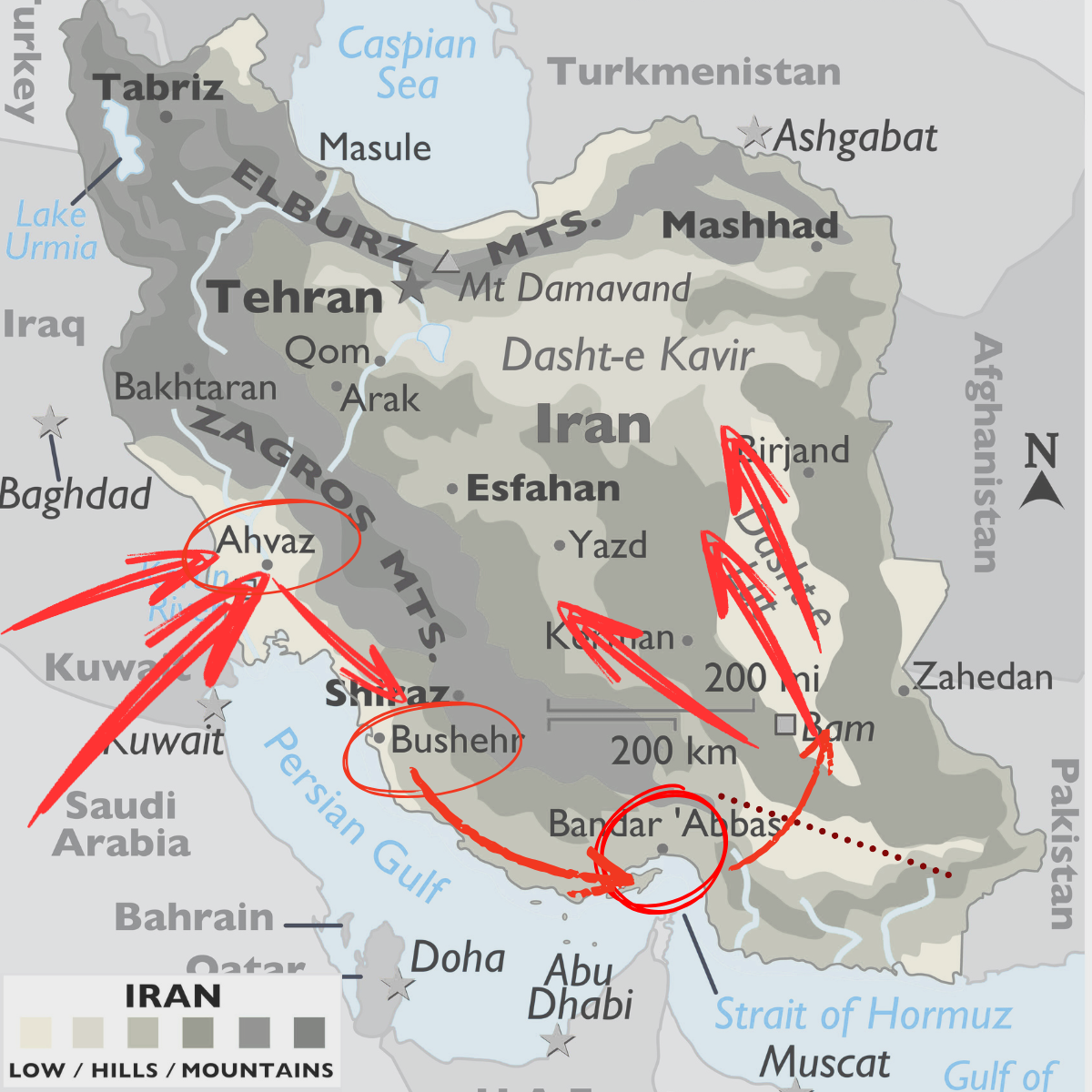
This relief map of Iran shows how the Persian Gulf coastline of Iran is its most vulnerable point for a land invasion by an US-led coalition. It is attached to the plains, holds a large share of Iran’s oil reserves and includes a significant Arab population.
- The mountain ranges to the North and West would make a land offensive extremely costly, especially given that the Iranian Kurds have seemingly refused to join the US.
- An invasion route through Pakistan from the east is highly unlikely due to strong domestic opposition to the US and Israel followicng the killing of Iranian Supreme Leader Ayatollah Ali Khamenei. This option only gets more complicated considering the on-going Pakistan-Afghanistan war.
- This leaves the Persian Gulf coastline as Iran’s strategic “soft underbelly.”
- This point is also economically important considering the fact that 80-90% of the Iranian oil exports are from this location. A loss of ground here would make it impossible for Iran to continue the war.
- The global economic strain caused by the blockade of the Strait of Hormuz by Iran also allows the potential for a greater international approval and support for such a campaign.
Potential route of the invasion:
Phase 1: Khuzestan and Ahvaz
- The most plausible invasion route would be through Iran’s Khuzestan province. Khuzestan consists of plains and marshes, which gradually move into hills north of the city of Ahvaz. This would be ideal for a US-Israel led military to attack through Kuwait and Iraq, particularly given their overwhelming air superiority.
Phase 2: Bushehr and Bandar Abbas
Following this, the campaign would avoid the Zagros interior and move south-east along the coastline and the Iranian oil fields.
This would involve the capture of Bushehr and Bandar Abbas.
This would achieve twin objectives:
- Secure the Iranian oil fields and cut off their economic leverage.
- Secure and open the Strait of Hormuz.
Success at this phase will not only weaken Iranian war-economy but could also garner international goodwill.
The capture of important ports like Imam Khomeini Port and Bandar Abbas would result in stronger supply routes for the coalition.
Phase 3: Options Inland
- Following the successful capture of the coastline, the coalition would have the option of declaring victory and halting the offensive, or continuing the offensive with potential support from local militia and anti-regime uprising. The most likely and safe option would be the former.
- The economic stress following the loss of oil fields and access to the coastline would bring the regime under extreme pressure.
- The ground campaign would weaken the IRGC significantly, allowing the scope for public protests and anti-regime militia to re-emerge.
- As seen in Iraq and Afghanistan, a successful ground offensive acts as an assurance for anti-regime individuals to organise and act to weaken the regime further.
- The US has already hinted at the objective of securing highly enriched uranium in Iran through a ground offensive. This could become a serious primary objective following the success of Phase 2 of offensive operations.
- Irrespective of whether the US ground offensive continues or halts after the capture of Bandar Abbas, the Iranian regime would have lost nearly all international leverage following its loss. The regime could also equally lose public trust and legitimacy domestically.
Challenges
1. Zagros Mountains
- These mountain ranges would not only act as a natural barrier but also house significant artillery, drone and missile systems that would be a complex target for the airforce. These systems could act as a significant challenge for not only the ground troop movement but also the ships of the Persian Gulf, putting additional strain on the supply route of the coalition.
- The relatively hilly terrain between Bushehr and Bandar Abbas would be a challenge for the ground offensive as the Zagros Mountain ranges in this area sometimes stretches into the coastline. The plains existing between Khuzestan and Bushehr that extend into the rocky mountainous coastline, can potentially slow down the offensive.
- Even after a potentially successful ground campaign and the capture of the coastline, these mountain ranges could act as a potential ground for a sustained armed insurgency as seen in Afghanistan. It could make the campaign unsustainable for the ground troops and could be a threat for any new regime that replaces the current dispensation.
2. Domestic calculations
- Saddam Hussein’s campaign into Khuzestan in 1980 expected the Arab population in the province to support the Iraqis as liberators. This failed as most Arabs sided with the Iranian regime united under the Shia identity.
- An invasion by the US and Israel could potentially rally and unite the population under a pan-Iranian identity, who, despite their ethno-religious differences, unite against a common enemy. The strong state structures in Iran would be the core component of this challenge.
- In such a case, even a successful capture of the coastline might not result in the defeat of the Iranian regime. Even in the case of a regime change, a new regime could be more hard-line and oppose US and Israel further.
- It is also important to note that the Iran-Iraq war of 1980-1988 was a period right after the Iranian revolution. Morale was high under this new leadership which reflected through how the population supported the regime during this campaign. However, after living under sanctions for decades, experiencing the excesses by the Ayatollah regime and facing constant pressure of war and aerial bombardment, the morale of Iranian people is expected to differ.
- Domestically, the support for a ground invasion within the US is also very low as reported by a Reuters-Ipsos poll. This could deter the Trump administration from a long drawn-out campaign.
3. International pressure
- A quick ground offensive that secures Bandar Abbas and opens the Strait of Hormuz would be appreciated by many players internationally. However, if the campaign slows down, pressure from regional countries would grow immensely.
- The US allies in the region would be viewed as complicit in this invasion by allowing the US/ Israel troops to use their territory. As seen in the latest case of Kharg island attacks, Iran would retaliate strongly against these countries. With their air defences already spent in the past weeks, the regional US partner states of Saudi Arabia, UAE, Qatar among others would be in a really vulnerable state.
- This international pressure could either deter the prospects of a ground campaign entirely or pressurise the coalition to end the campaign early.
- The seeming international support could also quickly vanish following the successful capture of the Iranian coastline and the opening up of the Strait of Hormuz.
4. War of attrition
- Iran recognises that its south-western border and coastline are its most vulnerable areas. This would automatically reflect in troop deployments to the region. Such massive troop deployment, coupled with potential local volunteers as seen during the Iraq war could result in a long drawn out war of attrition between both the forces.
- Coupled with Islamic Republic’s institutionalised martyrdom culture, this war of attrition would pose the biggest challenge for any ground offensive into Iran.
- If the ground offensive is not successful in the first few weeks, the war has the potential of becoming a drawn-out stalemate as in the case of the Russia-Ukraine war or the Iran-Iraq war in the 1980s. However, unlike Ukraine, Iran lacks the economic resources and international support to sustain such a drawn-out conflict on its soil, while the US would likely lack the political will to continue it.