Who paid for the Liberation Day Tariffs
| AUTHOR | Anupam Manur |
| DATE | May 2, 2026 |
| CATEGORIES | Geoeconomics Trade |
It is not often that economists’ theories are validated by reality, and it is even rarer for macroeconomists. So it was heartening to see that the impact of the Liberation Day tariffs unfolded exactly as expected. Gita Gopinath and Brent Neiman’s new NBER working paper makes a point that should sound obvious but is often obscured by political rhetoric: tariffs are taxes on imports, and the evidence in this paper suggests that most of the burden fell where textbook economics would predict it would: on U.S. firms and consumers.
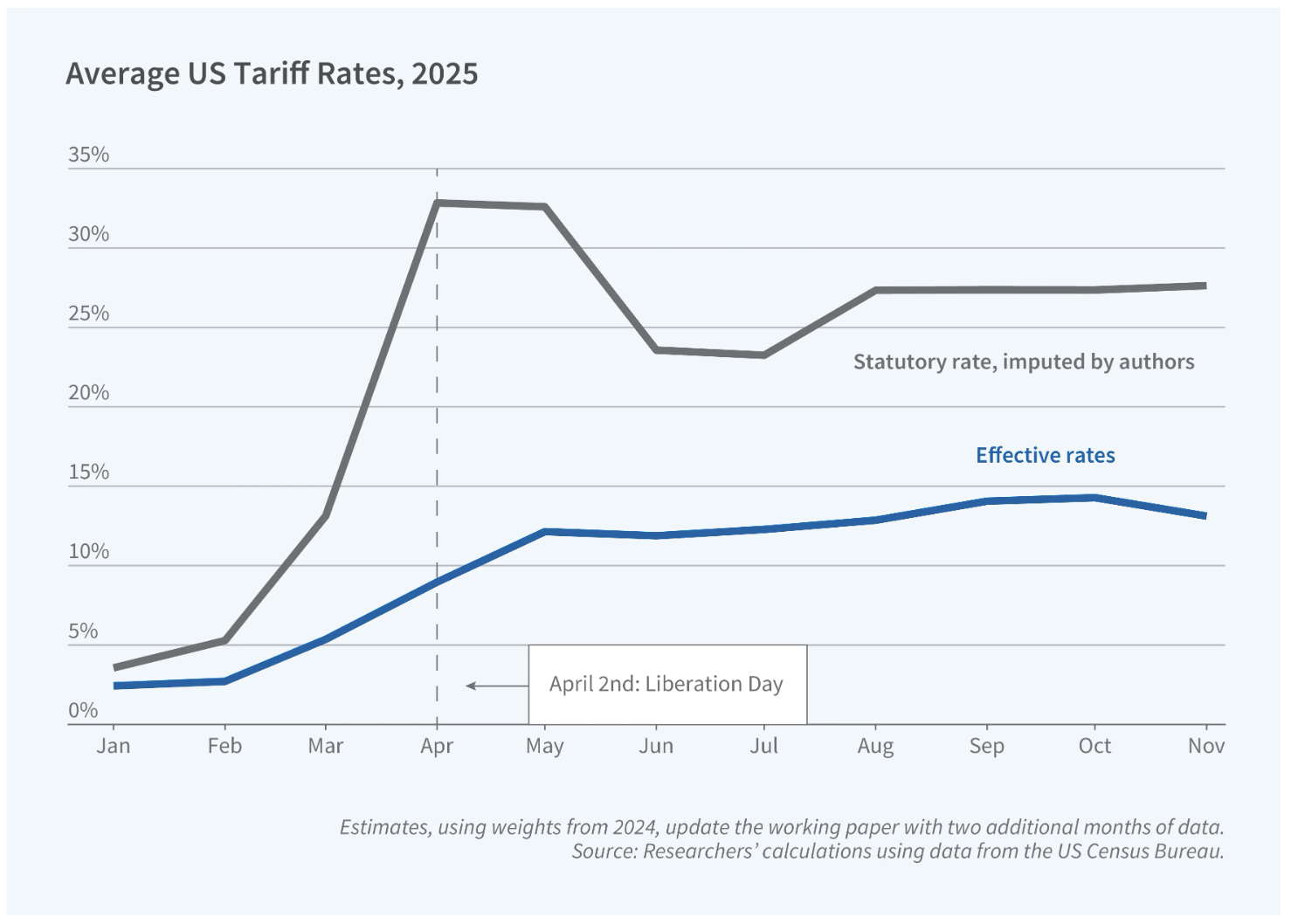
In September 2025, the US trade-weighted average statutory tariff rate stood at 27 percent, the highest in over a century. The first finding is that the actual tariff rate paid was 14.1 percent, roughly half the statutory rate of 27.4 percent. This gap was the result of four factors: shipping lags and an “on-the-water exemption” that delayed the implementation of tariffs, product- and company-specific exemptions, increased utilization of the United States-Mexico-Canada Agreement (USMCA), and uneven enforcement or evasion.
The researchers estimate pass-through rates of 80 percent for the 2018–19 tariffs and 94 percent for the 2025 tariffs, meaning US importers bore most of the tariff costs as foreign exporters generally did not reduce their prices. This finding of high pass-through held broadly across most countries and sectors.
Using input-output data, the researchers estimate something they call “production tariffs” — in other words, the equivalent tax increase on a firm’s overall production costs that would have the same effect as the import tariffs. For U.S. manufacturing as a whole, these production tariffs rose by 1.06 percentage points in 2025. Some sectors were hit much harder: heavy-duty trucks, for example, saw a 3.9 percentage point increase because they depend heavily on imported steel and vehicle parts. The authors also find signs that these higher production costs were passed through into prices: in 86 percent of manufacturing sectors where production tariffs rose by more than 2 percentage points, producer prices rose faster than trend in 2025. The incidence of the tariffs were borne entirely by the consumers and producers in the US. Make America Costly Again!