Browser Choice vs Defaults
| AUTHOR | Anupam Manur |
| DATE | May 2, 2026 |
| CATEGORIES | Tech Policy Regulation Platform Governance |
I found this fascinating paper in NBER by Jesper Akesson, Kush Amlani, Raul Cepeda Suarez, Emily Chissell, Stefan Hunt, Michael Luca, and Gemma Petrie, which looks at a simple question: can an “active choice” screen meaningfully reduce the power of preset defaults? Their evidence from the EU’s Digital Markets Act (DMA) suggests that when mobile users are prompted to choose a browser, many do not simply stick with the preinstalled option.
This has been a problem that competition authorities have been struggling with for a while. When there is vertical integration between the mobile phone maker, the operating system and the browser, you tend to have a violation of platform neutrality and self-preferencing behaviour. The oldest competition case between Microsoft and the FTC was exactly on these grounds - that internet explorer came preinstalled in Windows and that was anti-competitive and unfair to the other players.
Now, android would come pre-installed with Chrome and iOS with Safari and the added friction of having to download and install a new browser meant that many would stick with the default, preinstalled browser, thereby reducing competition. The DMA required iOS and Android to show users a browser selection screen under certain conditions. A browser choice screen is a prompt that displays several browser options and asks the user to select one rather than silently assigning a default browser for them.
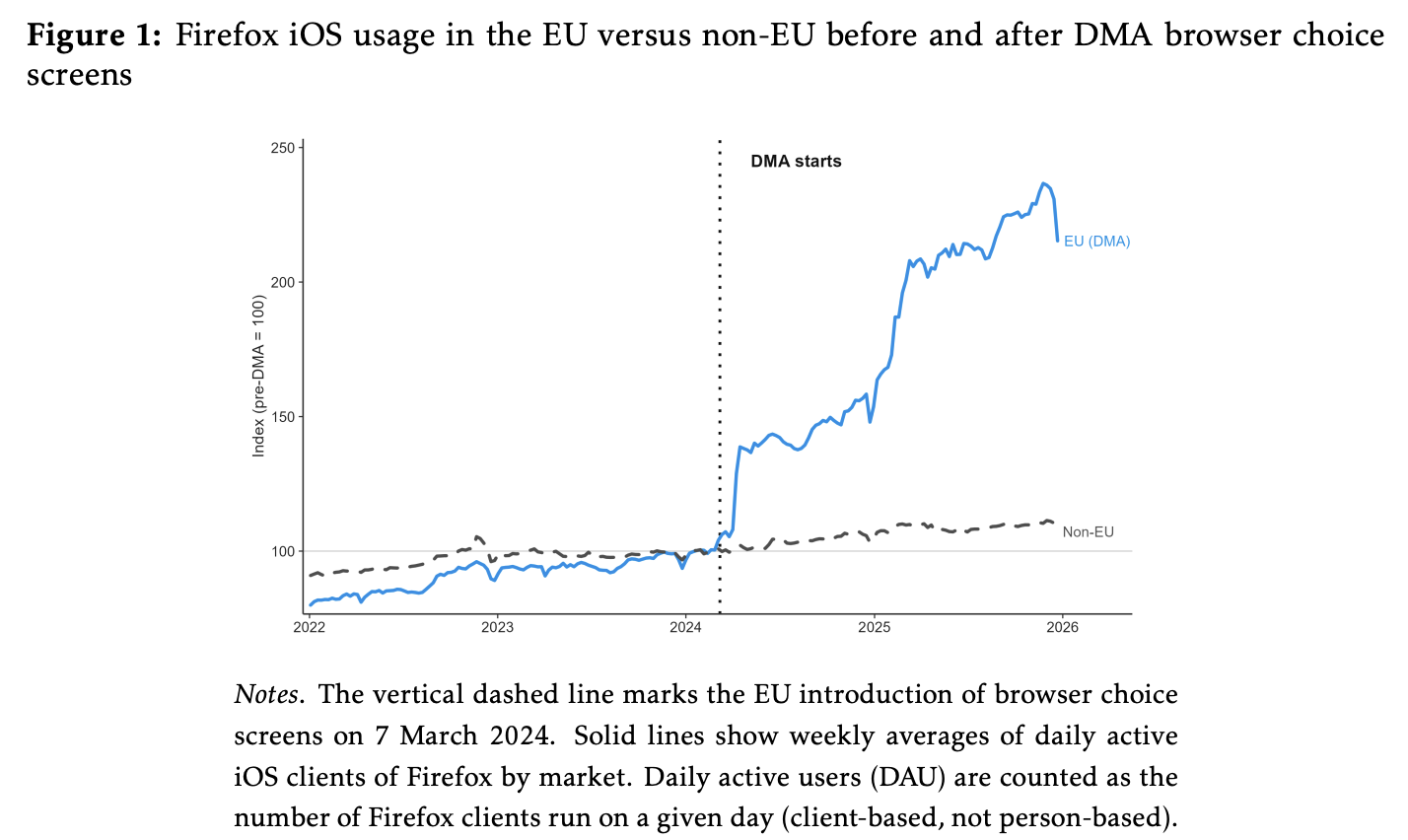
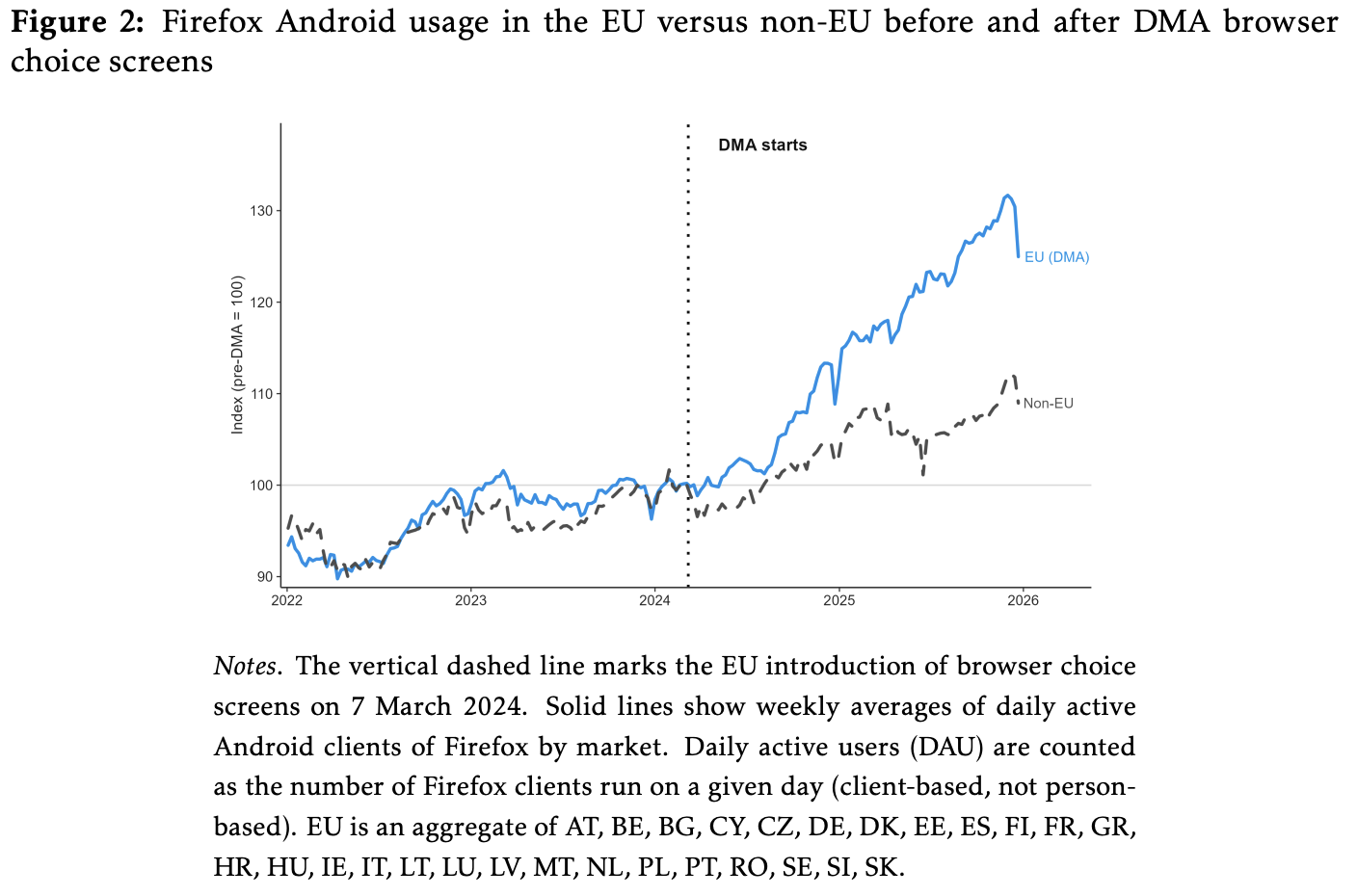
The main takeaway is striking: choice architecture matters a lot. The authors find that, 15 months after the mandate, Firefox usage was 113 percent higher on iOS and 12 percent higher on Android relative to a counterfactual without the mandate. That is a large shift for a product category where defaults tend to be sticky, where there are switching costs, and users often accept whatever comes preinstalled.
The difference between iOS and Android is quite striking. The paper links the stronger iOS effect to implementation differences: iOS showed choice screens on existing devices as well, while Android mainly showed them on new devices.
I think there is a deeper insight here more than just browsers. Digital markets often turn on default settings, rankings, and prompts that shape behavior without users fully noticing. The paper shows that active choice can loosen the grip of preinstallation and make competition more contestable. It also suggests that consumers are not necessarily inert or indifferent; many will choose differently when the environment makes the choice visible and easy.