Why trucks stick to the right?
| AUTHOR | Anupam Manur |
| DATE | May 11, 2026 |
| CATEGORIES | Economic Policy |
Anyone who has driven on Indian highways knows the frustration all too well: heavy trucks lumbering along in the right lane, forcing cars and quicker vehicles to weave around them, sometimes dangerously. The standard explanation that Indian drivers are simply undisciplined or that we are incapable of following rules is lazy and wrong (or only half-true). People respond to systems and incentives, and on Indian highways, the incentives are stacked against lane discipline.
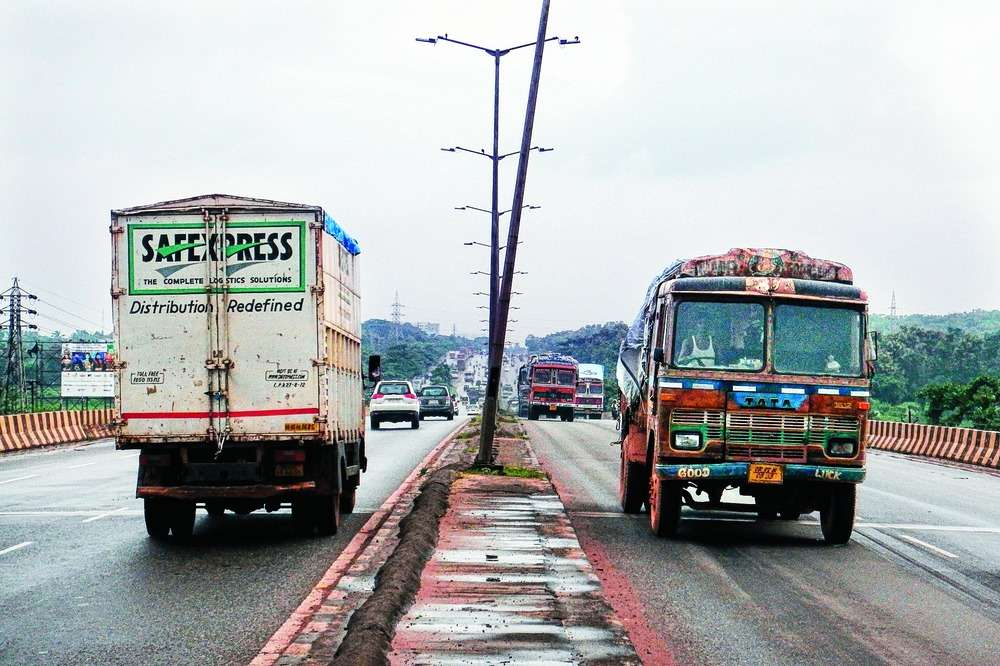
To understand why the heavy vehicles prefer to stick to the right most lane,which is generally earmarked for faster vehicles, we have to see what happens on the left lane where the trucks and slower vehicles are supposed to stay.
Consider what a truck driver actually faces. The left lane is cluttered with two-wheelers, autorickshaws, tractors, pedestrians crossing, and (more than) occasionally vehicles coming the wrong way. This is true, unfortunately, on highways and city arterial roads, with the addition of parked cars and even small makeshift shops in the latter. Highways run through small villages and would therefore have all of the regular daily traffic pouring on to the highway. This was the problem with the old Bangalore-Mysore highway.
Further, truck surfaces in the left lane are often more rutted, since heavy vehicles have historically used them. A loaded truck has poor acceleration and needs to maintain momentum to be fuel-efficient. The maneuverability of the trucks are also low, unlike cars, to dodge the randomly parked car or the tractor coming in the wrong direction. Plus, truck drivers are incentivised to deliver faster at lower fuel costs. Also, visibility from a truck’s left side is poor (the “blind side”). Staying on the right allows them to maintain a steady speed with fewer sudden maneuvers needed to avoid merging traffic or parked vehicles. Given all this, staying in the right lane seems like a rational response to a poorly designed system. Truck drivers feel safer on the right lane and it is more fuel efficient.
The end result though is added dangers and lower efficiency on the highway. Cars have to weave in and out of the right lane to overtake the trucks, often at high speeds. It also reduces the overall average speed as trucks act as a moving chicane on the fast lane. And heavens help the driver stuck behind two trucks of fairly similar speeds racing to glory on a 2 lane state highway!
What can we do? The Mumbai-Pune Expressway is often cited as proof that enforcement works. Maharashtra’s Intelligent Traffic Management System issued more than 18.25 lakh e-challans between July and December 2024 using AI cameras across 40 gantries. But an RTI revealed that roughly 6.2 lakh vehicles were wrongly fined ₹12.4 crore for “wrong-side driving” between January 2023 and March 2024, which is an error rate of around 34%. The lesson isn’t just “enforce more”; it’s that enforcement must be accurate and contestable to retain legitimacy. But, the general consensus is that lane discipline is much higher on this expressway than elsewhere.
A serious policy response has three components. First, build genuinely access-controlled expressways with service roads for slow local traffic like the Mumbai-Pune and Delhi-Mumbai already prohibit tractors and small two-wheelers, but most national highways cannot, because they double up as the only road for villages along the route. We have to distinguish between expressways, which can be tolled higher and can access-control from national highways, which are still public roads (even though they are tolled!).
Second, introduce lane-specific minimum speeds, as Germany does, where a truck doing 40 km/h has no business in the right lane (yes, right, because they drive on the right and the left lane is the overtaking lane there!). Third, enforce wrong-way driving aggressively, with credible penalties and proper appeal mechanisms. This goes without saying and irrespective of anything else we do. The fact that you have two-wheelers, cars, tractors, and even large trucks coming in the wrong direction on a 100 km/hr speed highway is just mind boggling. This must be treated as attempted murder! (Hyperbole, but bear with it!)
This lane indiscipline is the predictable output of a system that mixes incompatible vehicles on the same road and rarely enforces the rules it has.