An Analysis of the 2026-27 Union Sports Budget
| AUTHOR | Malathi Renati |
| DATE | February 16, 2026 |
| CATEGORIES | Budget Sports Policy |
Every year, the much-awaited Union Budget creates ripples, regardless of its allocations. This year was no different. Amid the current global uncertainty, the defence sector naturally claimed a substantial share, compelling other sectors to adjust. Experts opine that this budget prioritises long-term development over populist measures.
The sports ministry (MYAS) allocation received a modest 15% hike, pegged at ₹4,479.88 crore. Though this has doubled since 2018, it fell short of expectations, especially with the Indian sports sector at a turning point; the country is preparing to host the Commonwealth Games (CWG2030) in Ahmedabad while also signaling its ambition to bag the Olympic Games. Interestingly, the previous year’s Budgeted Estimate (BE) of ₹3794.30 crore was significantly under-utilised with ₹396.54 crore remaining unspent.The Revised Estimate (RE) was thus cut to ₹3346.54 crore, primarily due to Khelo India scheme delays, reflecting amongst other things, the shortcomings of our sports administration.
Key areas of focus in this years budget are:
- Contributions towards sports manufacturing (new)
- Introducing a 10-year Khelo India Mission for grassroots-to-elite pathways
- Scaled infrastructure with tech integration
Apart from the government’s token ₹500 crore contribution to the sports manufacturing sector, the other new line item is ₹31.85 crore for the Secretariat of Sports. This body is associated with the newly announced National Sports Board (NSB), which will eventually oversee the National Sports Federations (NSFs). This NSB is part of the 2025 National Sports Policy (Khelo Bharat Niti 2025), hence these new additions were expected.
However, other funding areas remain, with minor alterations in allocation:
- Schemes (₹650 crore)
- Assistance to NSFs (₹425 crore)
- Khelo India (₹924.35 crore, post-underutilisation)
- SAI (₹917.38 crore), and
- ₹50 crore for Commonwealth Games (CWG) preparations
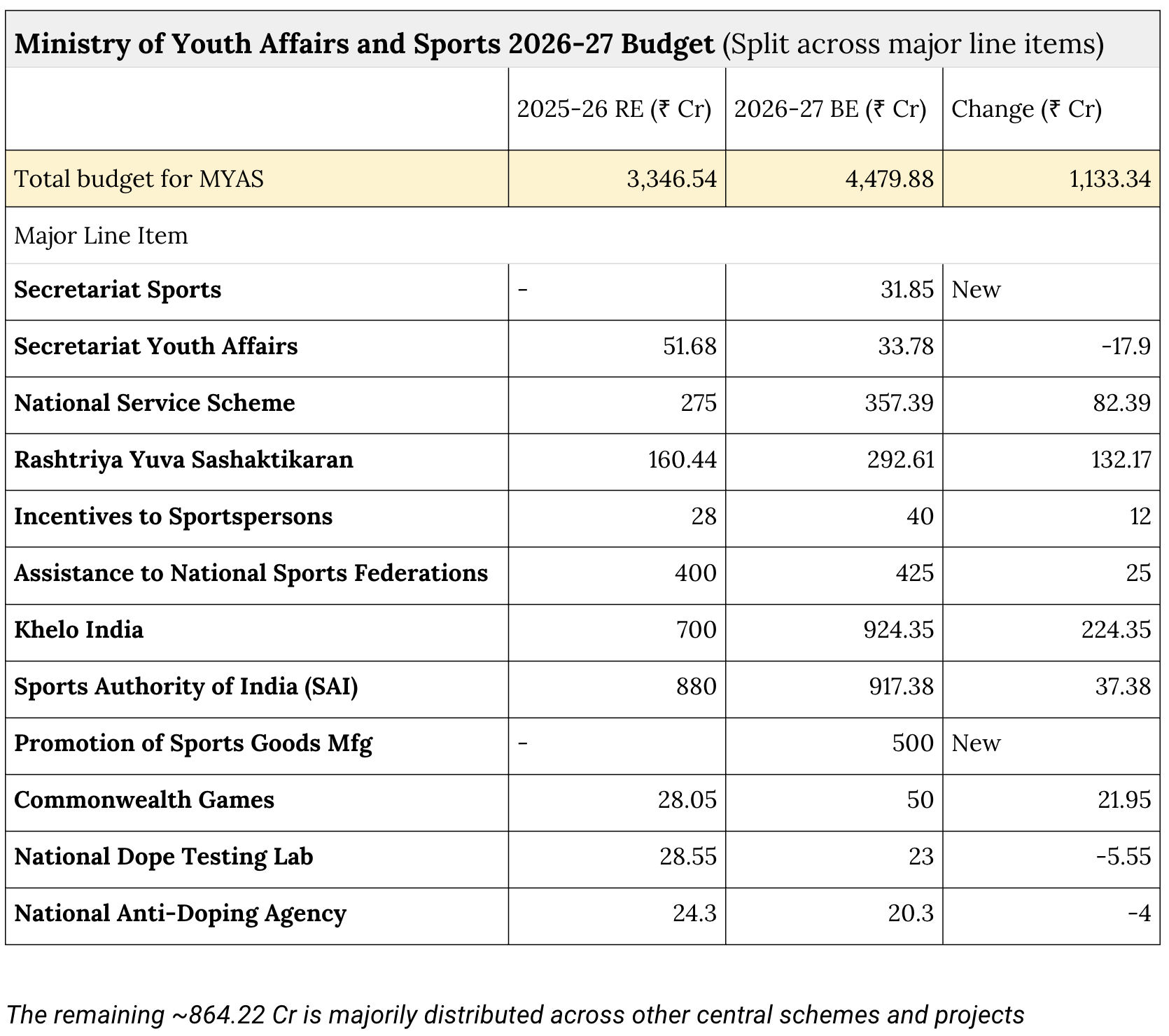
Refer to https://www.indiabudget.gov.in/doc/eb/sbe102.pdf for the detailed sports budget distribution
The budget primarily bolsters two of the pillars highlighted in the National Sports Policy 2025 (NSP2025): elite pathways and economic development.
Where it misses the mark
Disappointingly, anti-doping funding has been curtailed, not a prudent move. India has led global doping charts for three straight years, drawing unwelcome scrutiny. Yet the National Anti-Doping Agency (NADA), tasked with oversight, saw its allocation drop from ₹24.3 crore to ₹20.3 crore. The National Dope Testing Laboratory (NDTL)—India’s sole WADA-accredited human sports testing facility—fell from ₹28.55 crore to ₹23 crore. This misstep undermines the Ministry of Youth Affairs and Sports’ (MYAS) recent anti-drug and age-fraud campaigns.
The IOC President Kirsty Coventry announced that the Olympic hosting process will be highly transparent; this includes clear criteria, documented procedures, and local site visits to ascertain the progress and quality of the host nations’ readiness. India has shown interest in OLY2036 and needs to get its house in order to be a strong contender, then why the reduction in funding at this pivotal moment, baffles experts.
India’s sports sector is evolving, buoyed by its Olympic aspirations, economic rise, and youthful demographic (60% under 35). Urban interest has also seen a healthy surge in the metros and tier 1-2 cities. Yet sport demands generous funding, infrastructure, and grassroots investment, despite which 12% of last year’s modest budget remained unused. Some of the reasons for this are that the Government is constrained in capacity, expertise, and execution. Traditionally, Government intervention is from celebration and regulation to funding and direct production. It should emphasise the former two—where it’s strengths lie—and step back from the latter, as it lacks administrative prowess for high-level delivery.
The role of the private sector
After more than seven decades of independence, as the world’s fourth-largest and fastest-growing economy, India boasts ample resources and mature markets catering to a burgeoning middle class. Henceforth, governments must pivot to just facilitation: set guardrails (governance), enable markets to innovate, and foster sports businesses. Critically, one needs to separate the ‘steering’ (policy formulation & strategy) from the ‘rowing’ (implementation) in the MYAS. Additionally, with all eyes on India as it prepares to play host to the Centenary Edition of the Commonwealth Games (Ahmedabad 2030), urgency is mounting.
State sports policies
Sport is a State subject in the constitution, and thus the momentum hereon should hinge on the individual State policies to plan their budgets holistically. Sport drives fitness (health & physical activity), economic opportunity (jobs, tourism, manufacturing), soft power (diplomacy), and national pride. What can each State do to leverage its local state’s geographic, economic, and cultural interests (including indigenous sports)? The sports ecosystem is at a turning point.
Governments must catalyse by enacting policies and safeguards, empowering experts over nepotism, spur market innovation, and let society lead the transformation. Concerted collaborative action is essential for India to emerge as a truly global sporting nation.