Decoding the budget for India’s AI priorities
| AUTHOR | Bharath Reddy |
| DATE | February 3, 2026 |
| CATEGORIES | Artificial Intelligence |
India AI Mission
India’s approach towards government expenditure on AI seems to focus on use cases that have a benefit for the common person – healthcare, agriculture and education. The indigenous models funded under the mission are also intended to serve as multilingual or multimodal (text, speech, etc.) interfaces between citizens and services. The cutting edge of reasoning and thinking tasks still resides in frontier models from US or Chinese labs. The Indian approach seems to focus on the diffusion of AI to transform everyday experiences for the common person. All of the 11 mentions of AI in the budget speech are references to such use cases across governance, agriculture, accessibility, education and skilling.
The revised expenditure estimates for the India AI mission have come down from the budgeted ₹2,000 crores to 800 crores for 25-26. The budget for 26-27 is also similar at ₹1,000 crores. This seems lower than the 10,300 crores that were allocated under the mission over a five-year period.
| Expenditure Item Under MeitY | Actuals 24-25 | Budget 25-2026 | Revised Estimates 25-26 | Budget 26-27 |
|---|---|---|---|---|
| IndiaAI Mission | 19.24 | 2000 | 800 | 1000 |
Here is a split of the total budget allocation across the different pillars of the IndiaAI mission that was shared in response to a Lok Sabha question that was shared in Dec ’24.
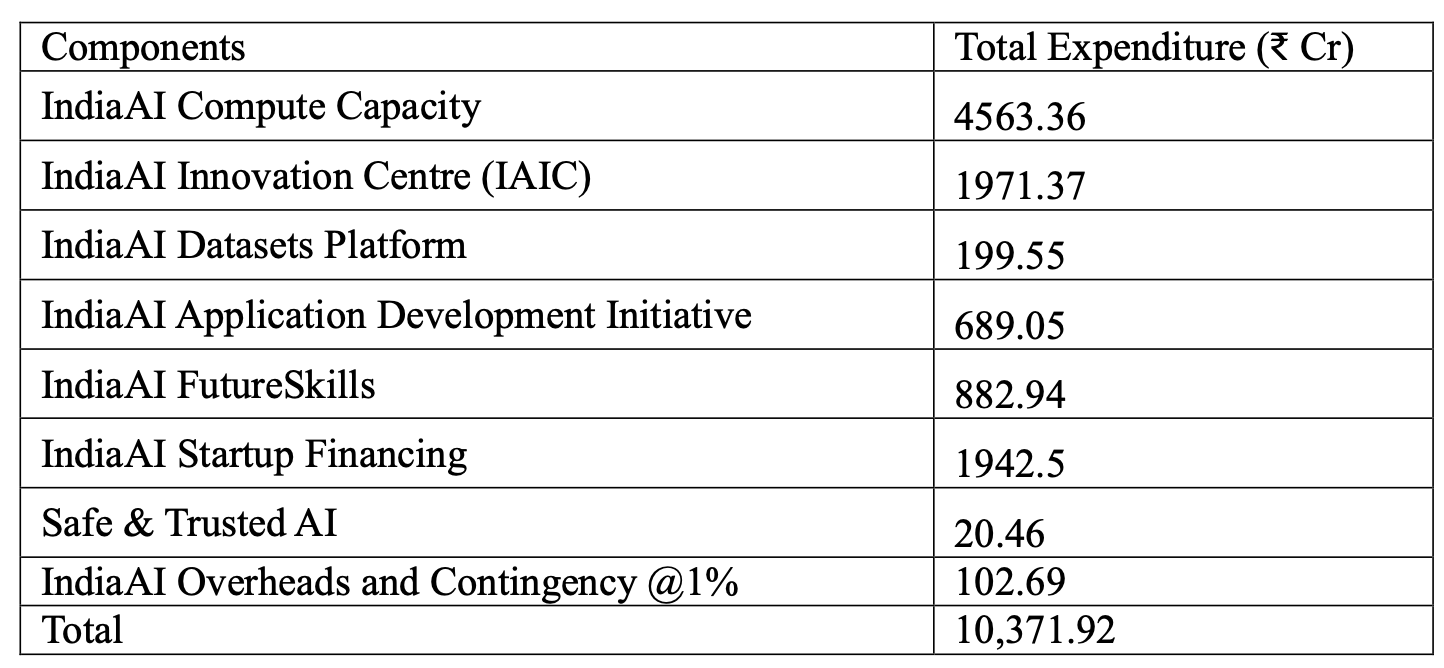
Over 85% of the over ₹1,100 crores subsidy disbursed under the compute pillar of the IndiaAI mission has been directed towards the development of indigenous generative AI models. Projects like Sarvam, BharatGen, Zenteq, SoketAI, Gnani.ai, Gan.ai and Avataar AI are recipients of these subsidies. Much of the expenditure under the AI mission so far seems to be towards the compute subsidies which also constitute over 40% of the total budget allocated for the mission. This likely serves two purposes: create demand for domestic data centres and subsidise priority sector use cases (currently dominated by indigenous models). In addition, the tax cuts on data centres also announced under the current budget will likely have a much broader impact on creating demand for domestic data centres. The other pillars of the AI mission seem to not be getting much attention in terms of funding.
The investments under the research, development and innovation fund and the national research foundation also include some expenditure towards AI. They also address a more foundational problem of strengthening the research and innovation ecosystem in academia and industry which is essential for long term resilience.
Research, Development and Innovation (RDI) Fund
The scheme aims to strengthen India’s capabilities in strategic technologies and promote technological self-reliance. It focuses on technologies that are at advanced stages of development (technology readiness levels 4 and above). It will also facilitate setting up a Deep-Tech Fund of Funds. The scheme aims to catalyse private sector investment in R&D with a total outlay of ₹1 lakh crore over six years. The budget amount for FY26-27 is ₹20,000.
| Expenditure Item Under DST | Actuals 24-25 | Budget 25-2026 | Revised Estimates 25-26 | Budget 26-27 |
|---|---|---|---|---|
| Research, Development and Innovation (RDI) scheme | … | 20000 | 3000 | 20000 |
This fund will operate through a two-tier funding structure. A Special Purpose Fund (SPF) will be created under the Anusandhan National Research Foundation (ANRF). Long-term loans at concessional rates will be provided from SPF to multiple second-level fund managers. These managers will then provide long-term loans to private companies at zero or low-interest rates. In case of startups, fund managers may also finance in the form of equity investments.
The scheme will focus on mission-critical areas that are vital for national development and global competitiveness, including:
- Energy security and transition, and climate action;
- ’Deep technologies’including quantum computing, robotics and space;
- Artificial intelligence and its applications to Indian problems including in agriculture, health, and education
- Biotechnology, biomanufacturing, synthetic biology, pharma, and medical devices;
- Digital economy including digital agriculture
National Research Foundation (NRF)
This aims to address the pressing need for a professional and comprehensive research framework that directs human and material resources towards carrying out well coordinated research across disciplines and across all types of institutions. The overarching goal of the NRF will be to seed, grow and promote research and development and foster a culture of research and innovation throughout Indian universities, colleges, research institutions. NRF will act as an apex body to provide high-level strategic direction of scientific research in the country as per recommendations of the National Education Policy.
In contrast to the RDI, it focuses on non repayable grants as the mode of disbursing the funds. The total corpus of investment is ₹50,000 crores over five years with the union government contributing 14,000 crores and the remainder sourced from donations, investments, and contributions by public sector enterprises, private sector entities, philanthropist organisations, foundations, international bodies, and corporate social responsibility funds.
| Expenditure Item Under DST | Actuals 24-25 | Budget 25-2026 | Revised Estimates 25-26 | Budget 26-27 |
|---|---|---|---|---|
| National Research Foundation | … | 2000 | 1948 | 2000 |